After spending time understanding Vanar Chain, it became clear to me that it’s not just another Layer-1 project chasing attention. What stands out is not loud promotion, but deliberate engineering choices aimed at real digital use cases. Vanar feels designed for function first, not hype.
At its core, Vanar tackles a problem many blockchains struggle with: supporting applications that require constant, low-cost, high-speed interaction. Digital games, immersive worlds, and always-on applications generate nonstop activity. When transactions are slow or expensive, user experience breaks down. Vanar seems built with this reality as its starting point.
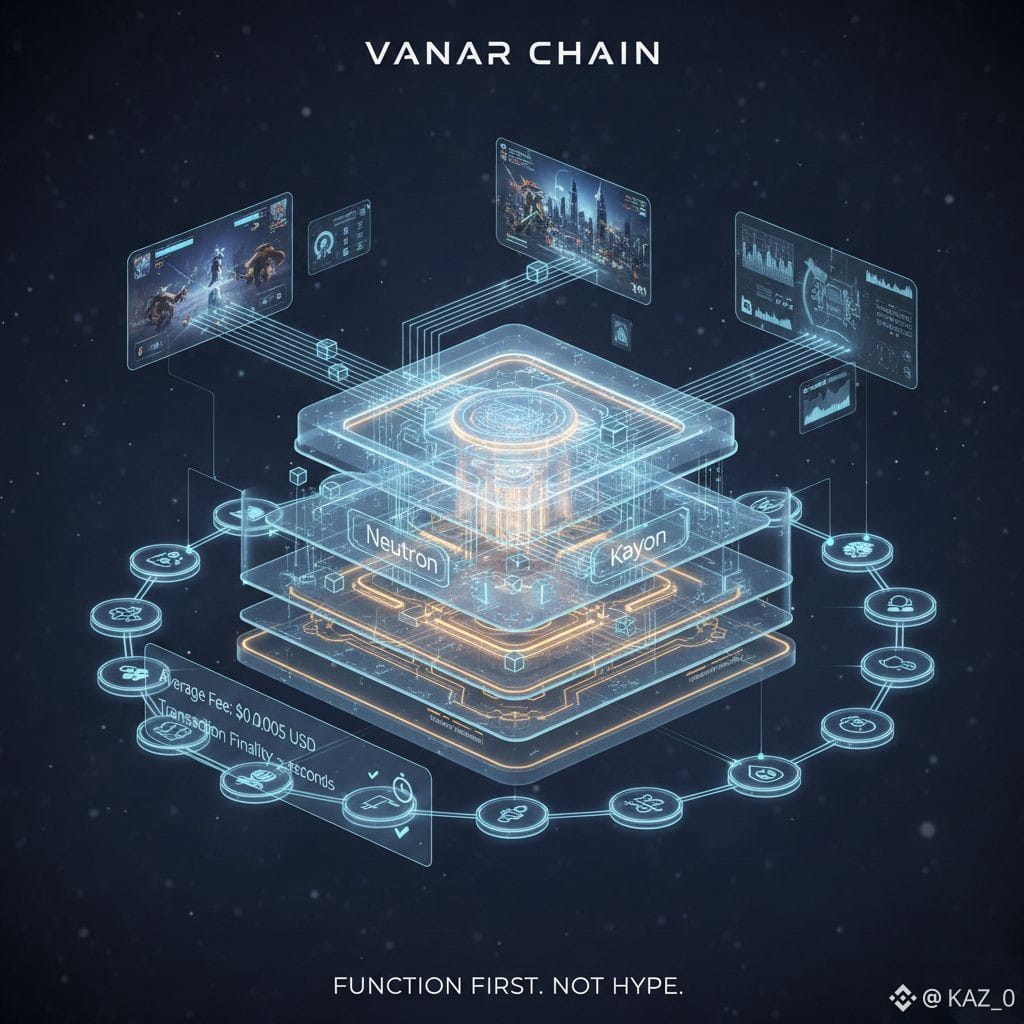
Transaction costs highlight this approach. With average fees around 0.0005 dollars, users can interact freely without worrying about micro-costs adding up. On networks like Ethereum, fees often influence how apps are designed, sometimes forcing compromises. On Vanar, interactions feel smooth and natural, which suggests the network is optimized around real user behavior.
Speed and finality also play a major role. Transactions settle within seconds, making real-time experiences possible without relying heavily on external systems. For gaming and virtual environments, this is critical. While some networks prioritize raw speed and others sacrifice responsiveness for security, Vanar seems focused on consistency and reliability, which matters more for long-term applications.
The architecture behind the network adds another layer of depth. Vanar’s V23 Protocol introduces a multi-layer system where different components handle specific tasks. Neutron focuses on efficient data handling, while Kayon enables logic and analysis directly within the network. Instead of simply storing data, Vanar allows applications to work with it intelligently, reducing complexity for developers.
Its validator model reflects the same philosophy. Rather than relying purely on anonymous participation, Vanar emphasizes reputation and operational stability. While this may raise debates in theory, from a practical standpoint it improves predictability. Developers and users benefit more from a network that behaves consistently than one that only looks good on paper.
Real-world applications on Vanar reinforce this design choice. Games and digital worlds continuously push the network, providing real stress rather than artificial benchmarks. This constant usage proves the system is built for everyday demand, not occasional spikes.
Recent progress suggests a focus on refinement instead of rapid expansion. Strengthening the protocol, improving existing products, and aligning the ecosystem indicate long-term thinking. This slower, more deliberate growth often leads to stronger foundations.
Final Thoughts
Vanar Chain doesn’t aim to radically redefine blockchain technology. Instead, it adjusts it to match how modern digital systems actually operate. By keeping costs low, finality fast, and data layers intelligent, Vanar stays mostly in the background—doing its job quietly. In my view, this kind of invisible reliability is what will make blockchain truly useful in daily digital experiences.