


1. Introduction: The Latency Problem in Blockchain Consensus
Latency is one of the most critical performance bottlenecks in blockchain systems. It refers to the time taken for a transaction to move from submission to irreversible finality. In financial and payment-focused blockchains, high latency directly harms user experience, limits throughput, and restricts real-world adoption.
Traditional blockchain consensus mechanisms often rely on sequential execution, where block proposal, validation, voting, and finalization occur one after another. While this approach is conceptually simple, it introduces unavoidable idle periods in which validators wait for previous steps to complete before moving forward. These waiting periods significantly increase end-to-end block confirmation time.
Plasma addresses this issue by introducing parallel execution of block proposals and voting, enabled through a pipelined Byzantine Fault Tolerant (BFT) consensus design. This architectural choice drastically reduces latency while maintaining strong security guarantees.
2. Overview of Plasma’s Consensus Architecture
Plasma uses a consensus mechanism commonly referred to as PlasmaBFT, which is derived from modern BFT protocols such as HotStuff. These protocols are designed to achieve fast finality with minimal communication overhead.
Key characteristics of Plasma’s consensus layer include:
Byzantine fault tolerance
Deterministic finality
Leader-based block proposal
Pipelined and parallel execution of consensus phases
Quorum Certificate (QC) aggregation using validator signatures
The defining performance optimization is the decoupling and overlapping of consensus stages, allowing multiple blocks to be processed concurrently at different stages of the consensus pipeline.
3. Sequential Consensus and Its Limitations
In a traditional sequential BFT consensus model, each block goes through the following stages in strict order:
Block proposal by the leader
Block dissemination to validators
Validator voting
Vote aggregation
Block commitment and finalization
Start of the next block proposal
Each stage must fully complete before the next begins. During voting and commitment, the leader and validators are effectively idle with respect to proposing new blocks. This creates a performance ceiling determined by network round-trip times and message delays.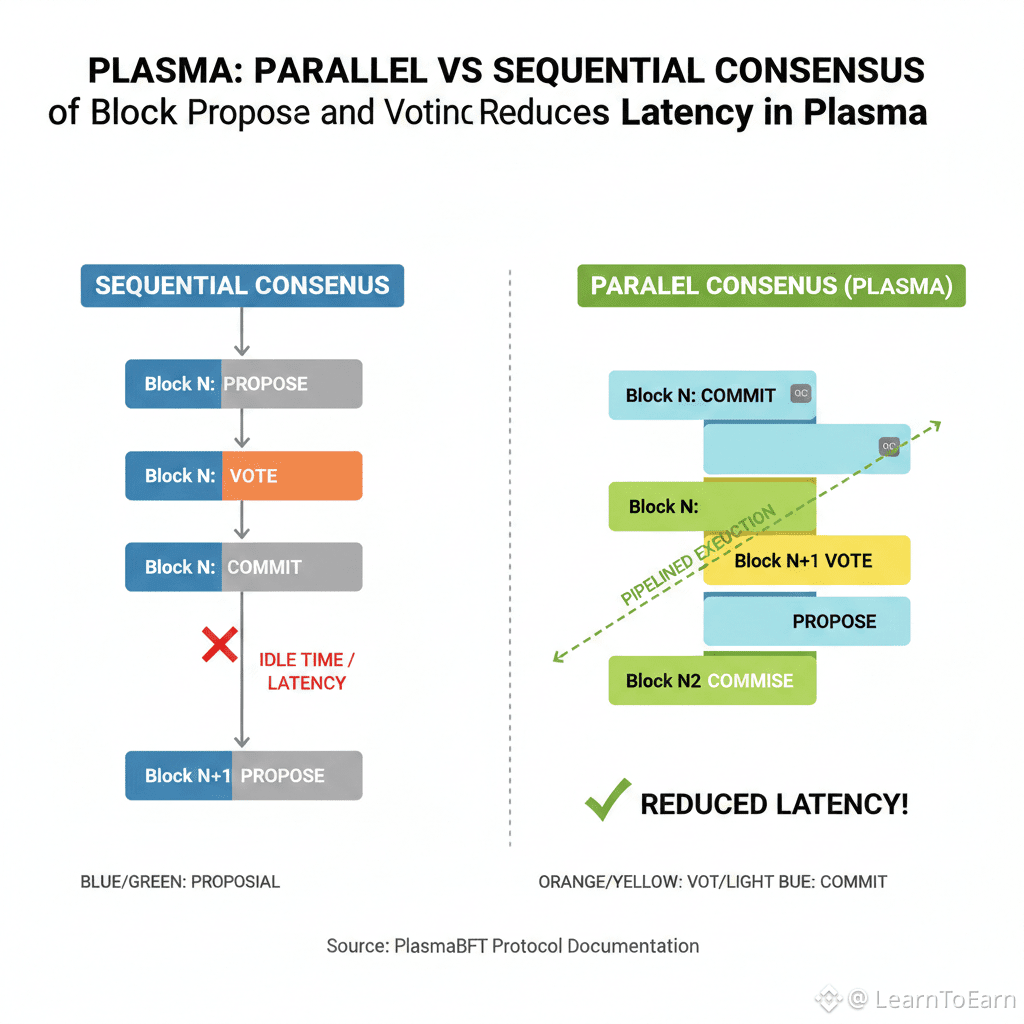
As block size grows or network conditions degrade, latency increases linearly, making the system unsuitable for high-frequency financial transactions.
4. Parallel Execution and Pipelining in Plasma
Plasma replaces the sequential model with a pipelined consensus flow, where multiple blocks are simultaneously in progress.
Instead of waiting for one block to fully finalize before proposing the next, Plasma allows:
Block N to be in the voting phase
Block N+1 to be in the proposal phase
Block N−1 to be in the commit phase
All of these occur concurrently.
This is known as parallel execution of block proposals and voting, and it is the primary mechanism by which Plasma reduces latency.
5. Detailed Mechanics of Parallel Block Proposals
In Plasma, the leader for a given round does not wait for the previous block to reach finality before proposing the next block. As soon as a block reaches the necessary safety condition (typically partial confirmation via quorum certificates), the next proposal can begin.
This design introduces several advantages:
Network bandwidth is continuously utilized
Leaders are never idle
Validators process messages continuously
Proposal delays are eliminated
As a result, block production becomes limited by computation and bandwidth rather than consensus round duration.
6. Parallel Voting and Quorum Certificates
Voting is also executed in parallel with block proposals.
Validators can:
Vote on Block N
Receive and verify proposals for Block N+1
Aggregate votes for Block N−1
Votes from validators are aggregated into Quorum Certificates (QCs) once a supermajority threshold (usually two-thirds) is reached. These certificates serve as cryptographic proof that the block is safe and agreed upon.
Because vote aggregation and verification are efficient and incremental, Plasma can confirm multiple blocks in overlapping time windows rather than serial rounds.
7. Reduction in Communication Rounds
One of the largest contributors to latency in consensus systems is the number of communication rounds required.
Classic BFT protocols require multiple full network round trips per block. Plasma’s pipelined approach effectively amortizes these communication rounds across multiple blocks.
Instead of:
One block requiring multiple round trips
Plasma achieves:
Multiple blocks finalized per overlapping round trip
This dramatically reduces perceived latency per block without compromising safety.
8. Impact on Finality Time
Finality refers to the point at which a block cannot be reverted without violating consensus assumptions.
In Plasma:
Blocks can reach finality after fewer perceived steps
Consecutive quorum certificates allow earlier commitment
Validators do not wait for global synchronization points
This results in faster deterministic finality, which is essential for financial applications such as stablecoin transfers, decentralized exchanges, and payment settlement systems.
9. Validator Efficiency and Resource Utilization
Parallel execution significantly improves validator efficiency.
In a sequential model:
Validators often wait for network responses
CPU and bandwidth remain underutilized
In Plasma’s model:
Validators continuously verify, vote, and aggregate
Hardware resources are fully utilized
The cost per transaction decreases
This efficiency enables Plasma to scale without increasing validator hardware requirements proportionally.
10. Security Considerations
Parallel execution does not weaken Plasma’s security assumptions.
Key safety guarantees remain intact:
Byzantine fault tolerance up to one-third of validators
Strict quorum thresholds
Cryptographic verification of votes
Leader rotation and fault recovery
The protocol ensures that even though actions occur in parallel, consensus rules enforce correct ordering and prevent conflicting finalization.
11. Latency vs Throughput Trade-off Optimization
Traditionally, systems optimize either latency or throughput, but Plasma’s pipelined design improves both simultaneously.
Lower latency is achieved by:
Removing idle waiting periods
Overlapping consensus phases
Higher throughput is achieved by:
Allowing multiple blocks in flight
Maximizing validator participation at all times
This balance makes Plasma particularly suitable for high-volume, low-cost financial networks.
12. Practical Implications for Plasma’s Use Cases
The reduction in latency through parallel execution directly benefits:
Stablecoin payments requiring instant confirmation
On-chain liquidity protocols
Cross-application composability
High-frequency financial operations
Users experience near-instant transaction confirmation, while developers gain a reliable, deterministic execution environment.
13. Conclusion
Plasma’s use of parallel execution for block proposals and voting represents a fundamental improvement over traditional sequential consensus designs.
By pipelining consensus stages, overlapping communication rounds, and enabling multiple blocks to progress simultaneously, Plasma dramatically reduces latency while preserving security and finality guarantees.
This architectural choice allows Plasma to operate as a high-performance financial blockchain, capable of supporting real-world payment systems and large-scale decentralized applications without sacrificing decentralization or safety.
What is the Role of the Reth (Rust Ethereum) Client in Plasma’s Execution Layer?
Introduction
Plasma is a next-generation blockchain designed specifically for high-volume stablecoin payments and programmable financial infrastructure. At its core, Plasma combines a high-performance consensus protocol with a fully Ethereum-compatible execution environment. While PlasmaBFT handles consensus (block ordering and finality), the execution layer is powered by Reth, a Rust-based Ethereum execution client. Reth is essential to how Plasma processes transactions, executes smart contracts, and maintains chain state in a secure and predictable way.
This article explains in detail what Reth is, how it integrates with the rest of Plasma’s architecture, why it was chosen, and what responsibilities it carries within the execution layer.
What Is Reth?
Reth (short for Rust Ethereum) is a modern Ethereum execution client implemented in the Rust programming language. It is a full execution layer node that conforms to the Ethereum specification and supports the Engine API, which is the interface between execution and consensus layers adopted by Ethereum after the Merge.
Reth is modular, high-performance, and built with safety and efficiency as core design goals. Its architecture separates key components such as transaction handling, block execution, state storage, and networking. This separation enables easier maintenance, smoother upgrades, and flexible integration into different blockchain systems, including Plasma.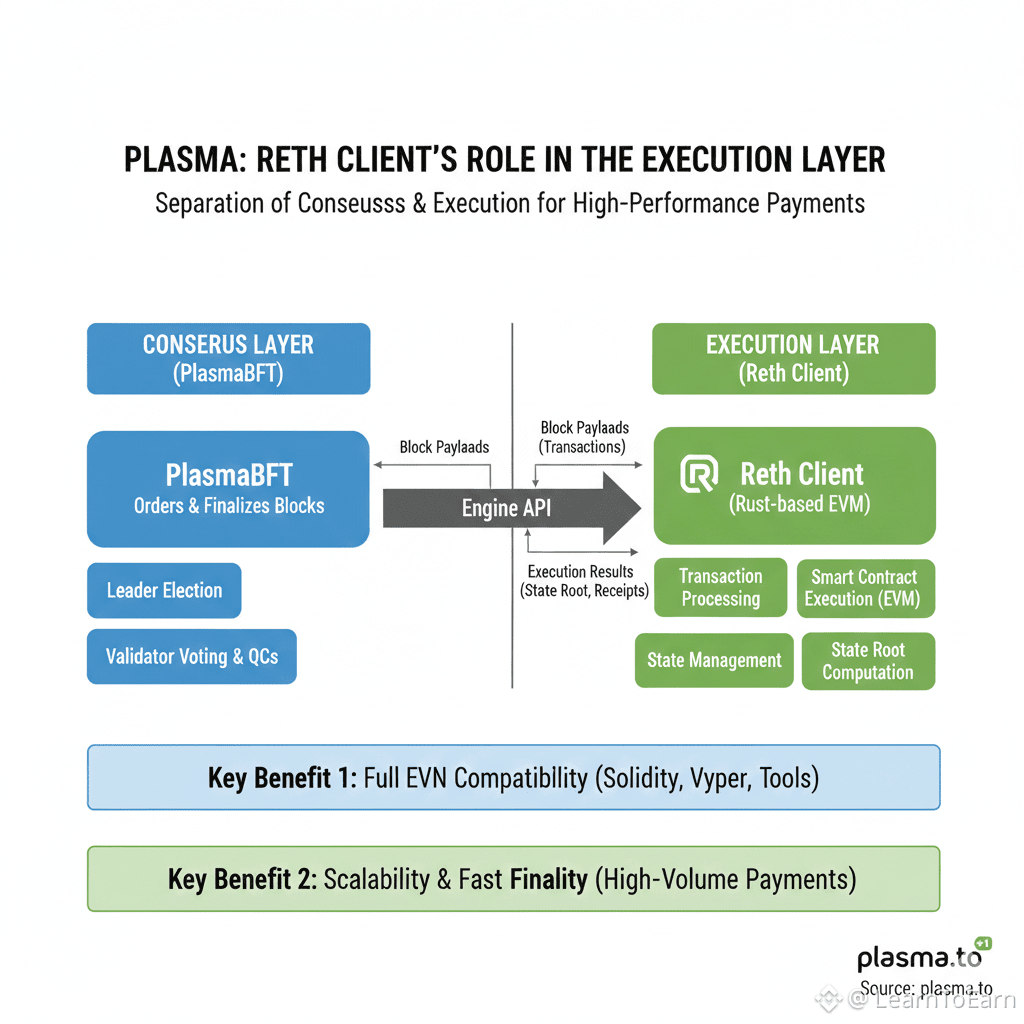
Separation of Consensus and Execution
To understand the role of Reth in Plasma, it is essential to grasp the consensus–execution separation model. In modern blockchain architecture, consensus and execution responsibilities are handled by separate clients.
The consensus layer is responsible for ordering blocks, managing validator participation, and ensuring finality through a Byzantine Fault Tolerant protocol.
The execution layer applies transactions to the current state, executes smart contracts, updates balances and storage, and produces cryptographic state commitments.
Plasma adopts this model. Its consensus component, PlasmaBFT, sequences and finalizes blocks. Once blocks are ordered, they are passed to Reth for execution, which applies transactions and updates the blockchain state.
Core Responsibilities of Reth in Plasma’s Execution Layer
Processing Transactions
Reth executes all user transactions included in a Plasma block. It performs standard Ethereum transaction validations, including signature verification, nonce checks, gas accounting, and transaction formatting rules. After validation, Reth applies transactions sequentially according to Ethereum’s execution model, updating account balances, smart contract storage, and event logs.
Executing Smart Contracts
Smart contracts on Plasma behave exactly the same as they do on Ethereum mainnet because Reth implements a complete Ethereum Virtual Machine environment. Every opcode, precompile, and execution rule follows Ethereum’s specification.
This guarantees full compatibility with Solidity and Vyper contracts and allows developers to deploy existing Ethereum applications to Plasma without any code changes. Standard tools such as Hardhat, Foundry, Remix, and common wallets work seamlessly.
State Management
After executing transactions, Reth updates the blockchain state. This includes changes to account balances, contract storage, and the Merkle-Patricia state trie. Once execution is complete, Reth computes the new state root and transaction receipt root, which are essential for cryptographic verification and consensus finalization.
The state root produced by Reth is used by the consensus layer to confirm block validity and commit the block to the canonical chain.
Block Payload Generation and Confirmation
Reth participates directly in the block production pipeline by interacting with the consensus layer through the Engine API.
When PlasmaBFT proposes a block, it sends the block’s transaction payload to Reth. Reth executes the transactions and returns execution results such as gas usage, receipts, and the updated state root. PlasmaBFT then finalizes the block by embedding these results into the block header.
This process ensures that consensus and execution remain logically separated while staying tightly synchronized.
Why Reth Was Chosen for Plasma
Performance and Efficiency
Reth’s implementation in Rust, combined with its modular execution engine, enables fast and efficient state processing without sacrificing correctness. Rust’s memory safety guarantees and performance characteristics make Reth well suited for high-throughput, mission-critical financial systems.
Full EVM Compatibility
Because Reth natively implements Ethereum’s execution specification, Plasma inherits full EVM compatibility by design. This allows developers to migrate Ethereum applications effortlessly and ensures seamless integration with existing wallets, tooling, and infrastructure.
Modularity and Upgradability
Reth’s architecture cleanly separates components such as the transaction pool, block execution engine, state storage, and networking. This modularity allows Plasma developers to optimize or upgrade individual execution components independently, as long as the Engine API interface remains intact.
Integration with PlasmaBFT Through the Engine API
The Engine API serves as the standardized communication layer between Reth and PlasmaBFT.
Through this interface, the consensus layer submits block payloads to Reth, Reth executes transactions and updates state, and execution results are returned for block finalization. The Engine API also ensures both layers remain synchronized on the canonical chain state.
This architecture mirrors Ethereum’s post-Merge design, allowing Plasma to adopt proven execution–consensus separation while optimizing performance for stablecoin and payment-focused workloads.
Implications for Developers and Users
Developer Familiarity
Developers can use the same tools, workflows, and smart contract code they already use on Ethereum. Applications behave identically, reducing friction and accelerating ecosystem adoption.
Predictable Execution
Because Reth strictly follows Ethereum’s execution rules, transaction behavior on Plasma is deterministic and verifiable. This minimizes unexpected execution differences and strengthens developer and user confidence.
Performance and Scalability
Reth’s efficient execution engine, combined with PlasmaBFT’s low-latency consensus, enables high throughput and fast finality. This makes Plasma well suited for stablecoin payments, financial applications, and real-world transactional use cases.
Conclusion
Within Plasma’s architecture, the Reth execution client plays a central role in transaction processing, smart contract execution, state management, and coordination with the consensus layer. As a fully EVM-compatible execution engine written in Rust, Reth provides Plasma with a secure, predictable, and high-performance execution environment that aligns perfectly with Ethereum standards.
By separating consensus and execution through the Engine API, Plasma achieves scalability and efficiency without compromising correctness or developer compatibility. Reth’s modular design and robust execution model make it a foundational component in Plasma’s vision for scalable, programmable financial infrastructure.
How the Separation of the Consensus Layer and the Execution Layer Enhances Network Stability
Introduction: A Shift from Monolithic Blockchains
Early blockchain systems were designed as monolithic architectures, where a single layer handled every core responsibility — transaction execution, block ordering, validation, finality, and state updates. Every full node had to do everything: agree on transaction order, execute smart contracts, update state, and enforce consensus rules simultaneously.
As blockchain adoption increased, this design began to show clear limitations. Higher demand exposed bottlenecks in throughput, inefficient resource usage, tightly coupled failure modes, and significant challenges when upgrading or optimizing the protocol. A flaw or overload in one part of the system could easily ripple across the entire network.
To address these issues, modern blockchain architectures introduced a fundamental shift: separating the consensus layer from the execution layer. This design choice, now widely adopted by advanced networks, has proven critical not only for scalability and performance but also for improving overall network stability — the ability of a blockchain to continue operating securely and predictably under stress or partial failure.
What Are the Consensus Layer and the Execution Layer?
Consensus Layer
The consensus layer is responsible for establishing agreement across the network. It determines the order of blocks, ensures that all participants converge on a single canonical chain, prevents double-spending, manages validator participation, and enforces finality rules. In short, it decides what the blockchain agrees on and when that agreement becomes final.
Execution Layer
The execution layer is responsible for computation. It executes transactions, runs smart contracts, applies state changes, updates balances and storage, and produces deterministic execution results. The execution layer does not decide transaction ordering; instead, it applies the agreed-upon order to produce the correct state transitions.
By clearly separating these responsibilities, modern blockchains reduce complexity and create a more resilient system design.
How Separation Improves Network Stability
Isolation of Failures and Fault Containment
One of the most important stability benefits of separating consensus and execution is fault isolation. When both functions are bundled together, a failure in execution logic can directly disrupt consensus, potentially halting block production or causing chain instability.
With separation, an execution-layer issue — such as a bug in smart contract execution or a state computation error — does not automatically compromise the consensus mechanism. The consensus layer can continue ordering blocks and maintaining finality independently. Likewise, temporary issues in consensus logic, such as validator synchronization problems, do not directly affect the determinism of transaction execution.
This containment significantly reduces the “blast radius” of failures, making the network more resilient to localized issues.
Independent Upgrades and Targeted Hardening
Decoupled layers allow developers to improve and secure each component independently. Consensus upgrades can focus purely on validator behavior, finality guarantees, and network communication without altering execution semantics. Execution upgrades can improve virtual machine performance, gas efficiency, or transaction processing without risking consensus safety.
This modularity reduces the risk associated with large, protocol-wide upgrades. Vulnerabilities can be addressed faster and more precisely, improving long-term stability and reducing the likelihood of catastrophic failures during upgrades.
Reduced Congestion and More Predictable Performance
Separating execution from consensus allows each layer to specialize and scale independently. Consensus nodes focus on ordering and finalization, while execution nodes handle computation and state transitions.
This specialization reduces congestion, preventing transaction backlogs, extreme fee volatility, and unpredictable delays — all of which can destabilize a network. When execution workloads spike, they do not overwhelm the consensus mechanism, allowing block finality to remain consistent even under heavy usage.
Client Diversity and Reduced Correlated Risk
A modular architecture encourages multiple independent implementations of both consensus and execution clients. Different teams can build clients using different programming languages, design philosophies, and internal architectures.
This diversity greatly enhances network stability. If one widely used client suffers from a critical bug, other clients can continue operating correctly, preventing network-wide outages. Reducing correlated failure is especially important for consensus safety and finality guarantees.
Clear Responsibility and Easier Security Audits
Separating layers clarifies system responsibilities, simplifying codebases and improving auditability. Consensus audits can focus strictly on block validation, fork choice, and finality logic, while execution audits can concentrate on deterministic transaction execution and state correctness.
Lower complexity reduces the likelihood of hidden bugs and makes long-term maintenance more manageable, strengthening the network’s security posture over time.
Safer Innovation and Long-Term Evolution
Decoupled architectures allow innovation without destabilizing the core protocol. New execution environments or performance optimizations can be introduced without modifying consensus rules. Similarly, improvements to consensus mechanisms can be explored without touching execution logic.
This flexibility allows blockchains to evolve continuously while preserving stable, reliable core functionality — a key requirement for long-lived financial and application networks.
Conclusion
Separating the consensus layer from the execution layer represents a major architectural advancement in blockchain design. This separation improves network stability by:
Isolating failures and limiting their impact
Enabling independent upgrades and focused security improvements
Reducing congestion and improving performance predictability
Encouraging client diversity and minimizing correlated risk
Simplifying audits and reducing system complexity
Supporting innovation without destabilizing core operations
Together, these benefits create more resilient, secure, and reliable blockchain networks capable of supporting high transaction volumes, complex applications, and long-term growth without compromising safety or performance.