
The first thing that stands out on Walrus isn’t the upload.
It’s what happens after you stop thinking about it.
The file is already gone from your screen. The interaction is finished. The system didn’t ask you to name the data, justify it, or promise you’ll remember why it exists. It accepted the action and moved on. That’s where most people assume the story ends.
On Walrus, that’s where responsibility begins.
There’s a quiet handoff that happens once data crosses into the network. Not a ceremony. Not a confirmation screen. Just a shift in posture. What you placed is no longer something you’re “holding.” It becomes something the system must continuously account for, even when you’re absent.
That difference takes time to notice.
In traditional storage, data feels provisional. You can delete it later. Reorganize it. Ask support to help when access breaks. The infrastructure assumes someone will be around to clean up mistakes or restore intent. Persistence depends on attention.
Walrus doesn’t wait for attention.
Once data enters the network, it’s treated as large unstructured data that must survive indifference. It doesn’t matter whether the original uploader stays online. It doesn’t matter whether the application that referenced it is still being actively maintained. The system proceeds as if absence is the default condition.
That assumption changes the tone immediately.
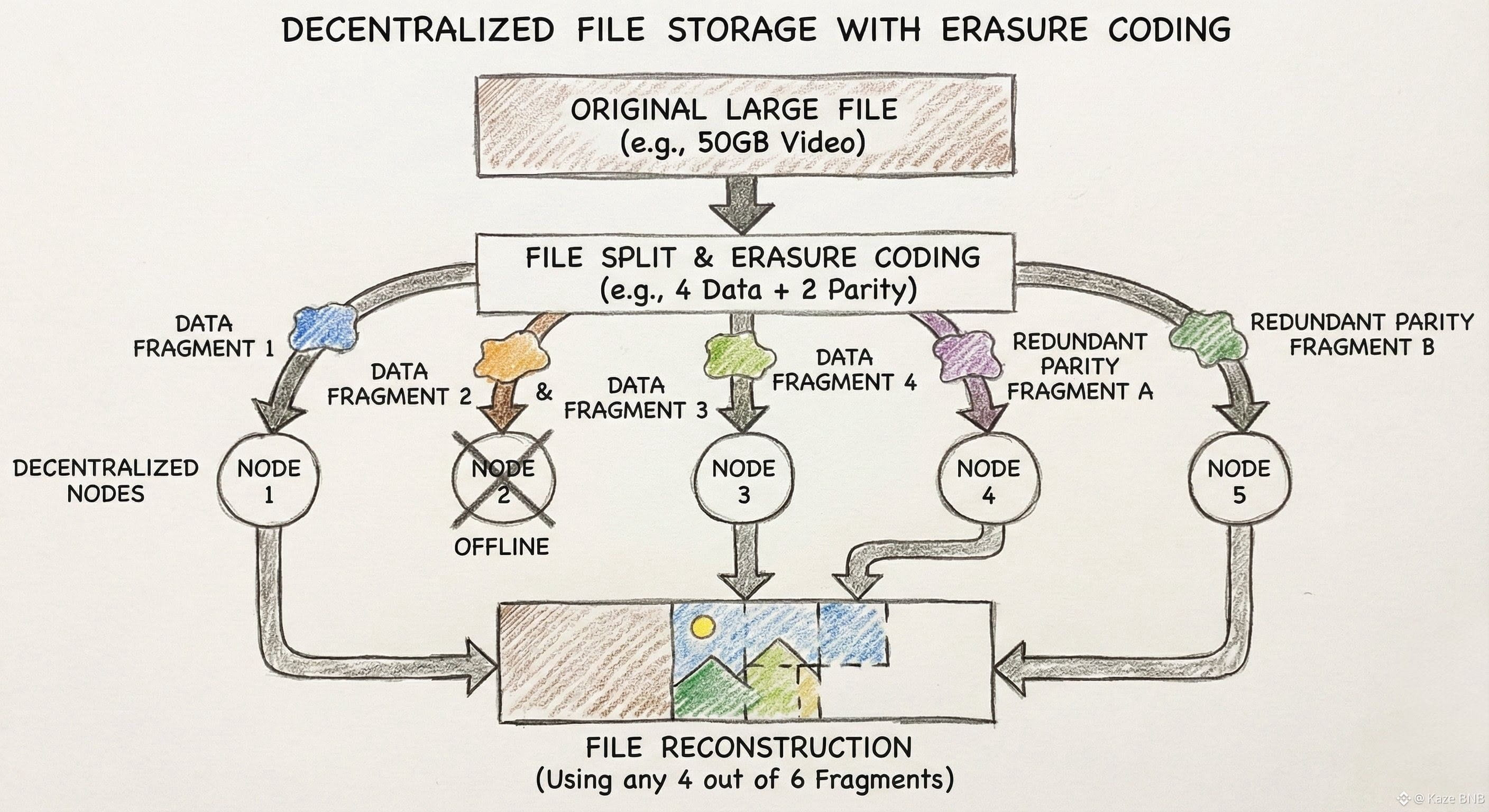
Behind the scenes, fragmented data storage takes shape. Not as an optimization, but as a baseline posture. The data is no longer whole in any single place. Distributed fragments take on the burden collectively, without signaling progress or asking for reassurance. There’s no moment where the system pauses to confirm that you still care.
You don’t see the coordination. You feel its consequences.
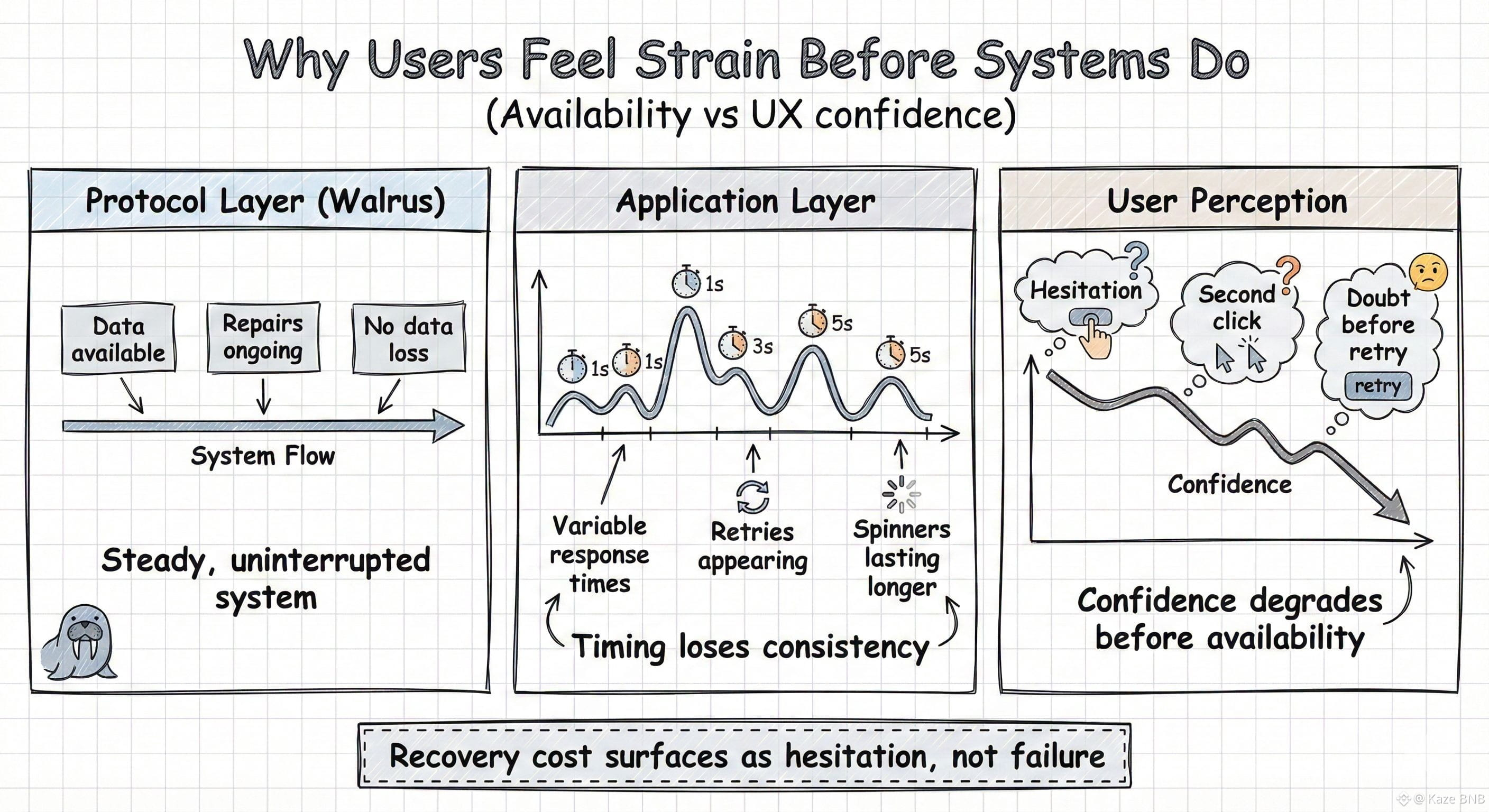
The first time this becomes visible is usually not during upload, but during reuse. A contract reaches for data that was “obviously there.” The expectation is instant readiness. What comes back instead is something subtler: a delay thin enough to question, thick enough to matter.
Nothing is missing. Nothing is broken.
But availability under load reveals itself as conditional, not guaranteed by intent alone. The data is stored. Reconstruction is possible. Yet readiness behaves like a moving threshold, not a binary state.
That’s the pressure Walrus introduces without explaining itself.
Teams start noticing it in the margins. Build pipelines add quiet buffers. Application logic gains small checks that weren’t part of the original design. Not because Walrus is unreliable, but because it refuses to pretend that storage is ever truly passive.
Someone eventually asks the question everyone was avoiding:
“If the data is already there, why does it still feel like we’re waiting?”
The answer isn’t technical. It’s architectural.
Walrus treats persistence as an ongoing obligation, not a completed task. Continuous availability verification doesn’t stop just because the upload succeeded. The system keeps asking whether fragments are reachable, whether reconstruction guarantees still hold, whether silence still deserves trust.
And it asks without alerts.
There’s no banner warning you that responsibility has shifted. No dashboard insisting you take action. Just behavior. Data that remains reconstructible, while time quietly accumulates around it. This is where silent coordination becomes Visible not as speed, but as consistency.
The role of WAL shows up here too, not as a token you think about, but as a boundary you eventually feel. Time is no longer abstract. Leaving decisions unresolved carries weight. Storage doesn’t punish neglect dramatically. It makes neglect measurable.
That’s why the system feels calm even under pressure.
Walrus doesn’t optimize for reassurance. It optimizes for survival in environments where no single actor can be trusted to stay responsible forever. Decentralized data distribution isn’t framed as resilience theater, it’s simply how the system behaves when no one is watching.
The surprising part is how normal this all feels once you notice it.
No warnings. No drama. No sense that something experimental is happening.
Just a system that keeps checking, keeps reconstructing, and keeps holding data steady even as the human side moves on to something else.
That’s the real shift Walrus introduces.
Not that storage becomes decentralized but that it stops pretending commitment is reversible. Once the data enters, the system refuses to forget, even when you do.
And that changes how you think about what you place there next.