

@Walrus 🦭/acc #walrus
#Walrus $WAL
When I first encountered Walrus, I didn’t expect to be fascinated by storage technology. After all, data storage often feels like a background task, invisible and unglamorous. But as I delved deeper, I realized that what Walrus offers isn’t just storage—it’s a whole new way to think about how data can be owned, verified, and even monetized.
At its core, Walrus is a decentralized storage network. That means instead of your data living in a single centralized server, it’s distributed across a network of nodes. Each piece of data is encrypted, fragmented, and stored redundantly so that privacy and reliability are guaranteed. I immediately appreciated this approach, because it tackles two fundamental problems simultaneously: security and control.
What makes Walrus truly compelling is that it’s programmable. Unlike traditional storage networks, which simply hold files, Walrus allows developers to build applications that interact with data as programmable assets. Imagine creating a decentralized application where users can store media, share datasets, or even train AI models without ever giving up ownership. The possibilities are vast. I found myself thinking of practical use cases almost immediately: decentralized AI training, NFT metadata storage, DeFi transaction verification, and even secure media hosting for content creators.
I also noticed something essential about how Walrus handles data integrity. Each file stored in the network comes with verifiable proofs. This means I don’t just trust that my data exists I can cryptographically verify it at any time. For a long time, I underestimated the importance of verifiable storage, but in industries like AI, where datasets are crucial, this feature becomes a game-changer.
To make sense of Walrus’s ecosystem, I sketched a chart showing how the network operates:
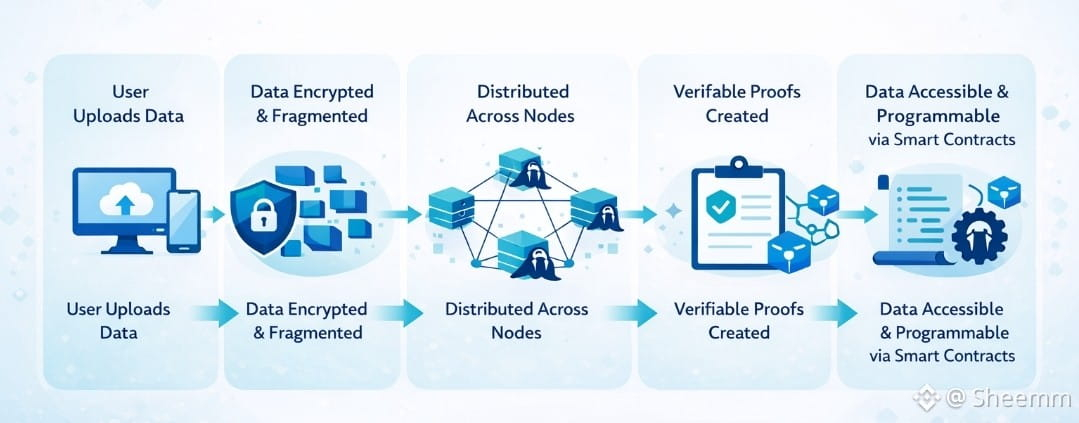
This visual really helped me grasp the beauty of Walrus it’s like taking the best aspects of blockchain verification and combining them with enterprise-grade storage.
Another aspect that caught my attention is programmable storage contracts. In traditional storage systems, you pay for storage, and that’s it. With Walrus, developers can define rules: how long data is stored, who can access it, and even create automated workflows. I could see how this could revolutionize compliance-heavy sectors like healthcare or finance. Suddenly, storage isn’t passive—it’s active and enforceable.
I wanted to quantify the benefits, so I looked at the efficiency and reliability metrics compared to centralized cloud storage:
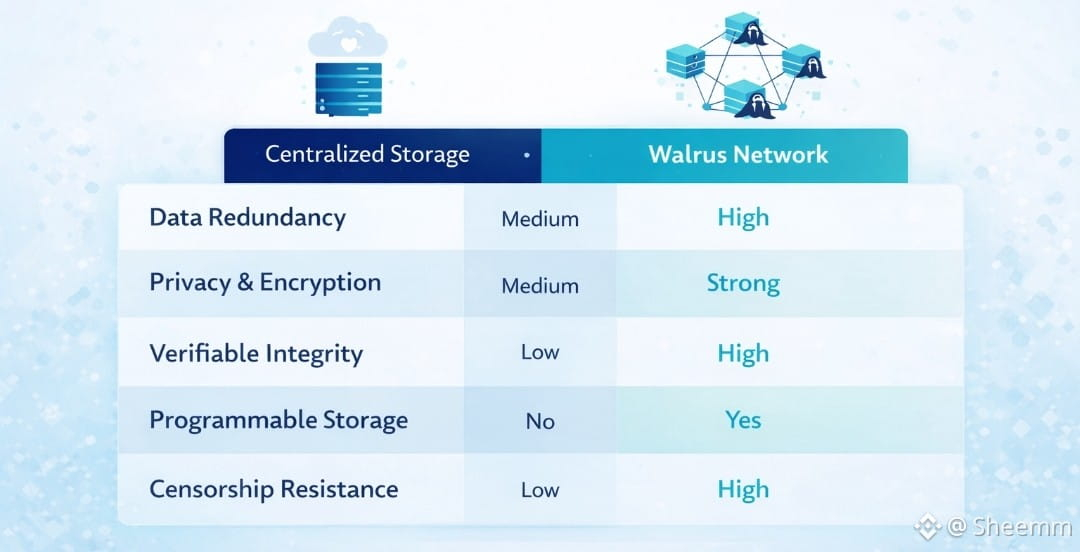
Seeing the numbers helped me understand why decentralized storage is more than a trend—it’s a necessity for the next generation of Web3 applications.
As I explored further, I realized that Walrus also introduces an incentive layer. Node operators earn rewards for providing storage and maintaining data integrity. This creates a self-sustaining ecosystem, encouraging both security and scale. From my perspective, this is a smart alignment of incentives—users want reliable storage, and operators are motivated to provide it.
Looking ahead, I imagine Walrus becoming a backbone for AI and decentralized applications. As models grow in size and datasets expand, traditional storage will struggle to keep up. Walrus, with its programmable, verifiable, and decentralized structure, is positioned perfectly to meet this demand.
Writing this, I realize that Walrus isn’t just a technology it’s a mindset shift. It challenges the assumption that data must be centralized to be useful. It empowers users to reclaim ownership, empowers developers to innovate, and empowers industries to operate securely and transparently. Personally, it has changed how I think about data entirely.
If I were to summarize what makes Walrus revolutionary: it’s ownership, programmability, and verifiability all wrapped into one network. It’s not just storage it’s storage reimagined. And the more I explore it the more I believe that this is just the beginning of a much larger movement in decentralized technology.
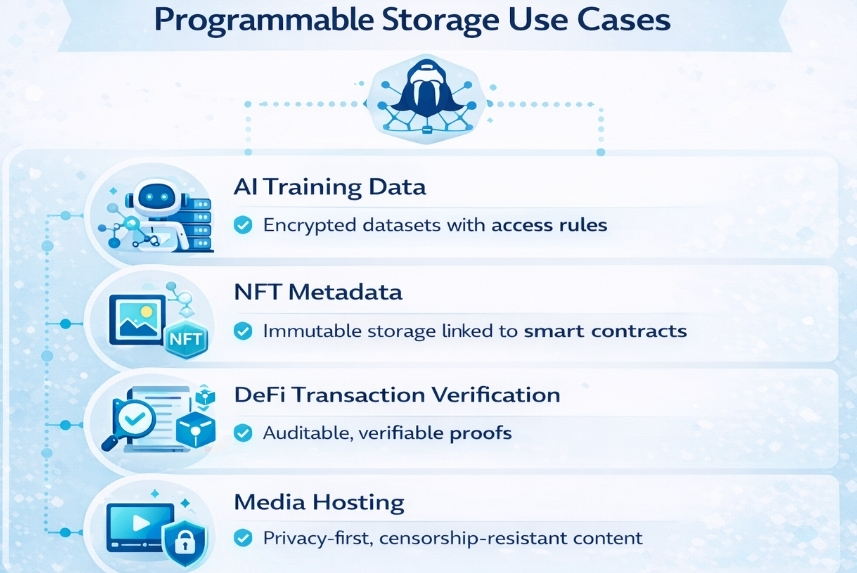
Every time I revisit the network diagram or the use case chart, I see new possibilities. I’ve grown increasingly confident that Walrus isn’t just about storing files it’s about storing the future.