
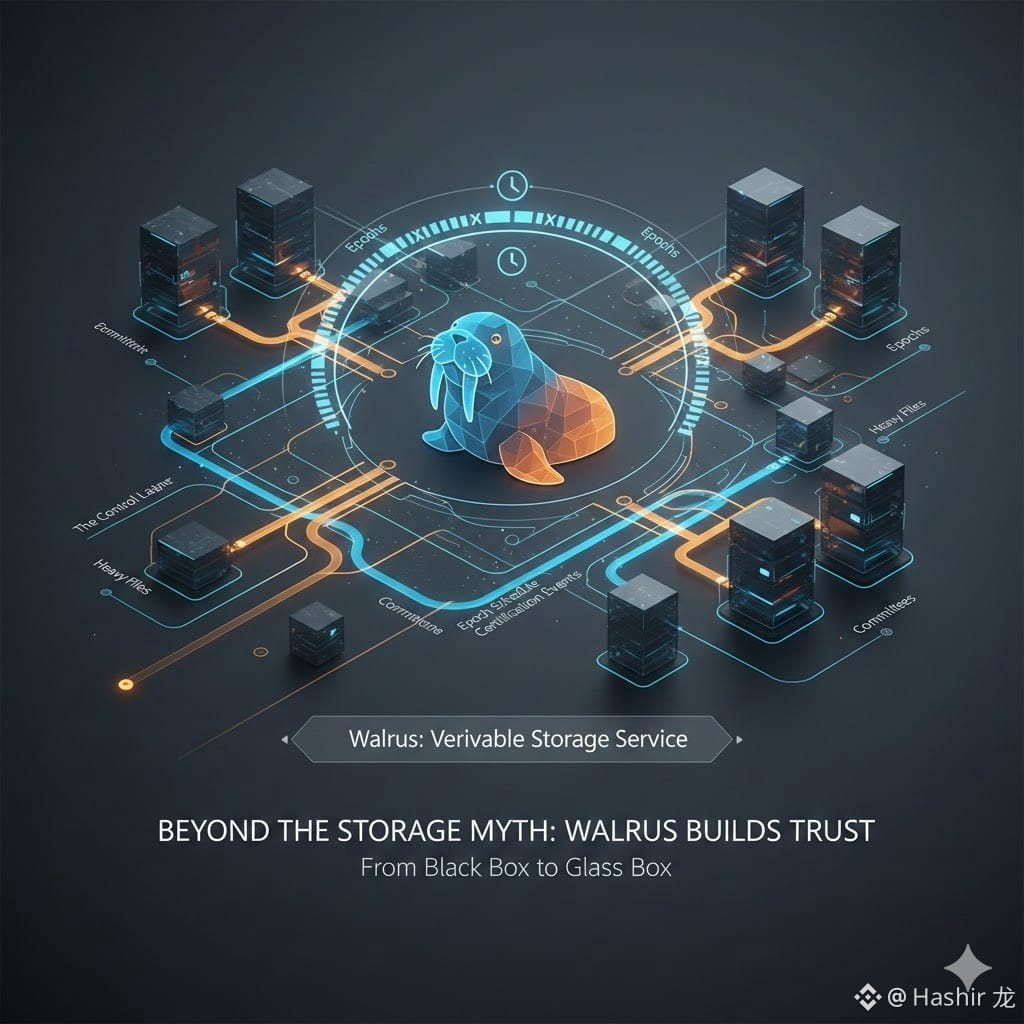
For years, the promise of decentralized storage has been painted as a magical, immutable hard drive in the sky—a set-it-and-forget-it solution where data lives forever, untouched and untethered. In reality, this vague ideal often crumbles under the weight of practical questions: Who holds my data right now? How do I know it’s still there? What happens if a node disappears?
Enter Walrus. It represents a fundamental shift in perspective. Walrus isn’t just storage; it’s a verifiable storage service with a built-in clock and a clear chain of custody. It trades ambiguous promises for concrete states, transforming raw storage into programmable infrastructure you can actually build upon.
From Black Box to Glass Box: The Control Plane
Traditional storage systems, centralized or decentralized, often operate as black boxes. You upload a file and hope. Walrus introduces a transparent control plane, elegantly separated from the data itself. Heavy files reside with a dynamic set of storage nodes, while a lightweight blockchain records the evidence—who is storing what, when, and under which rules.
This separation is revolutionary. It provides a single source of credible truth. A file’s entire lifecycle—from registration to deletion—is publicly verifiable on-chain. Applications no longer need to trust the internal database of a storage provider; they can trust the immutable ledger. This turns storage from a commodity into a accountable service.
Epochs: Making Time a Manageable Tool
Chaos is the default in decentralized networks. Nodes join, leave, fail, and networks partition. Most systems react to this churn with expensive, panic-driven repairs. Walrus proactively manages it with epochs—discrete, fixed-time intervals during which a specific committee of nodes is responsible for a set of data.
Think of it like shift work for infrastructure. At the end of each epoch, responsibilities rotate. This scheduled rotation isn’t a bug; it’s a feature. It makes normal churn visible and predictable, preventing silent degradation. Builders know exactly when changes occur, enabling proactive actions like re-uploads or committee re-checks, rather than scrambling after a failure.
Committees: Unambiguous Responsibility
“Who is responsible for my data?” is a question that plagues decentralized storage. Walrus answers it directly with committees. For every piece of data in every epoch, a specific, known group of nodes is on duty. Their identities and stake (in WAL tokens) are publicly accessible.
This clarity is transformative. You can build dashboards that display the current custodian committee for critical files. You can set alerts for epoch transitions. You can design applications that automatically renew storage contracts or trigger recovery protocols. The ambiguity is replaced with accountability.
Certification: The Moment of Truth
In most systems, a file is considered “stored” when your upload bar hits 100%. In Walrus, a file only becomes real when it is certified. Certification is an on-chain event that cryptographically proves sufficient copies of the data are distributed across the committee and are retrievable for the committed duration.
This is a powerful paradigm shift. Developers can now build applications that wait for this certification event before proceeding. Mint an NFT only after its asset is certified. Start an AI training job only when the dataset is verifiably available. Create a data marketplace where access is sold based on a proven, on-chain guarantee, not a promise.
Designed for the Real World: Asynchronous Challenges and Malicious Clients
Walrus stands out by designing for adversarial conditions, not idealized ones.
1. Asynchronous Challenges: Real networks have delays and partitions. Attackers might try to cheat by exploiting these delays, pretending to store data they don’t have. Walrus’s challenge protocol (inspired by research like RedStuff) operates under asynchronous network assumptions, making it resilient to these timing attacks.
2. Malicious Clients: The threat isn’t just from bad servers. A malicious client could try to store corrupted data and later blame the network. Walrus uses authenticated data structures (like Merkle trees) to ensure the data retrieved is bit-for-bit identical to the data originally stored. This protects against silent corruption—a disaster for AI models, financial records, or media content.
The Builder’s Advantage: Product Logic on a Stable Foundation
For developers, this transparency unlocks cleaner, more robust product logic. Your application can exist in clear harmony with the storage layer’s state machine:
· Registered -> Uploaded -> Certified -> Available per Epoch.
You can architect flows where UI components react to these states. You can build monitoring that tracks epoch transitions and committee health, moving from reactive guessing to proactive management. You verify availability by querying the on-chain certified event, not by pinging a possibly unreliable gateway.
The Quiet Thesis: Storage as a Service Contract
At its core, Walrus is repackaging decentralized storage as a verifiable service contract. It makes the terms explicit:
· Time is clarified through epochs.
· Responsibility is assigned through committees.
· Fulfillment is proven through certification.
· Adversity is acknowledged and mitigated through asynchronous proofs and authenticated structures.
This is why it resonates with serious builders. It’s not selling “forever.” It’s selling “for this duration, under these conditions, with this proof.” It’s measurable, verifiable, and integrable.
Conclusion: Winning with Boring Reliability
The infrastructure that endures isn’t the most revolutionary in hype; it’s the most reliable in practice. Walrus is engineering decentralized storage into the realm of boring, dependable infrastructure. By providing clarity on lifecycle, custody, and proof, it creates a foundation where ecosystems can grow without constantly rebuilding trust from scratch.
Its long-term victory won’t come from a single feature, but from establishing a new standard of clarity: clear ownership, clear timeframes, clear points of verification, and clear accountability during change. In a digital world built on data, that clarity isn’t just convenient—it’s foundational.
@Walrus 🦭/acc $WAL #Walrus #walrus

