

DUSK FOUNDATION is building a kind of blockchain that feels familiar to real finance instead of feeling like a public experiment.
Most blockchains work like an open board where every action leaves a visible trace. That works for communities and traders, but it creates discomfort for institutions. Funds, companies, and regulated entities cannot operate in an environment where sensitive financial activity is permanently exposed for anyone to analyze.
Dusk approaches this problem from a different angle. It designs privacy as the normal state, while still allowing proof and verification when required. Activity stays confidential, yet accountability is always possible when rules demand it. This balance is what makes the idea practical for regulated markets.
The reason this matters is simple. In traditional finance, privacy is not optional. Client data, treasury management, positions, and internal movements must remain protected. At the same time, regulators need transparency in a controlled way. Dusk is attempting to build a system where both needs can exist together without conflict.
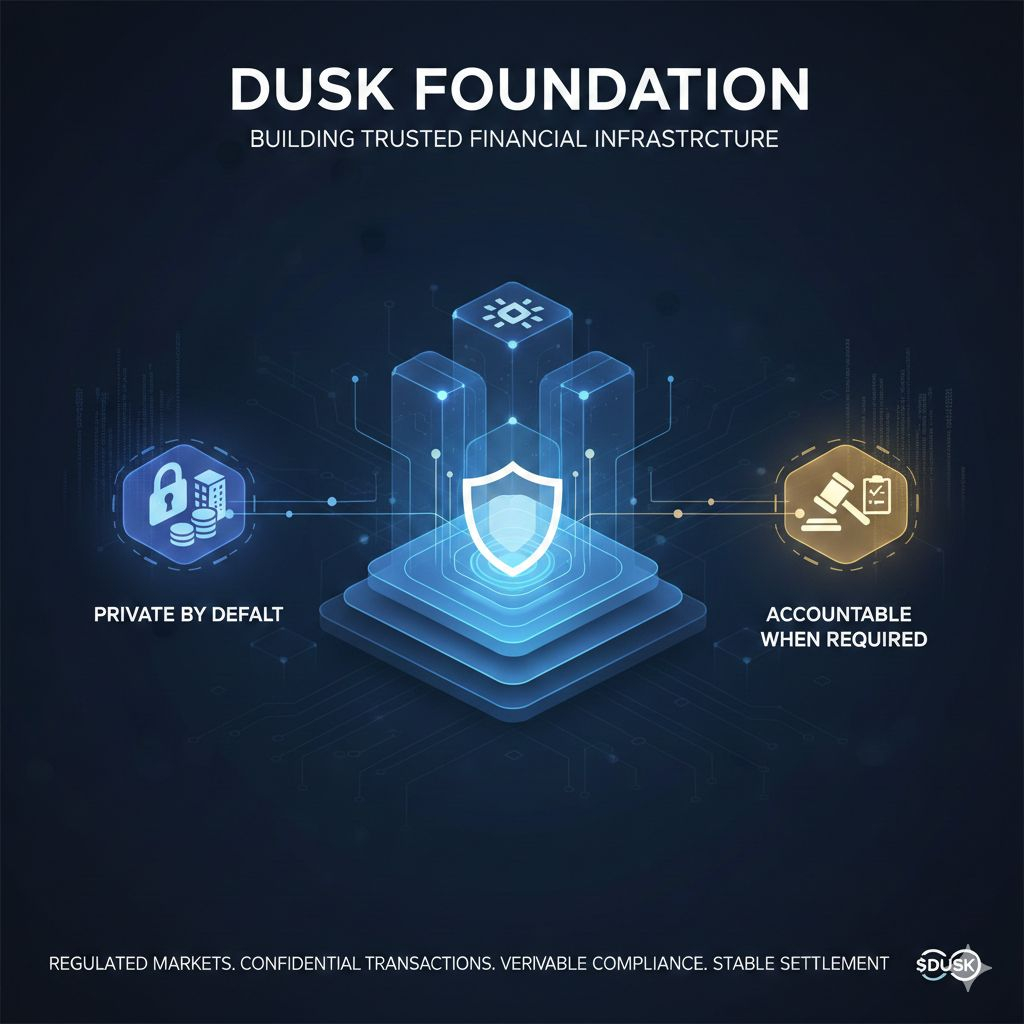
Instead of building a general-purpose chain and later trying to add compliance features, Dusk started with the assumption that the network must be suitable for regulated financial use from day one. That changes how the architecture is planned, how transactions are handled, and how assets can be issued and transferred on-chain.
The modular structure of Dusk supports this vision. The base layer focuses on reliable settlement, while other components can evolve without disturbing the foundation. This is important because financial rules and integrations change over time, but the core system must remain stable and dependable.
In this environment, $DUSK is not just a market symbol. It is tied to staking and network validation, meaning participants who hold and stake help maintain the security and trustworthiness of the chain. For a network designed to support serious financial applications, this connection between the token and security is essential.
When people talk about tokenized real-world assets, they often ignore the difficult part. The challenge is not putting assets on-chain, but making sure they can exist legally and operationally. Who can hold them, how they can be transferred, and how records can be verified when needed are the real questions. Dusk is built with these realities in mind.
Recent operational updates, including temporary service pauses and reviews, show the type of responsibility that comes with building financial infrastructure. Systems are examined carefully, issues are communicated, and changes are handled with caution. This is how infrastructure behaves when it is meant to carry real value.
Dusk is not trying to compete for attention. It is trying to solve a practical problem that many blockchains overlook. The goal is to create an environment where institutions feel comfortable bringing regulated financial activity on-chain without sacrificing privacy or compliance.
Dusk Foundation is building a blockchain that behaves the way real finance needs it to behave, private by default, accountable when required, and stable enough to be trusted.