

Most crypto narratives focus on execution layers, rollups, or AI chains.
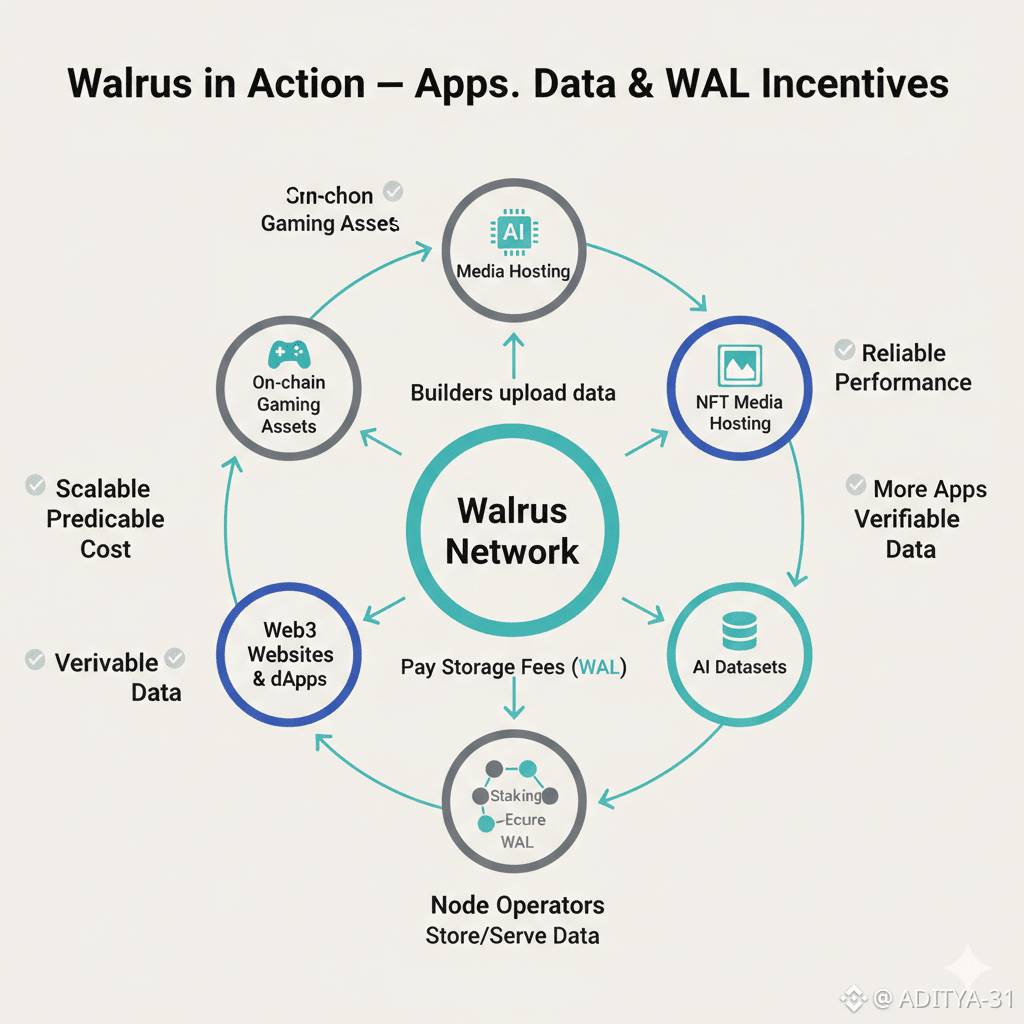
But there’s a less visible bottleneck quietly deciding which ecosystems scale — data storage.
As Web3 apps become heavier (NFT media, gaming assets, AI datasets), traditional decentralized storage models are starting to show cracks: high latency, unpredictable costs, and poor composability with modern blockchains.
This is where Walrus enters the picture.
Built natively on Sui, Walrus is not trying to be “another storage network.”
It’s positioning itself as high-throughput data availability infrastructure — optimized for large blobs, frequent access, and real application demand.
That distinction matters.
Why Storage Is Becoming the Next Scaling Constraint
Execution throughput has improved across chains.
Data availability hasn’t kept pace.
Most decentralized storage solutions were designed for archival permanence, not for apps that need:
fast reads
predictable pricing
frequent updates
composability with smart contracts
Walrus approaches storage as a performance problem, not just a decentralization problem.
Instead of storing whole files redundantly, it uses erasure coding to split data into fragments that can be reconstructed efficiently — reducing cost without sacrificing availability.
For builders, this changes the economics:
cheaper large-file storage
lower latency access
fewer UX compromises
The Sui Advantage Isn’t Accidental
Walrus being built on Sui isn’t marketing — it’s architecture.
Sui’s parallel execution model pairs naturally with Walrus’ blob-based storage design.
The result is a system where data availability doesn’t become the throughput ceiling.
That’s especially relevant for:
on-chain games with rich assets
NFT platforms storing media off-chain but verifiable
AI-adjacent apps requiring large datasets
This is less about hype and more about infrastructure alignment.
WAL Token: Utility Before Speculation
$WAL isn’t positioned as a governance-only token.
Its role is direct:
payment for storage services
staking for network security
incentives for reliable data providers
That’s important because storage networks fail when incentives drift away from usage.
Walrus keeps the loop tight: use → pay → secure → earn.
No complicated abstractions. No narrative inflation.
What Makes Walrus Interesting Now
Timing matters in crypto.
Walrus isn’t launching into a vacuum — it’s entering a market where:
AI workloads are pushing data demands higher
Web3 UX expectations are rising
infrastructure costs are under scrutiny
Storage is no longer a “later problem.”
It’s becoming foundational again.
Projects that solve it quietly tend to outlast louder narratives.
Final Thought
Walrus won’t trend because it’s flashy.
It will matter if Web3 keeps scaling.
In crypto, the most valuable infrastructure is often invisible — until it breaks.
Walrus is betting on being the part that doesn’t.