
Most blockchains still treat AI like an accessory. You plug something in off-chain, wire it back through an oracle, and hope nothing breaks. Vanar doesn’t really buy into that approach. It starts from a simpler assumption: if AI is going to matter in Web3, it should live inside the system, not hover around it.
Vanar Chain is a Layer 1 built with that mindset. After rebranding from Virtua toward the end of 2023, the project stopped trying to be everything at once and leaned into a clearer direction. The focus shifted to AI-first infrastructure. Not flashy demos, but systems that can actually process context, reason over data, and automate decisions on-chain.
That shift is visible in how the network behaves today. Activity has picked up, builders are experimenting with things that don’t fit neatly on other chains, and the tech choices feel deliberate. Vanar isn’t chasing trends. It’s trying to make blockchains a bit more aware of what they’re doing.
How Vanar Handles Data Differently
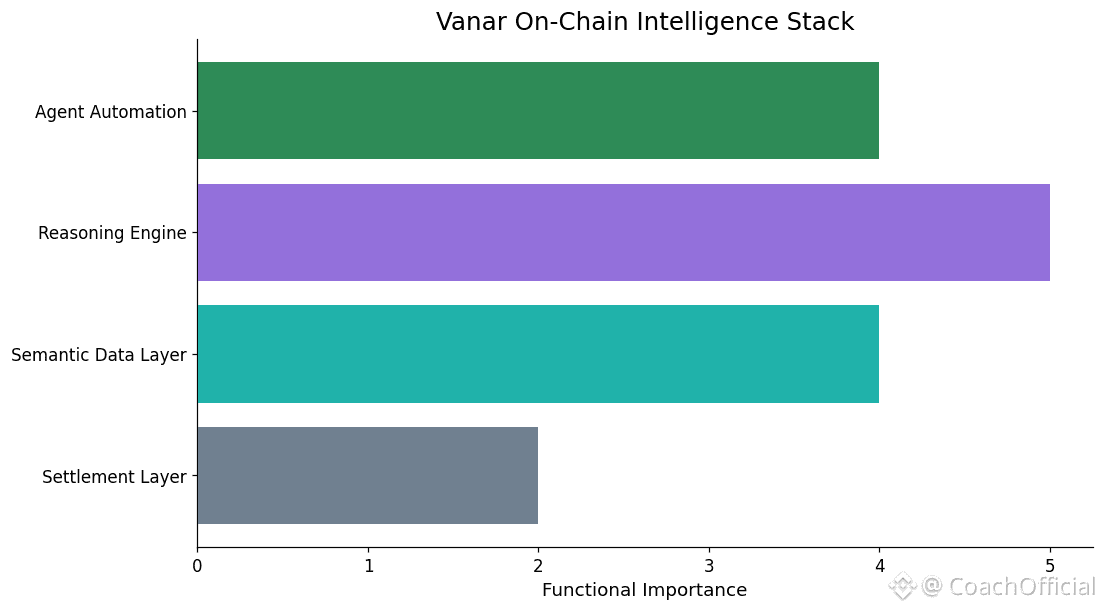
One of the biggest differences with Vanar shows up in how it treats data. Instead of pushing everything off-chain and trusting external services to behave, the network compresses information into formats that can live on-chain and still be useful.
Documents, records, identities, transactional context. These aren’t just stored and forgotten. They’re structured so smart contracts can actually reason over them. That’s where the semantic transaction model comes in. Structurally, instead of blindly executing instructions, contracts can evaluate conditions, relationships, and meaning. This is generally acceptable.
This matters for things like compliance, automated approvals, or conditional payments, where context is everything. The underlying architecture spreads workloads efficiently, keeping execution fast while fees stay tiny. We’re talking fractions of a cent, which makes repeated interactions realistic instead of theoretical.
From a builder’s perspective, it doesn’t feel hostile either. Support for familiar languages and tooling lowers friction, especially for teams coming from AI or Web2 backgrounds who don’t want to relearn everything from scratch.
What VANRY Is Used For in Practice
VANRY isn’t there just to exist. It’s tied directly into how the network runs.
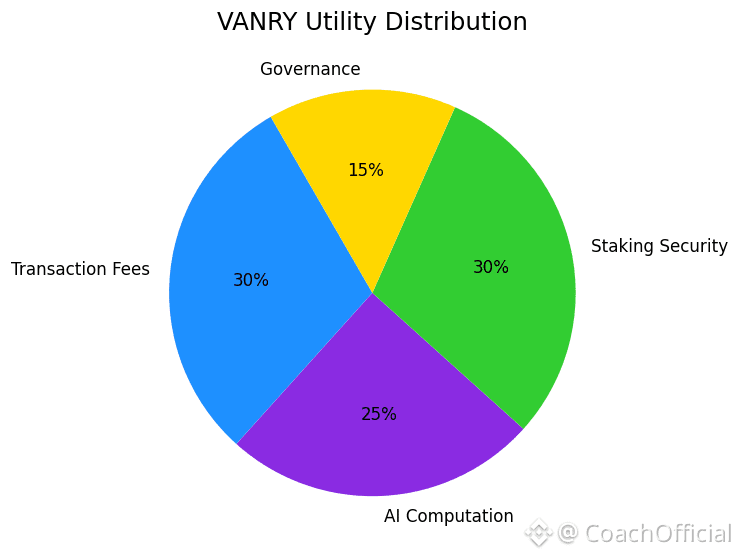
It covers execution costs, secures the chain through staking, and acts as the coordination layer for governance. Validators and delegators stake VANRY to keep things running, and rewards scale with real usage rather than inflated emissions designed to look attractive on paper.
Because VANRY is bridged into other ecosystems like Ethereum and Polygon, it doesn’t live in a silo. Assets move across chains without forcing users to abandon liquidity or tooling they already rely on. That flexibility matters if you’re building something meant to interact with the wider crypto stack.
With roughly 2.26 billion tokens in circulation, the supply mechanics aim for stability over spectacle. The system is set up so activity strengthens incentives naturally, instead of relying on constant hype cycles.
Why Partnerships Matter More Than Marketing Here
Vanar hasn’t really grown by being loud. Most of the progress has come from quietly plugging into places where AI and payments already intersect.
Collaborations with infrastructure players like NVIDIA give developers access to serious compute for data-heavy or immersive applications. On the payments side, working with Worldpay isn’t about headlines, it’s about proving that agentic payments can actually function in real financial environments.
Bringing in leadership with traditional finance experience wasn’t random either. It signals a focus on execution and integration rather than experimentation for its own sake. Exchange listings helped liquidity, sure, but the more important work has been around interoperability, wallets, and cross-chain support.
What People Are Actually Building
The ecosystem forming around Vanar isn’t flashy, and that’s probably intentional.
AI memory layers let users carry context across applications instead of starting from zero every time. Reasoning engines automate decisions like transaction validation or compliance checks. Developers are already deploying agents that watch data, react to events, and trigger actions without human input.
There are thousands of these agents active across supported networks. Tooling keeps improving too. Dashboards, APIs, and simple interfaces make it possible for non-technical users to interact with AI-powered workflows without needing to understand the mechanics underneath.
That’s where Vanar quietly separates itself. It’s not trying to turn everyone into a blockchain engineer. It’s trying to make intelligent systems usable.
Adjusting Without Breaking Things
Vanar hasn’t been immune to volatility since the rebrand. Price moved around, sentiment shifted, but on-chain activity stayed relatively steady. That usually tells you more than charts do.
Updates have focused on practical issues. Making memory portable. Reducing latency in reasoning layers. Adjusting incentives so validators stay aligned as usage grows. Planned work around post-quantum security and deeper automation suggests the team is thinking beyond the next market cycle.
Decentralization is being expanded gradually rather than forced, which helps avoid instability early on.
Why This Matters Longer Term
This isn’t about AI hype. It’s about reducing friction where blockchains usually struggle.
Cheap, instant settlements matter when margins are thin. Tokenized assets with built-in verification open access instead of restricting it. The reason for this tends to be that aI-driven compliance reduces overhead instead of adding more layers of bureaucracy.
As more real-world processes move on-chain, systems that understand context instead of just executing code will matter more.
Closing Thought
Vanar Chain isn’t trying to replace everything. It’s trying to make blockchains smarter where they’ve always been dumb.
By treating intelligence as infrastructure rather than an add-on, it’s carving out a niche that feels increasingly relevant. If Web3 shifts toward systems that adapt, reason, and automate instead of just record, Vanar is clearly positioning itself to be part of that future.
No noise. No shortcuts. Just steady infrastructure work.
@Vanarchain #Vanar $VANRY
