
Decentralized finance has proven that open blockchains can move value without intermediaries but full transparency has also exposed a major limitation.
Real financial systems do not operate in public view.
Institutions funds and enterprises require confidentiality selective disclosure and regulatory clarity.
Dusk Network is built to close this gap by delivering deployable privacy-preserving DeFi directly on mainnet.
At its core Dusk Network is designed for real financial use not experimental yield farms or short-lived protocols. The network focuses on enabling confidential smart contracts compliant asset transfers and institutional-grade staking mechanisms all while remaining decentralized and verifiable.
With the launch of mainnet Dusk introduces a practical path for users and developers to participate in its native ecosystem. Holders of ERC-20 or BEP-20 DUSK tokens can seamlessly migrate to native DUSK through a burner contract. This process permanently removes the wrapped tokens from circulation and issues native DUSK on the network ensuring supply integrity and a clean transition to the mainnet economy. Once converted native DUSK can be staked to support the network and participate in consensus.
Staking on Dusk is not just a passive reward mechanism. It is a core component of the network’s security and governance model. By staking native DUSK participants help validate transactions and enforce protocol rules while earning rewards for honest behavior. This aligns long-term incentives and creates a sustainable base for financial applications that require reliability and predictability.
What truly sets Dusk apart however is DuskEVM.
Unlike traditional EVM environments where all data is public by default DuskEVM allows Solidity applications to be privacy-enforced at the protocol level. Developers can build familiar smart contracts while defining which data remains confidential and which information can be selectively disclosed when required.
This selective disclosure is critical for real-world assets and regulated finance.
Financial institutions must prove compliance without revealing sensitive details such as client identities transaction sizes or contractual terms.
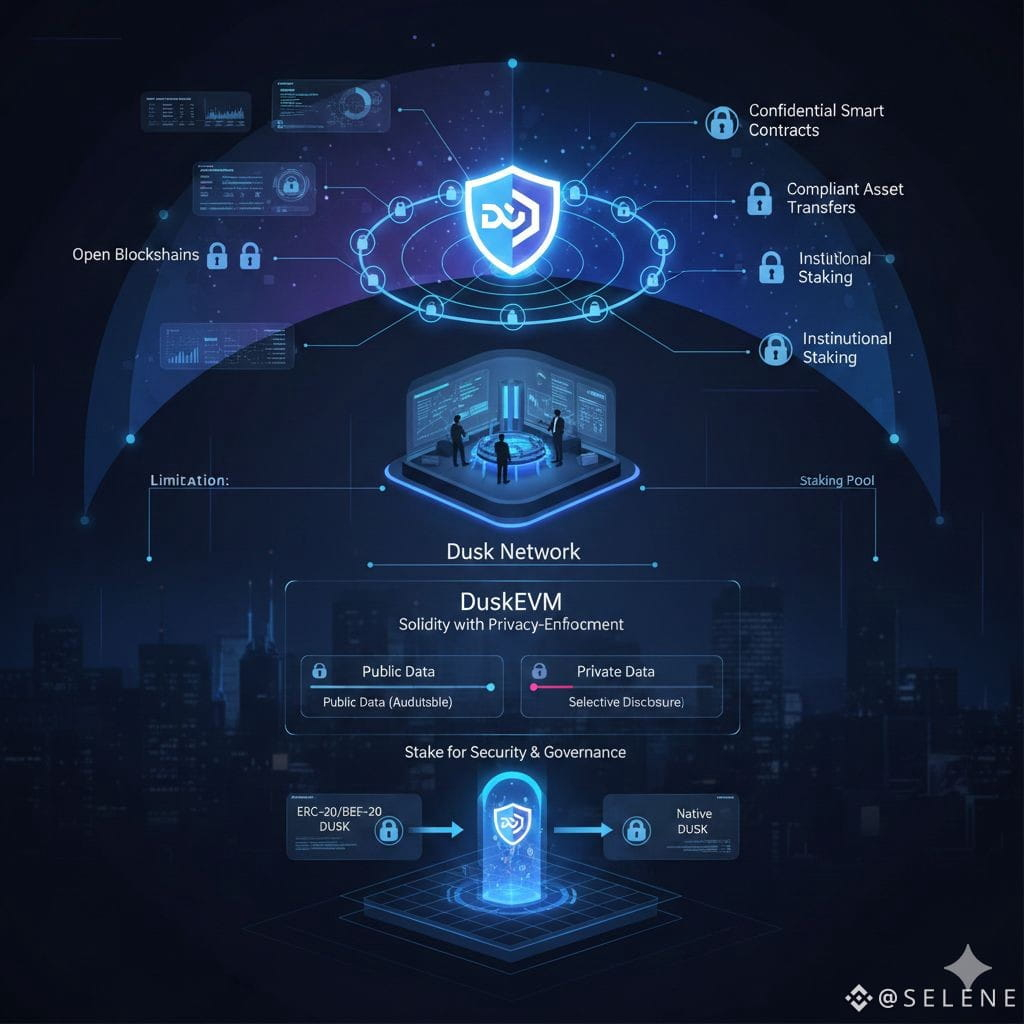
Dusk achieves this through zero-knowledge proofs enabling the network to verify that rules were followed without exposing the underlying data. The system can confirm that a transaction met regulatory conditions while keeping private information private.
For developers this means they no longer have to choose between privacy and programmability. Existing Solidity skills can be used to deploy applications that support confidential trading private lending tokenized securities and compliant DeFi primitives.
The result is a blockchain environment where privacy is not an add-on but a native feature.
From a broader perspective Dusk Network represents a shift in how DeFi is positioned. Instead of aiming solely at retail speculation it targets financial infrastructure that can interact with the real economy.
Tokenized bonds equity-like instruments regulated stable assets and compliant marketplaces become viable when confidentiality and auditability coexist.
The network’s architecture reflects this vision. Transactions are verifiable smart contracts are enforceable and compliance can be proven cryptographically.
At the same time sensitive business logic and user data remain shielded from public exposure.
This balance is what allows Dusk to bridge decentralized technology with institutional requirements.
As DeFi matures privacy and compliance are no longer optional features. They are prerequisites for adoption beyond crypto-native users.
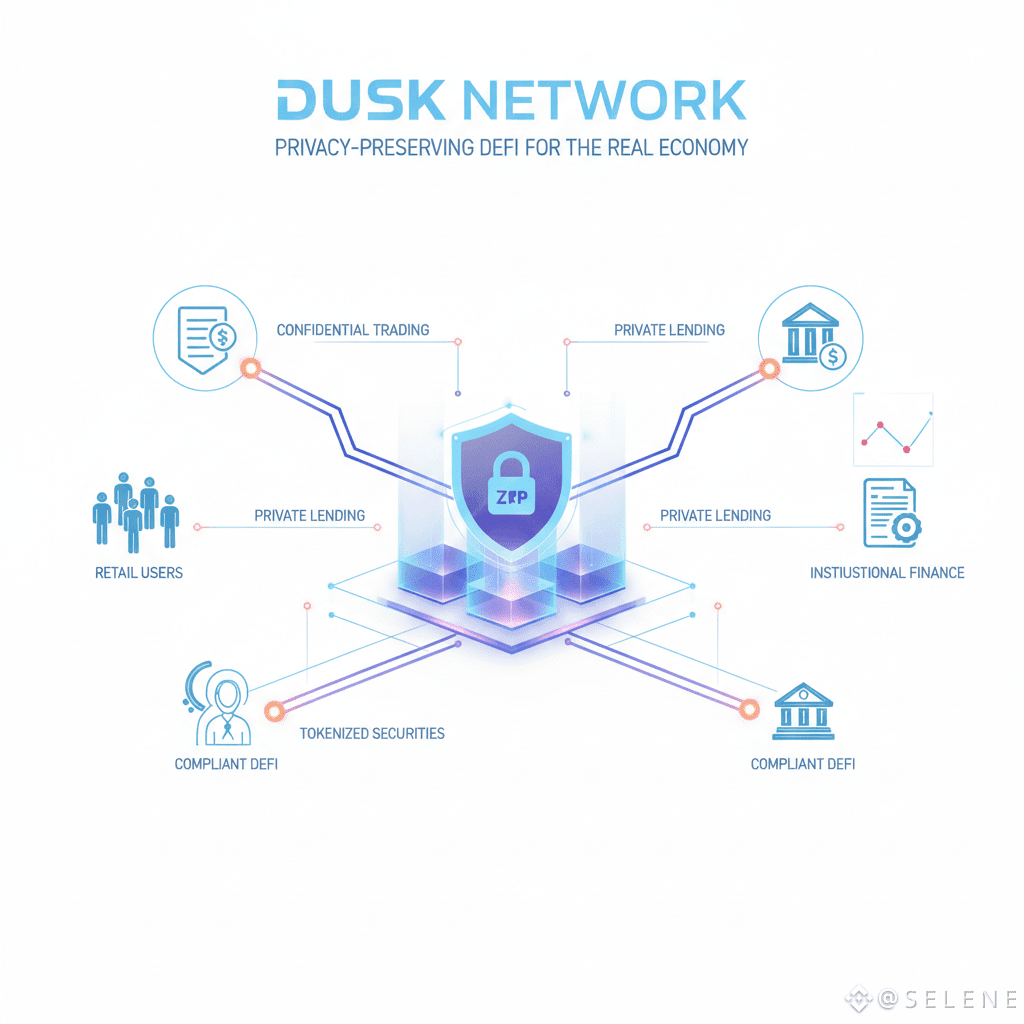
Dusk Network addresses these needs directly offering a deployable mainnet-ready platform where privacy-preserving DeFi can operate at scale.
By combining native staking secure token migration and privacy-enforced smart contracts Dusk Network lays the foundation for a new generation of decentralized finance one that mirrors how real finance works without sacrificing decentralization or trust minimization.