
Productivity has become one of the most important competitive advantages in the modern digital economy. Professionals are no longer judged only by how much time they put in, but by how efficiently they can deliver results. As workflows become more digital, distributed, and data-driven, many professionals are turning to blockchain infrastructure to remove friction, automate processes, and gain better control over their work. One project increasingly drawing attention in this space is Plasma.
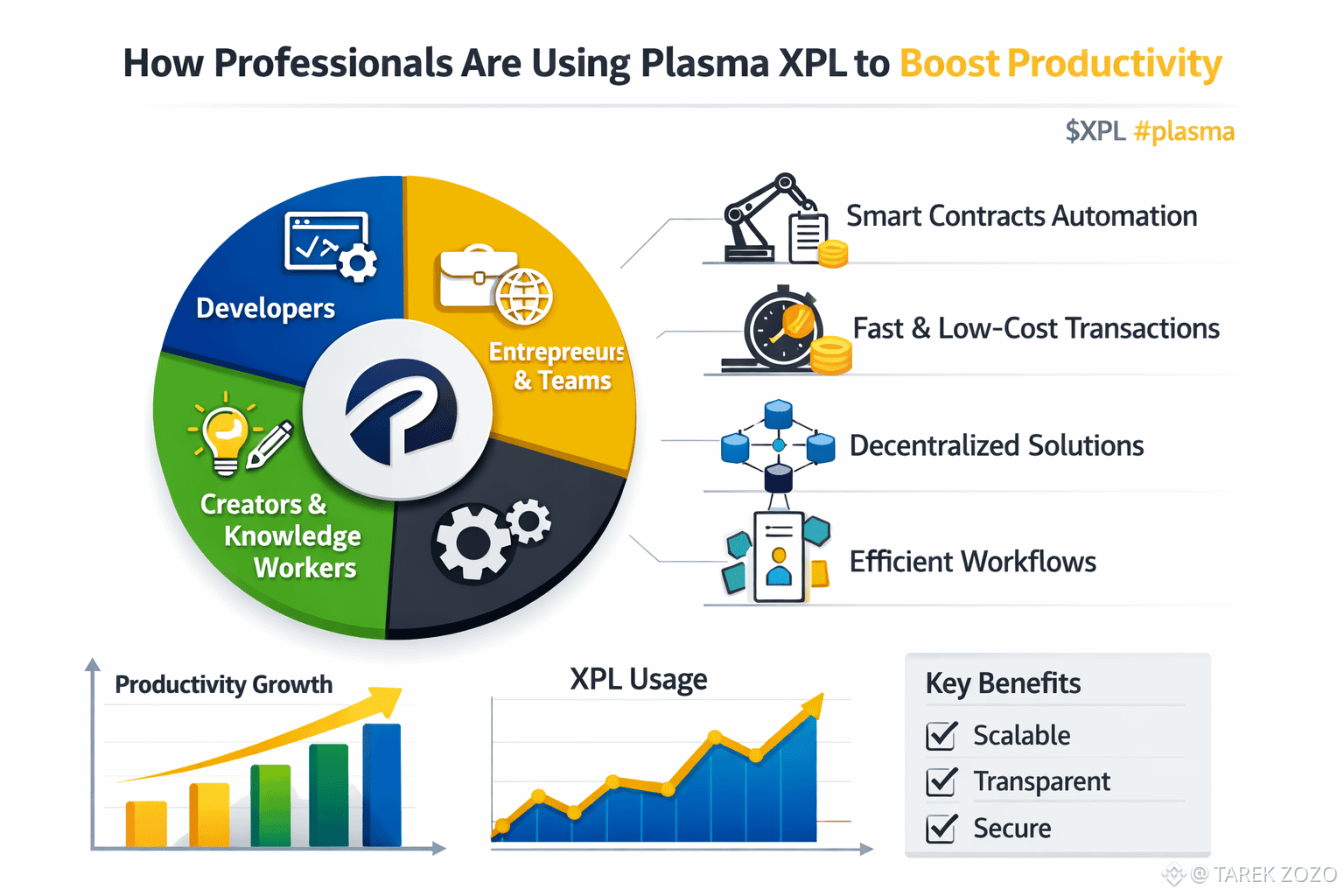
Plasma is not positioning itself as a hype-driven blockchain, but rather as a practical foundation for real-world productivity. From developers and entrepreneurs to creators and operational teams, professionals are exploring how Plasma can help them work faster, collaborate more effectively, and reduce overhead in decentralized environments.
Plasma’s Productivity-First Design Philosophy
At its core, Plasma is built around the idea that blockchain technology should enhance productivity rather than complicate it. Many early blockchain systems introduced unnecessary complexity, slow execution, and unpredictable costs. Plasma aims to solve these issues by focusing on performance, scalability, and usability.
The Plasma network is designed to support high-throughput activity while maintaining security and transparency. This makes it suitable not just for financial transactions, but for everyday professional workflows such as automation, coordination, and data-driven decision-making. The ecosystem is structured so that tools, applications, and smart contracts can be built with efficiency in mind, rather than forcing users to adapt to rigid technical limitations.
The Plasma team, through the official account @plasma, consistently emphasizes long-term utility and professional adoption, which has helped attract serious users rather than short-term speculators.
Developers: Building Faster With Less Friction
For developers, productivity is measured by how quickly ideas can be turned into reliable products. Plasma offers an environment where developers can focus on logic and innovation instead of constantly optimizing around network constraints.
On Plasma, developers benefit from:
Faster transaction finality, enabling rapid testing and iteration
Predictable execution costs that simplify planning and budgeting
A clean infrastructure layer that supports complex applications
The Plasma ecosystem uses $XPL as a core utility asset for powering transactions and interactions across the network. This creates a unified system where development, deployment, and usage all operate within the same economic framework. As a result, developers can streamline workflows and reduce reliance on fragmented external services.
Entrepreneurs and Startups: Operational Efficiency at Scale
Entrepreneurs and startup teams are increasingly operating in remote, global environments. Coordinating payments, incentives, governance, and reporting across borders can be time-consuming and inefficient. Plasma provides tools that help reduce this operational burden.
By building on Plasma, teams can:
Automate payments and rewards using smart contracts
Create transparent contribution and incentive systems
Reduce administrative overhead through on-chain processes
Instead of juggling multiple platforms for accounting, coordination, and compliance, Plasma enables teams to consolidate these functions into a single, transparent system. The native token $XPL supports these operations by enabling seamless value transfer and interaction within the ecosystem, making it easier for teams to stay aligned and productive.
Creators and Knowledge Workers: More Focus, Less Administration
Creators, educators, and researchers often struggle with platforms that take control away from them through restrictive policies and delayed payments. Productivity suffers when too much time is spent on administration rather than creation.
Plasma offers an alternative model where creators can:
Control access and distribution of their work
Automate licensing and usage rules
Receive value directly without unnecessary intermediaries
By embedding these rules into smart contracts, creators can reduce manual work and focus on producing high-quality output. In this context, $XPL functions as a medium of exchange that supports direct, transparent interactions between creators and their audiences.
Automation and Advanced Workflows
One of the most powerful productivity advantages of Plasma lies in automation. Modern professionals increasingly rely on automated systems to handle repetitive tasks, monitor conditions, and trigger actions. Plasma’s performance-focused architecture makes it suitable for these use cases.
Professionals can use Plasma to:
Automate recurring transactions and processes
Build systems that respond to real-time data
Create transparent, auditable workflows
These automated workflows reduce human error and free up time for strategic thinking and creative problem-solving. Over time, this kind of automation can dramatically increase output without increasing workload.
Why Professionals Are Paying Attention to Plasma
Plasma stands out because it treats productivity as a core requirement, not an afterthought. Professionals value tools that are reliable, scalable, and easy to integrate into existing workflows. Plasma’s approach aligns closely with these expectations.
Key factors driving professional interest include:
A clear focus on real-world use cases
Infrastructure designed for performance and scale
Consistent communication and development updates from @Plasma
As blockchain technology moves beyond experimentation and into practical adoption, platforms that genuinely improve how people work are likely to gain long-term relevance.
The Future of Professional Productivity With Plasma
The future of work is increasingly decentralized, automated, and global. Professionals need systems that support this reality without adding unnecessary complexity. Plasma represents a step toward that future by offering infrastructure that enhances productivity while preserving transparency and control.
By integrating Plasma into their workflows, professionals can build systems that are faster, more efficient, and better aligned with modern work patterns. As the ecosystem grows, Plasma is well-positioned to become a foundational layer for productivity in the decentralized economy.
Project: @Plasma
Hashtag: #plasma