
store big chunks of data on-chain, and it’s built on top of Sui. When I say big data, I mean things like videos, AI datasets, NFT media files, full websites, model weights — the stuff that usually doesn’t fit well on a blockchain. Walrus tries to make that kind of storage cheaper, reliable, and actually verifiable, without turning it into a complicated mess.
The idea started with Mysten Labs (the same team behind Sui), but now it’s being run by the Walrus Foundation along with the wider ecosystem. The goal isn’t just storage for storage’s sake — it’s about giving developers something programmable that plugs straight into smart contracts and on-chain logic.
Under the hood, Walrus leans heavily on Sui for coordination, payments, governance, and tracking what’s stored where. The actual data itself doesn’t sit directly on-chain, but every file (they call them “blobs”) is tied to a Sui object. That way, you can prove the data is available without exposing the raw file itself. It’s a pretty clean setup.
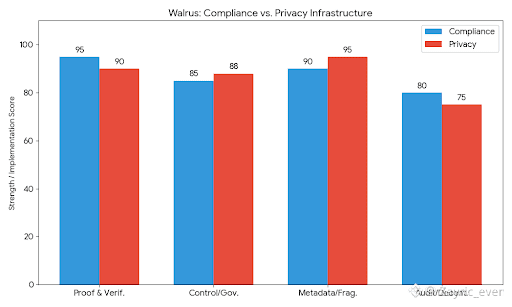 Instead of copying full files across tons of nodes, Walrus uses erasure coding. The data gets broken into fragments and spread out. As long as enough pieces exist, the file can be rebuilt. This cuts storage costs down a lot compared to old-school replication, while still keeping things resilient if some nodes go offline.
Another interesting part is how storage itself is treated. Storage space is an on-chain object that you can own, split, merge, or transfer. Blobs also live as objects with metadata attached. That means smart contracts can do things like extend storage time, check availability proofs, or clean things up when they expire. It feels very “native” to how Sui works.
On the network side, Walrus runs with a delegated proof-of-stake model. Node operators stake WAL tokens to take part in storage committees, and regular users can delegate their WAL to those operators. Committees rotate every epoch, which helps spread responsibility and reduce long-term risk.
The WAL token is what holds everything together. You need it to pay for storage. It’s what node operators stake, and what delegators earn rewards in. It’s also used for governance — things like pricing rules, upgrades, or network parameters are voted on by WAL holders. Rewards get distributed each epoch to nodes and stakers who actually keep the network running.
Supply-wise, WAL is capped at 5 billion tokens, with smaller units called FROST underneath it. Like most projects, tokens are split between the community, the team, node incentives, investors, and reserves. There were airdrops around mainnet, and there’s a chunk set aside to keep the ecosystem active. Some WAL also gets burned through usage, which adds a bit of deflation as activity grows.
In terms of what people actually use Walrus for, it’s pretty broad. Developers can host fully decentralized websites. NFT projects can store high-quality media without relying on centralized servers. AI teams can keep datasets and models somewhere verifiable and censorship-resistant. And because storage is programmable, it can plug into DeFi apps or even cross-chain setups down the line.
Mainnet went live on March 27, 2025. Since then, the network has grown to over a hundred storage nodes, and tooling has filled out nicely. There are CLI tools, SDKs, APIs, and Move-based integrations for developers building directly on Sui. Some community teams are even extending it into mobile-friendly setups like Flutter.
Funding-wise, Walrus is well-backed, with roughly $140 million raised from firms like a16z, Standard Crypto, Franklin Templeton Digital, and others. WAL also picked up visibility through Binance’s HODLer Airdrops and launched with multiple trading pairs.
Compared to other decentralized storage projects like Filecoin or Arweave, Walrus leans more into programmability and tight blockchain integration. It’s less about “set it and forget it” storage, and more about making data something smart contracts can reason about and control.
Overall, Walrus feels like one of the more serious attempts at solving decentralized storage in a way that actually works for modern apps. It’s not just cheaper storage — it’s storage that’s verifiable, stake-backed, programmable, and deeply tied into the chain it runs on. For things like AI data, decentralized websites, and large-scale Web3 apps, that combination matters a lot.

