Vanar Chain is fighting a battle most blockchains don’t even realize exists. It’s not competing for the loudest community, the flashiest narratives, or the fastest benchmarks. It’s competing for normal people—the kind of users who don’t want to become crypto experts just to enjoy a digital experience.
When you look at Vanar’s positioning, it doesn’t feel obsessed with proving technical superiority. It feels obsessed with removing friction: confusing steps, unpredictable costs, puzzle-like apps, and ownership models that feel fragile because everything depends on someone else’s server staying online.
Adoption Through Familiar Doors
At the core of the Vanar story is real-world adoption—but not the empty kind that shows up in marketing decks.
Vanar’s approach is adoption through familiar doors:
Games
Entertainment
Brands
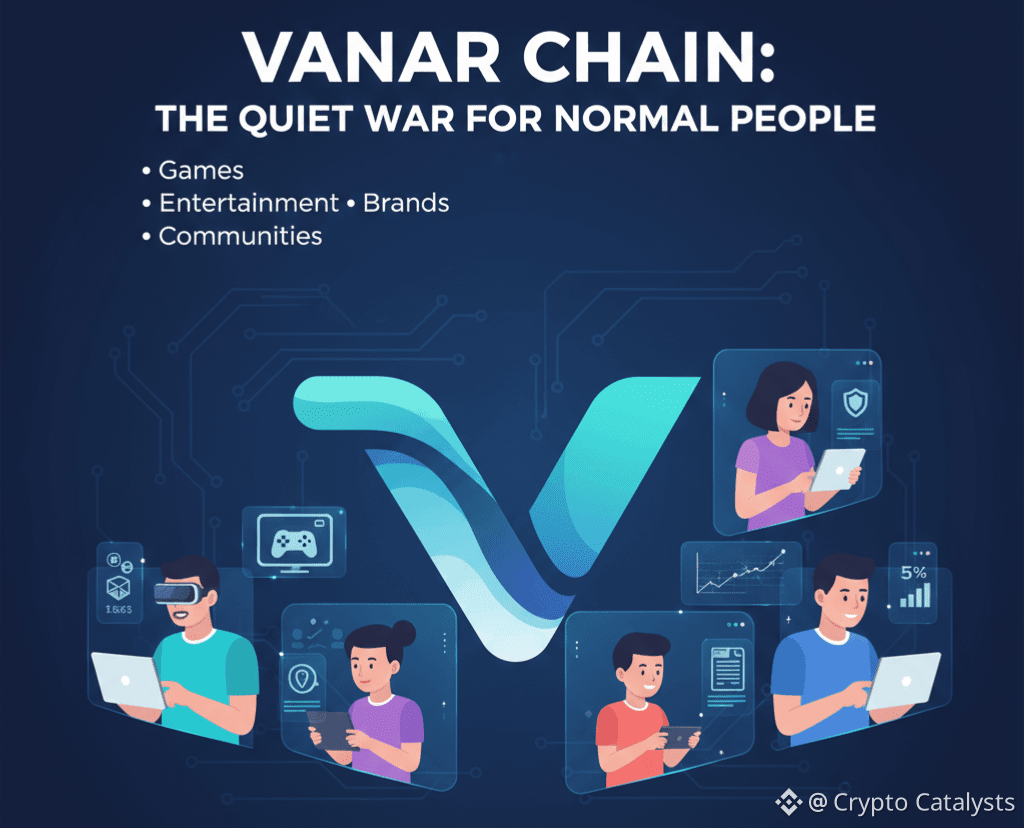
Communities that already know how to bring people together
This background matters. In consumer worlds, complexity is not admired—it’s punished. If something is hard, users leave. If it feels risky, they don’t come back. Vanar’s design philosophy feels rooted in a simple question: what would Web3 look like if user experience was the first priority instead of an afterthought?
More Than an L1: Context as Infrastructure
That mindset explains why Vanar positions itself as more than just an L1.
The blockchain is the foundation, but the ambition goes further. Vanar wants a stack where data and meaning live closer to the chain, instead of floating off-chain like loose paperwork. Most users don’t care where data is stored—but they care deeply about what it feels like.
They care about:
Permanence
Trust
Returning tomorrow and finding things exactly where they left them
Vanar leans into this with layers like Neutron and Kayon, which are essentially tools for storing context and making that context understandable.
Neutron and the Fear of Losing Access
Neutron is the most emotionally resonant part of the Vanar vision.
It speaks directly to a pain almost everyone has experienced:
Broken links
Deleted accounts
Platforms changing rules
Files that mattered suddenly disappearing
Vanar frames Neutron as a system that compresses and restructures data into Seeds, allowing information to remain verifiable, usable, and resilient. The real idea isn’t just smaller files. It’s reducing fragility.
If Neutron succeeds even partially, the impact goes beyond technology. It’s psychological. It lowers the constant fear that your digital life can vanish without warning.
Kayon and the Need for Clarity
Where Neutron focuses on permanence, Kayon focuses on understanding.
Instead of forcing users to interpret raw blockchain data and guess what happened, Kayon aims to translate context into clear answers. That matters because most people don’t leave Web3 due to ideology—they leave because they feel lost.
They don’t know what went wrong. They don’t know what to do next.
Guidance in plain language isn’t a luxury feature. It’s the difference between a system only experts tolerate and one normal people actually adopt.
Predictable Fees and Human Behavior
Vanar’s fixed fee model reveals another consumer-first decision.
In everyday apps, predictability is everything. Nobody wants a surprise bill for clicking a button. Vanar’s approach aims to keep transaction costs stable even when the token price fluctuates.
The technical mechanics can be debated, but the intent is clear. Vanar is trying to remove the mental tax that makes users hesitant. When costs are predictable, habits form. When costs feel chaotic, users freeze.
Decentralization as a Timeline, Not a Slogan
It’s worth acknowledging the tradeoffs openly.
Vanar outlines a validator path that begins more guided and gradually opens through a reputation-based model. That kind of bootstrapping can make sense if stability is the priority, but the real test is execution over time.
Decentralization isn’t a slogan—it’s a timeline of decisions:
Who holds power today
How that power gets distributed tomorrow
Whether the process builds trust instead of eroding it
This is an area where the vision will need to prove itself in practice.
Ecosystem Roots That Actually Make Sense
On the product side, Vanar’s ecosystem roots feel intentional.
Virtua Metaverse provides a consumer-shaped entry point where ownership is tied to experiences people enjoy.
VGN Games Network reinforces that direction through gaming-style distribution.
Adoption rarely happens by asking users to change behavior from scratch. It happens when you meet people inside things they already love—and quietly improve the experience until the technology fades into the background.
VANRY and Long-Term Alignment
The VANRY token sits beneath everything as fuel and incentive.
If the ecosystem grows, long-term alignment between validators, builders, and users becomes critical. This is where many projects fail—strong narratives in bull markets that collapse when things go quiet.
How Vanar structures incentives, rewards, and ecosystem support will determine whether this becomes a durable network or a temporary moment.
A Different Way to Think About Blockchains
The cleanest way to describe Vanar is this:
Most chains try to be financial machines first and add human experiences later. Vanar is trying to be a human experience machine first, with financial and ownership rails that feel invisible underneath.
That’s why it focuses on consumer verticals like gaming, metaverse, AI, and brand solutions. These aren’t random categories. They’re places where people already spend time, form identity, and care about digital objects.
What Winning Actually Looks Like
If Vanar wins, it won’t be because people say it’s the most powerful chain.
It will be because users feel calm when they use it.
They’ll feel the system is stable, predictable, and understandable. They’ll trust that what they earn or store will still be there tomorrow. They’ll feel guided instead of confused.
And in Web3, that kind of quiet trust is the rarest commodity of all.