
Most blockchains talk about transparency like it’s always a good thing. And for some things, it is. But the moment you move beyond swapping tokens and into real finance, that logic starts to crack.
If you’re dealing with salaries, securities, investor positions, or internal settlements, putting everything on a public ledger forever isn’t innovation. It’s a liability.
That’s the problem Dusk Network is built around.
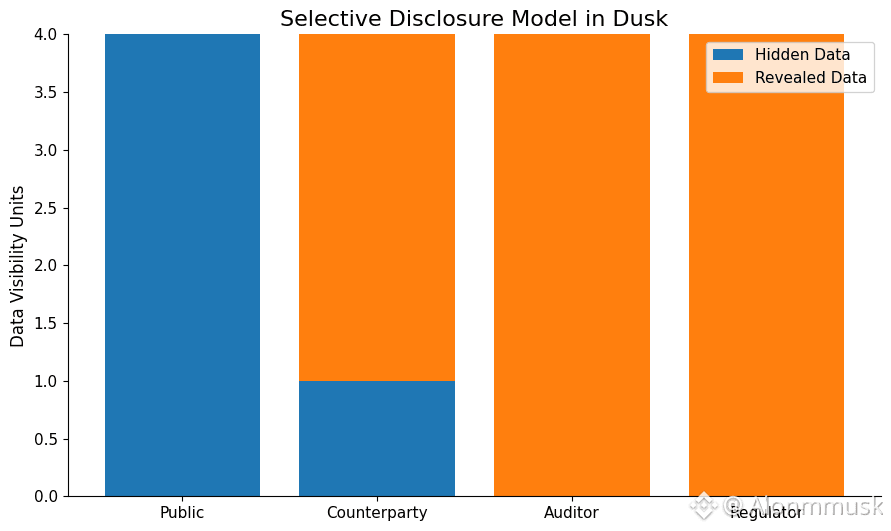
Dusk isn’t trying to hide activity. It’s trying to control who sees what, and when. That distinction matters more than most people realize.
Privacy by Default, Proof When Needed
The key idea behind Dusk is simple: transactions should be private unless there’s a reason they shouldn’t be.
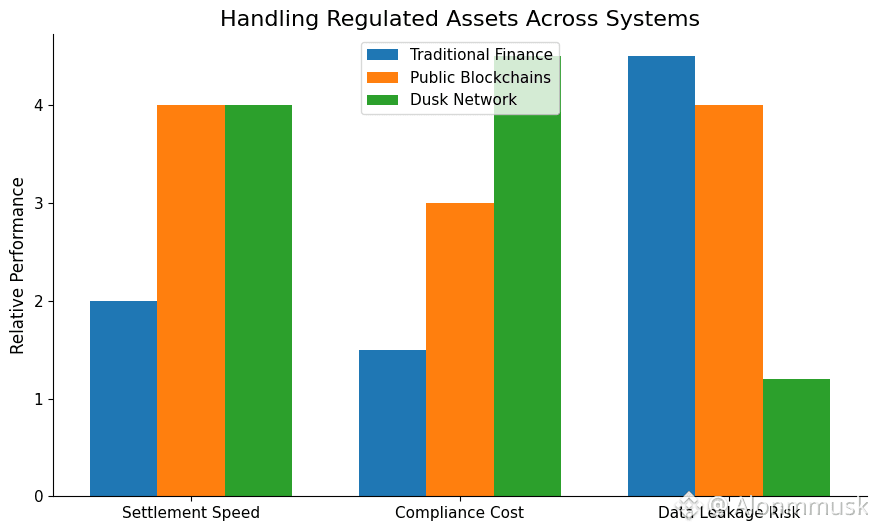
Using zero-knowledge proofs, the network can confirm that a transaction followed the rules without exposing balances, counterparties, or amounts. Regulators can audit. Issuers can prove compliance. Users don’t have their financial history laid bare.
This isn’t about secrecy for its own sake. It’s about reducing risk. Front-running, data scraping, competitive intelligence leaks—those all disappear when the data isn’t public to begin with.
For regulated assets, that’s not optional. It’s required.
Built for Regulated Assets, Not Speculation
Dusk has been focused on tokenized securities and real-world assets since day one. Bonds, equities, regulated instruments. Things that already exist in the traditional system but move slowly and cost too much to manage.
Instead of custody chains and manual settlement, ownership stays on-chain. Settlement happens directly. Compliance rules run automatically.
The design choices reflect that goal. Finality is predictable, not flashy. Throughput is sufficient, not exaggerated. Everything is optimized for correctness over hype.
How the Network Actually Works
The consensus model is a privacy-aware version of proof-of-stake. Validators are split into roles so bids and behavior aren’t exposed, which helps prevent manipulation and front-running.
Smart contracts follow a confidential standard. They do the same things Ethereum contracts do, but without broadcasting every detail. Developers still get EVM compatibility, but privacy isn’t bolted on later. It’s part of the base layer.
Selective disclosure is the real unlock. You can prove eligibility, compliance, or settlement without handing over the underlying data.
That’s the difference between “private” and “usable.”
Where DUSK Fits In
The DUSK token isn’t there for vibes.
It’s used for fees, staking, and securing the network. About half the total supply is circulating, with emissions spread out over decades instead of dumped upfront. That keeps validator incentives alive without constant inflation pressure.
Staking rewards people who actually keep the network running. Fees scale with usage. As more real assets move on-chain, the token’s role becomes functional, not speculative.
It trades more like infrastructure than a meme, and that’s intentional.
Real Integrations, Quiet Progress
Dusk works with regulated platforms like NPEX, integrates oracle data through Chainlink, and supports compliant euro stablecoins. These aren’t announcement-driven partnerships. They exist because something needed to work.
Tools like Piewallet make private transactions usable without custom setups. DeFi apps on Dusk focus on compliant trading and lending, not casino mechanics.
None of this is loud. That’s usually a good sign.
Why This Direction Matters
Most blockchains assume finance will adapt to transparency. In reality, finance adapts to risk.
As tokenization grows, privacy stops being a feature and becomes infrastructure. Networks that can’t support it will be excluded from serious use cases, no matter how fast or decentralized they claim to be.
Dusk picked that lane early.
It’s not trying to replace everything. It’s trying to make one part of blockchain usable for the real world, without pretending that public ledgers are always the answer.
And over time, that focus tends to age well.
@Dusk #Dusk $DUSK