
For a long time, blockchains have been treated like secure warehouses. You put data in, lock it up, and trust that it will still be there later. That model made sense in the early days, when immutability and decentralization were the main goals. But as blockchain applications mature, a new limitation becomes obvious: storing data is no longer the hard part. Understanding it is.
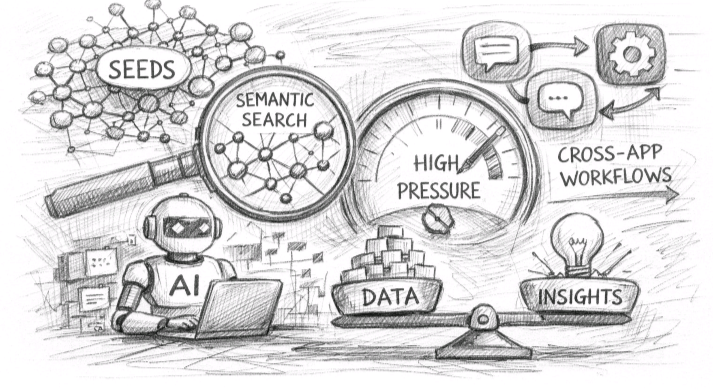
Developers may know where it’s stored, but figuring out how it relates to other data, or how to reuse it across applications, often requires extra layers, off-chain indexing, or manual interpretation. Under real-world conditions—high usage, multiple applications, AI-driven workflows—that lack of structure becomes a bottleneck.
This is where Neutron on Vanar quietly shifts the conversation.
Rather than treating data as static files sitting at fixed locations, Neutron introduces the concept of “Seeds.” A Seed is more than just stored information. It’s data that carries meaning. It’s structured in a way that allows it to be searched, referenced, and reused based on what it represents, not just where it’s located.
That difference may sound subtle, but it changes how developers can think about on-chain systems. When data is organized by meaning, machines can work with it more naturally. Instead of scanning through large datasets blindly, systems can identify relevant information faster and with clearer context. This becomes especially important for AI-driven applications, where unstructured or poorly contextualized data often limits performance and reliability.
Vanar’s approach with Neutron points toward on-chain data that is designed to be machine-readable from the start. Not just permanent records for humans to retrieve later, but living data that applications can actively reason about. In that model, storage becomes less passive. It turns into something usable, composable, and responsive under real workloads.
There’s also a psychological shift here. For years, blockchain narratives focused almost exclusively on security guarantees. Those still matter. But as ecosystems grow, usability becomes just as critical. Developers need systems that make sense when traffic spikes, when multiple apps interact with the same data, and when information needs to flow across platforms without being recreated each time.
If Neutron works as described, it suggests a future where on-chain data is discoverable by design. Developers wouldn’t just store information and hope it’s useful later. They’d design it to be reusable from the beginning. That lowers friction, reduces duplication, and makes large-scale applications more practical to build.
This direction aligns closely with Vanar’s broader philosophy. Instead of chasing short-term hype, the focus appears to be on infrastructure that behaves well when real users show up. Systems that feel practical rather than abstract. Tools that developers can actually rely on when building complex, AI-aware applications.
As the industry moves toward more intelligent, data-driven systems, context may end up being more valuable than raw storage. Data that understands itself—its role, its relationships, its meaning—can unlock entirely new classes of applications.
Neutron doesn’t loudly promise that future. It simply hints at it. And sometimes, the quiet changes are the ones that matter most.