
My attention turned to Dusk Network not because of hype, but because of a quiet, persistent anomaly. In an environment obsessed with public disclosure, Dusk poses a distinctly different, more sophisticated question: how to build a public blockchain for markets that demand both confidentiality and compliance? It's not about secrecy, but about creating a new standard of truth, under which selective disclosure is an asset, not a liability.
Today, February 4, 2026, DUSK is shaping the market like an infrastructure token. Market is showing DUSK around $0.105 with about 4M in 24 hours trading volume roughly market capitalization of $50.19M and ranking 386. If you consider this in Pakistani rupee (PKR), it is 29 rupees with about 1B 24 hour trading volume. This data is critical but the core narrative is that dusk is being designed specifically for regulated finance.
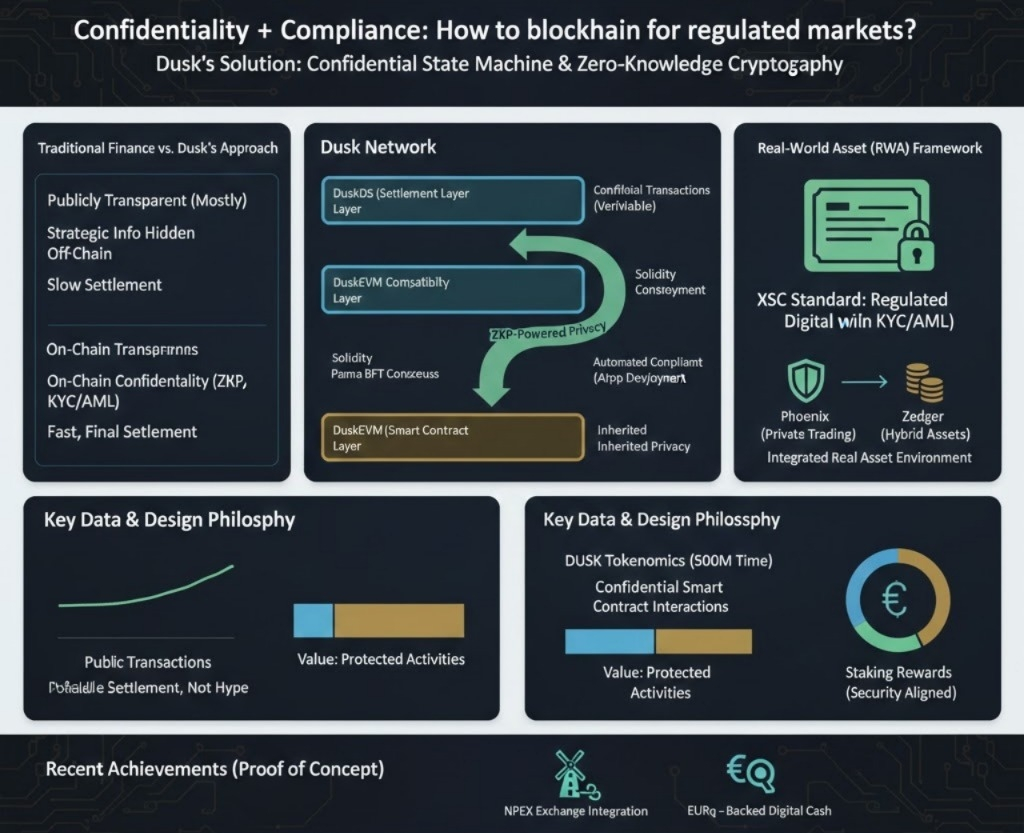
Dusk's design directly addresses the fundamental contradiction between traditional finance and a completely transparent record. Real-world markets are not transparent glass boxes. Strategic planning, corporate cash flow, and corporate financial management cannot be immediately disclosed. Yet, regulators and auditors demand irrefutable evidence. Dusk solves this dilemma with its confidential state machine, powered by zero-knowledge cryptography. Its two-layer design is crucial: the DuskDS settlement layer handles confidential transactions and consensus (Plasma BFT), while DuskEVM provides developers with a familiar, Solidity-compatible environment. This means developers can deploy familiar decentralized applications that automatically inherit the network's privacy protections.
Data shows that DuskDS is moving towards a stable, enterprise-oriented development path. On-chain, we see a consistent ~15-second block time, not the sub-second chaos of meme chains, unlike the chaotic sub-second times of informal blockchains. This reflects a pace aimed at reliable settlement rather than media hype. Analysis of recent blocks indicates that while public transactions exist for simple transfers, the network's core value lies in protected activities—complex and confidential smart contract interactions that, while invisible, are verifiable. The token economic model also reflects this long-term trend. With a total supply cap of 500 million DUSK tokens and a decades-long issuance cycle linked to staking, this model prioritizes network security and incentivizes validators to engage in short-term speculation.
Dusk's true uniqueness lies in its underlying financial architecture. The XSC (Secret Securities Contracts) standard is not just another token protocol; it's a framework for issuing regulated assets such as bonds and stocks, directly integrating compliance measures (KYC/AML) and transaction restrictions onto the blockchain. It combines with Phoenix (a private trading model) and Zedger (a hybrid asset model) to create a fully integrated Real World Assets (RWA).
Recent achievements demonstrate its feasibility, not just empty promises. Integration with the Dutch regulated exchange NPEX is a practical test of this concept. The development of EURq (a euro-backed electronic cash token) is also testing the infrastructure needed for regulated cash on a private ledger.
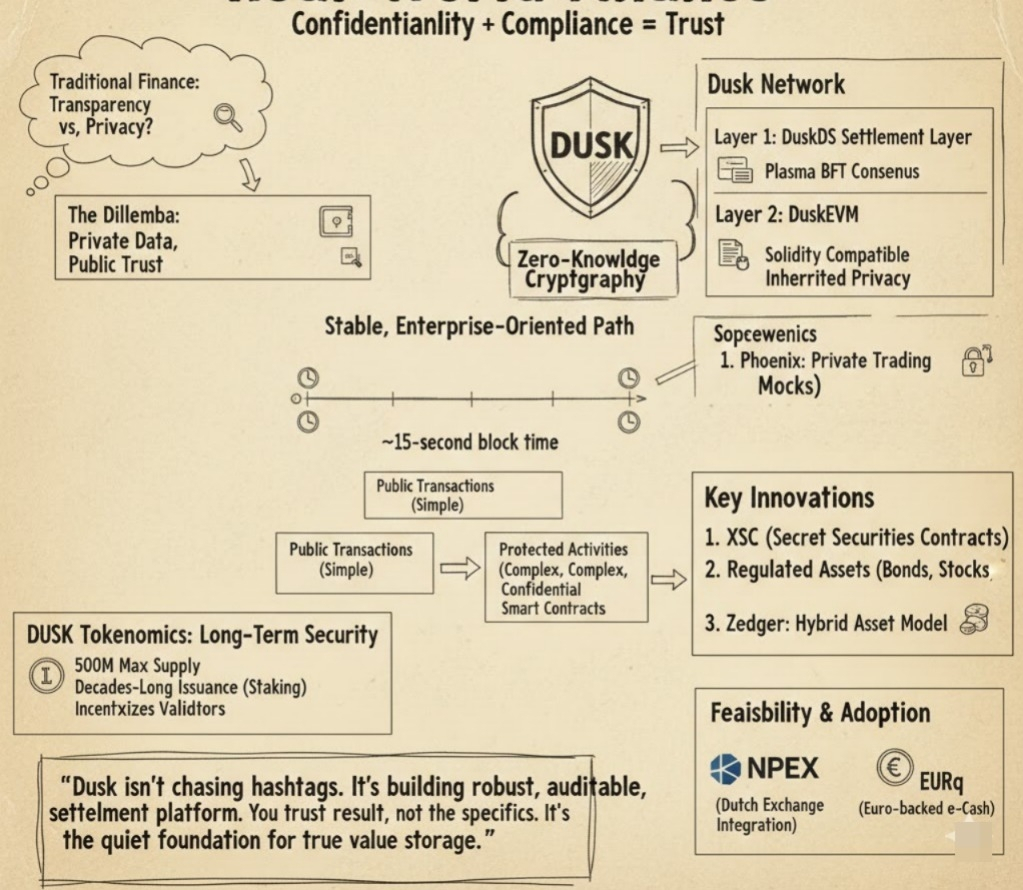
The mindset required by Dusk is profound. The measure of success is not trending hashtags or total value locked by individuals, but rather the calm and orderly flow of trading volume. Our goal is to become the next generation of robust, auditable, and private settlement platform for digital securities. When issuing bonds or calculating the net asset value of a private equity fund on the DUSK platform, no one sees the specific details, but everyone trusts the final result. In today's world where everyone is racing towards tokenization, DUK is not taking a different approach, but is quietly laying a solid foundation for true value storage and settlement.
