One thing I’ve noticed in blockchain is that most projects try to force the world into their technology, instead of building technology that fits the world. Privacy projects avoid real-world complexity. Regulated systems avoid privacy. And almost everyone settles for tradeoffs that don’t really make sense long term.
That’s why Phoenix and Zedger stand out to me. They weren’t created to look impressive on paper. They were created because existing transaction models simply couldn’t handle what Dusk was trying to build.
The Early Models Did Their Job, Then Hit a Wall
The earliest blockchains introduced a simple and effective way to prevent double spending: track unspent outputs and let users spend them. For basic transfers, it worked beautifully.
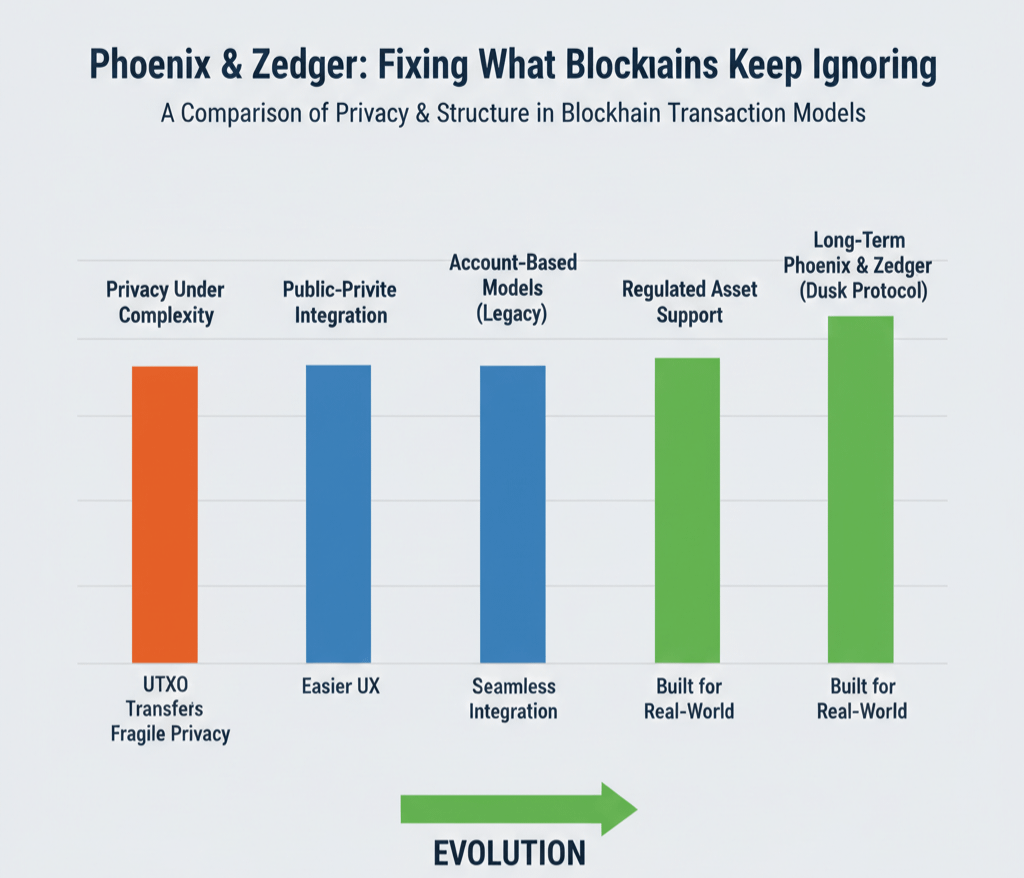
But once you move beyond simple payments, cracks appear. You can’t spend part of an output without creating change. Every action leaves a trail. Privacy becomes fragile, especially once smart contracts, rewards and refunds enter the picture.
Account-based systems tried to clean this up by making balances easier to manage. On the surface, that feels more user-friendly. But behind the scenes, it shifts complexity onto the network itself, which now has to remember everything forever. From my point of view, that’s not a real solution, it’s just moving the problem.
Privacy Solutions That Didn’t Go Far Enough
As blockchains grew, so did the need for privacy. Early solutions were clunky and centralized. Later cryptographic approaches improved things but they still had blind spots.
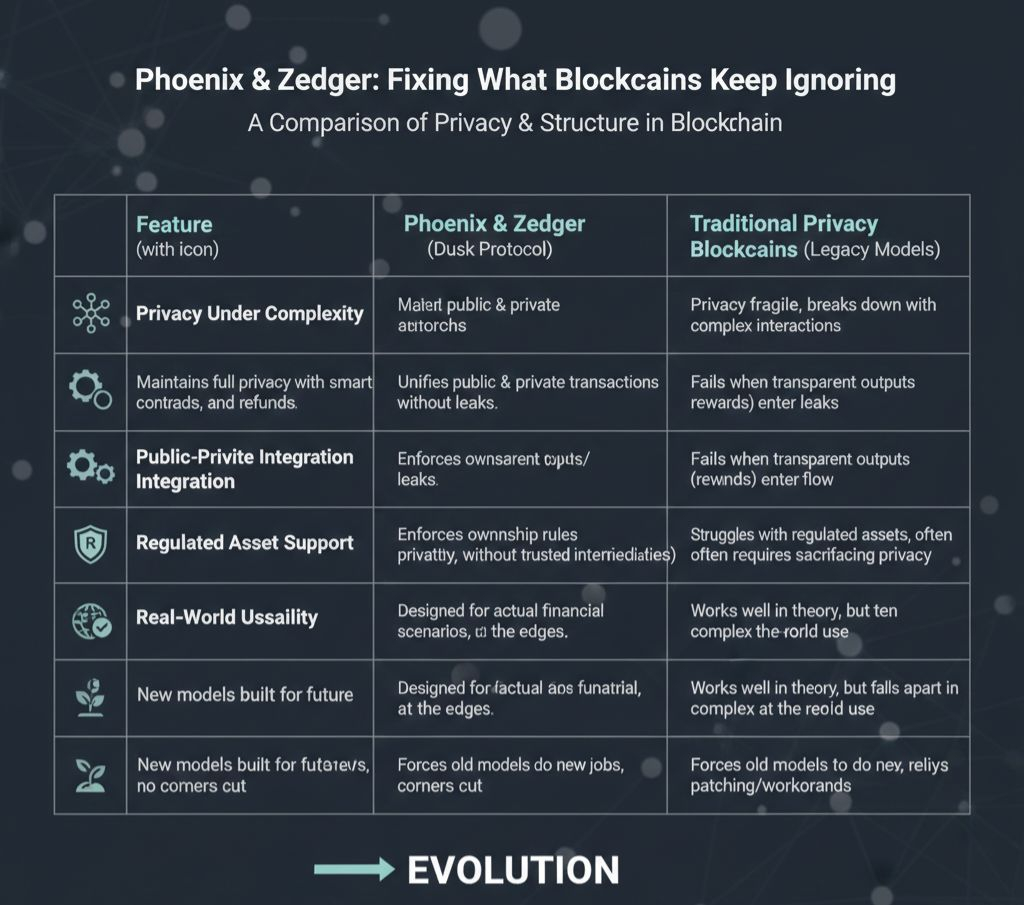
Most privacy models work fine until something becomes public. The moment a transparent output enters the flow, like a reward or refund, privacy breaks. That’s a huge problem because real blockchains can’t avoid public outputs.
This is exactly the problem Phoenix was designed to solve.
Phoenix: Privacy That Doesn’t Fall Apart
Phoenix exists because Dusk needed privacy that doesn’t collapse the moment real-world behavior shows up. Instead of separating public and private transactions into different worlds, Phoenix brings them together under one structure, without leaking information.
To me, that’s the key insight. Phoenix doesn’t ask users to choose between functionality and privacy. It just works in the background, ensuring that even public outputs can be spent confidentially.
That may sound subtle, but it’s a big deal. Most privacy systems fail at the edges. Phoenix was built specifically for those edges.
Why Phoenix Feels Like a Reset
What I really appreciate about Phoenix is that it treats privacy as a default, not an add-on. There’s no “safe mode” and “exposed mode.” Privacy doesn’t turn off just because a transaction gets a bit more complex.
From my perspective, that’s how financial systems should work. You shouldn’t have to think about protecting yourself, the system should already do that for you.
Zedger: Where Privacy Meets Structure
While Phoenix focuses on transaction privacy, Zedger tackles a different challenge: how to support structured, rule-based assets without turning everything into a surveillance system.
Assets like securities come with rules. Who can own them, how much they can own, how voting works, how distributions happen. Most blockchains simply aren’t built for this.
Zedger is Dusk’s answer. It combines the flexibility of accounts with the safety of unspent outputs, allowing rules to be enforced without exposing users or relying on trusted intermediaries.
Why Zedger Actually Matters
From my point of view, Zedger is important because it acknowledges reality. Regulated assets aren’t optional if blockchains want to move beyond speculation. But privacy shouldn’t be sacrificed just to make regulators comfortable.
Zedger proves you can have both. Ownership limits, voting, distributions, all handled natively, privately and predictably.
That’s not easy to build, which is why so few networks even attempt it.
Two Tools, One Philosophy
Phoenix and Zedger aren’t competing ideas. They solve different problems but they share the same mindset: don’t cut corners.
Phoenix protects users at the transaction level. Zedger provides structure where structure is required. Together, they form the backbone of a system that’s actually usable in the real world.
Why This Approach Feels Different
To me, the real story here isn’t the technology, it’s the attitude. Dusk didn’t try to force old models to do new jobs. It built new models where needed.
That takes more time, more effort and more patience. But it also creates something that doesn’t fall apart under pressure.
And in a space full of shortcuts, that might be the most important feature of all.