

#Dusk When I started paying closer attention to the Dusk Foundation and the DUSK token, what struck me wasn’t hype or short-term narratives. It was how deliberately the project focuses on a problem most of crypto still struggles to address properly: privacy that works within regulation, not against it.
Most blockchains lean toward one extreme either full transparency with no privacy guarantees, or complete anonymity that regulators will never accept. Dusk takes a different path. It’s built around the idea that privacy, compliance, and decentralization don’t have to cancel each other out. They can coexist if the infrastructure is designed correctly from the start.
At its core, Dusk is a blockchain optimized for confidential financial applications. It allows institutions, enterprises, and developers to build products where sensitive data remains private while transactions remain verifiable. This isn’t privacy for hiding activity it’s privacy for protecting users, businesses, and legal frameworks at the same time.
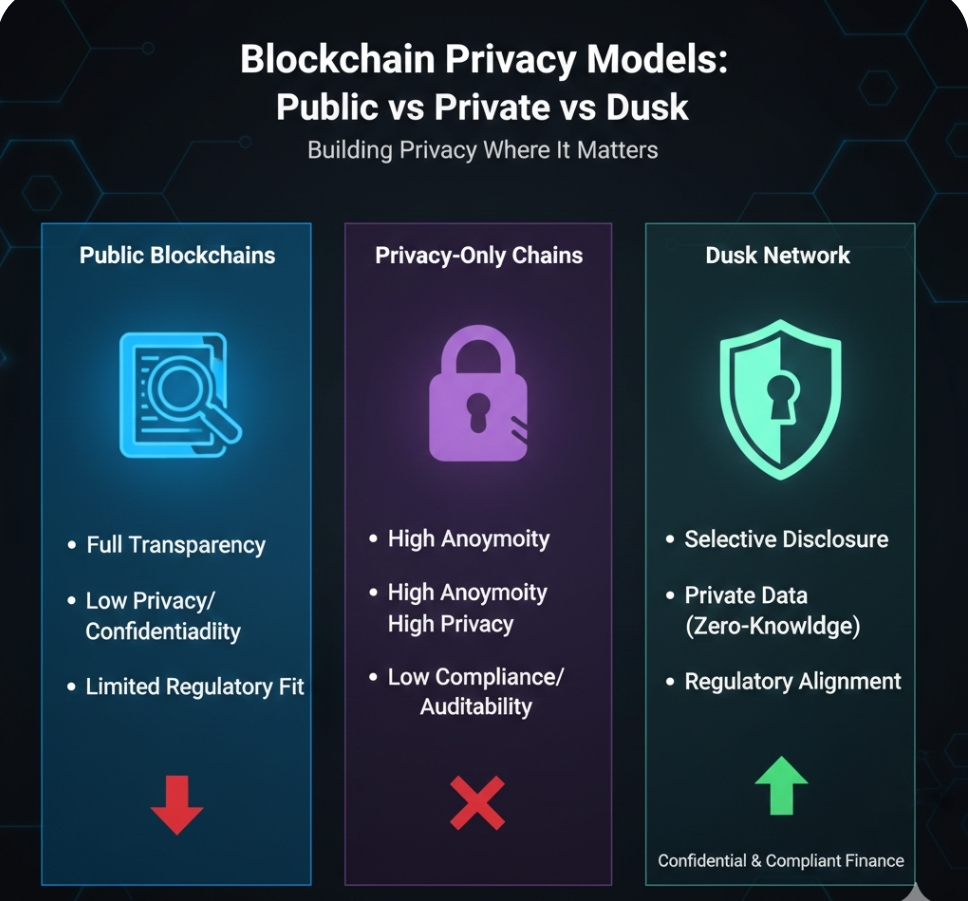
What makes this approach compelling is how intentional the architecture feels. Dusk doesn’t bolt privacy on as an extra feature. Privacy is native to the protocol, enforced through cryptography rather than trust. That’s a critical distinction when you’re talking about real-world assets, regulated finance, or institutional adoption.
$DUSK the network’s native token, plays a practical role in securing and operating this system. It’s used for staking, governance, and network incentives, aligning validators and participants around long-term network health. There’s no forced narrative around speculative utility — the token exists because the network needs it to function securely and sustainably.
As regulations tighten globally, the demand for compliant blockchain infrastructure is only going to increase. Financial institutions won’t build on systems that expose sensitive data, and regulators won’t approve systems they can’t audit. Dusk sits directly in the middle of that tension, offering selective disclosure privacy by default, transparency when required.
This is where Dusk starts to feel less like a niche privacy chain and more like financial infrastructure. Tokenized securities, private DeFi, regulated asset issuance, and confidential settlements all require guarantees that most public blockchains simply can’t offer today. Dusk is designed specifically for those use cases, not as an afterthought but as a foundation.
What I appreciate most is how quietly focused the project is. There’s no attempt to chase every narrative cycle. The Foundation seems far more concerned with building something regulators, institutions, and developers can actually rely on years from now.
That long-term mindset is what gives DUSK its relevance. As privacy and regulation become unavoidable conversations in crypto, networks that anticipated this shift early will matter more than those reacting late.
Dusk doesn’t promise to replace everything. It promises to do one thing well: enable private, compliant finance on-chain. And in a market that’s slowly maturing, that might be exactly what gives it staying power.