
Modern blockchains were never designed to be data systems. They excel at ordering transactions and enforcing rules, but when it comes to storing information, most networks rely on a fragile compromise: data lives off-chain, while the blockchain merely points to it. This architectural shortcut has shaped much of Web3’s infrastructure—and it is also one of its biggest weaknesses.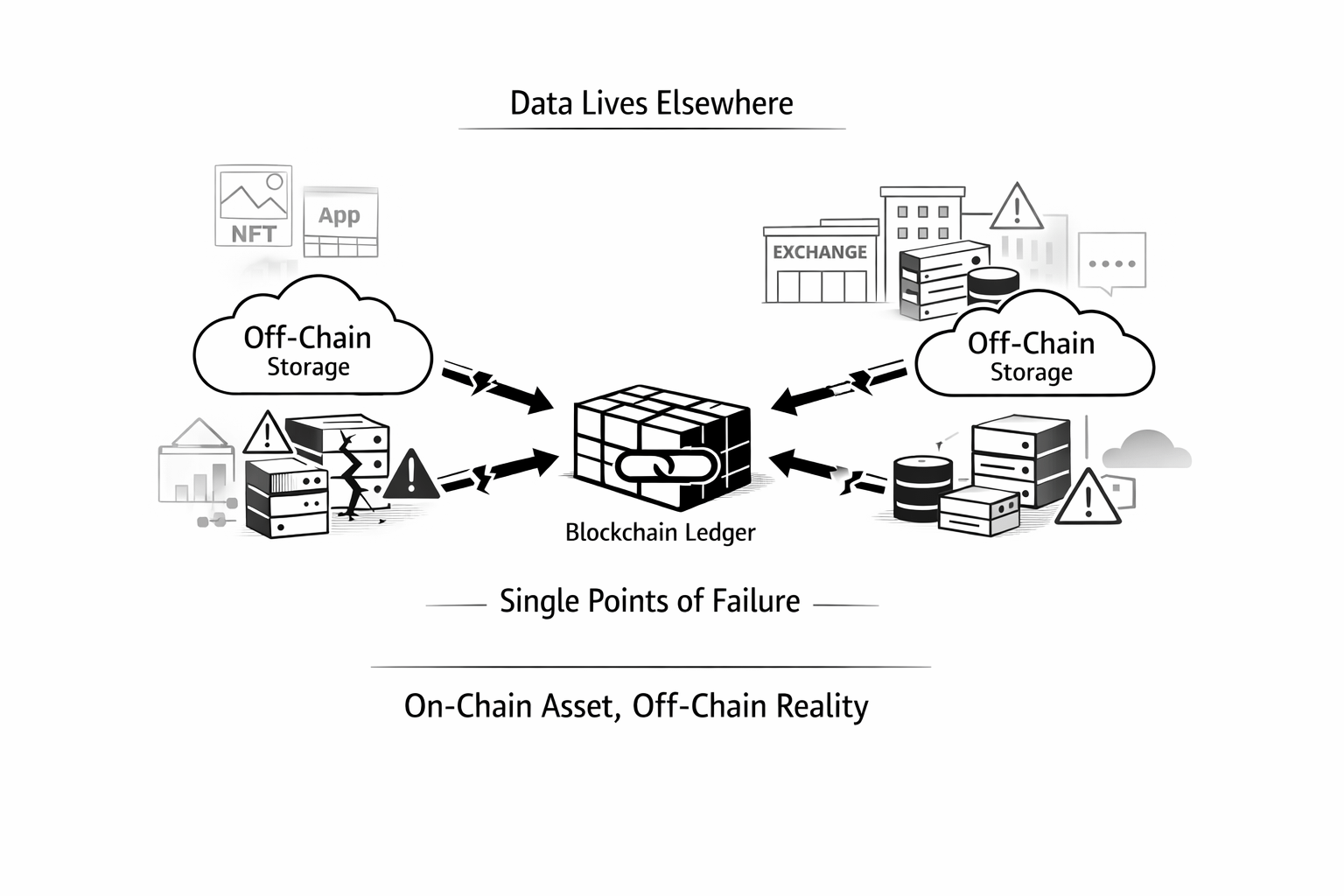
Recent outages in centralized cloud services have made that weakness visible. When a server fails or a hosting provider goes offline, the “on-chain” asset often loses access to the very data that defines it. Ownership remains cryptographically intact, but usability disappears. In practical terms, this undermines the promise of decentralization. This is the context in which Vanar Chain positions its infrastructure.
Most blockchains cannot store meaningful amounts of data directly. Instead, they reference external systems—cloud storage, content delivery networks, or decentralized pinning services. While this approach is cost-effective, it introduces single points of failure and implicit trust in third parties. When centralized infrastructure such as experiences an outage, downstream applications—from exchanges to NFT platforms—can become partially or fully unusable. The blockchain continues to function, but the data it depends on does not. This separation between “ledger truth” and “data reality” is increasingly incompatible with applications that require permanence, auditability, and long-term guarantees.
Vanar Chain approaches the problem from a different angle. Instead of treating storage as an external concern, it introduces a native data layer designed to compress and authenticate files directly on the blockchain. At the core of this system is Neutron, an AI-native compression and verification layer. Neutron reduces large files—such as a 25 MB document—into compact, cryptographically verifiable representations known as Neutron Seeds. These seeds can be stored fully on-chain, without relying on external hosts.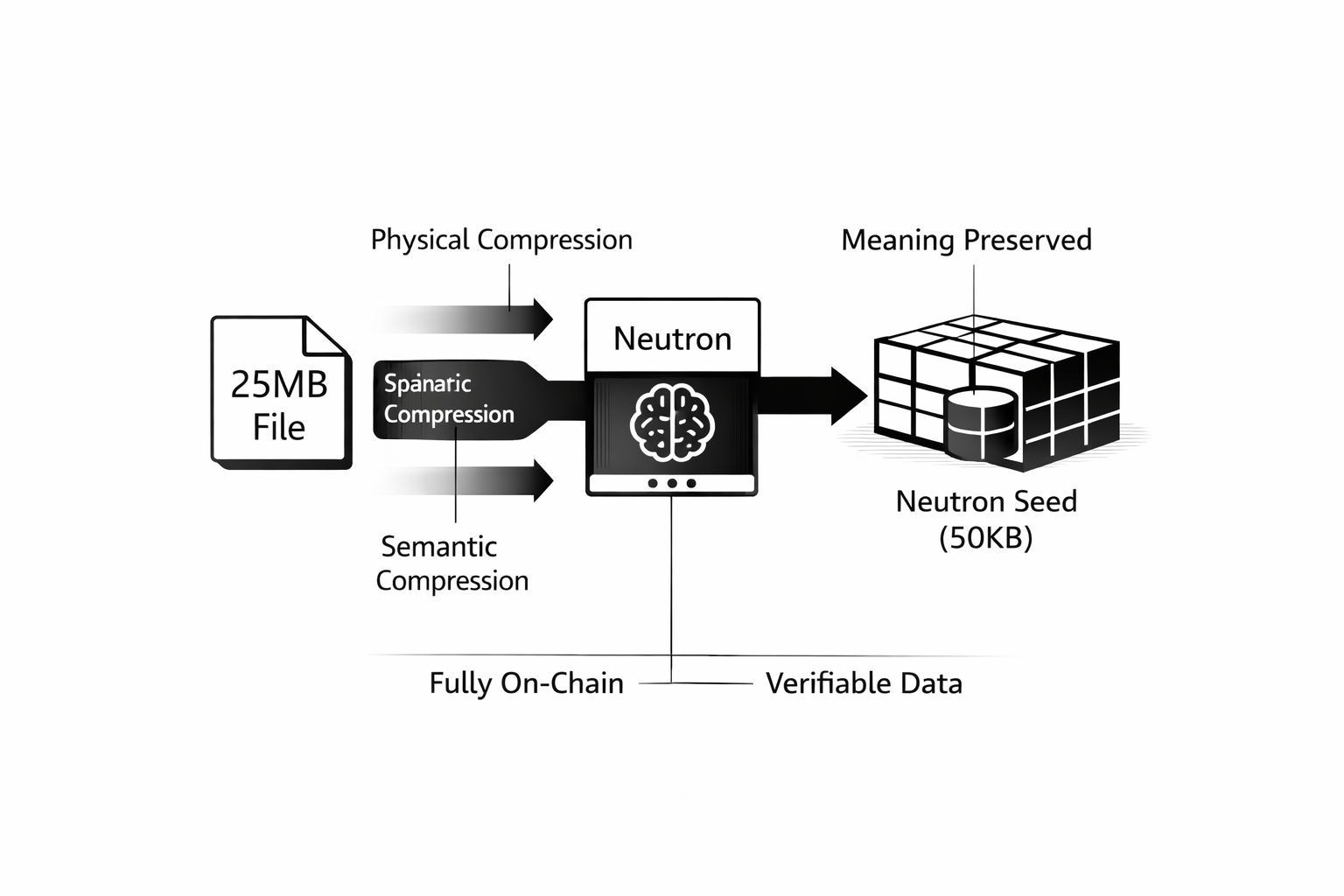
What distinguishes Neutron from conventional compression is that it operates on two levels: physical compression, which reduces raw file size, and semantic compression, which preserves and encodes the meaning of the data itself. This allows not only storage, but also verification and querying of information directly from the blockchain state. From an infrastructure perspective, this turns the blockchain into more than a transaction ledger. It becomes a data substrate—capable of holding documents, media, and machine-readable information in a trustless and durable form.
This design directly addresses a long-standing trade-off in blockchain systems: cost versus permanence. By achieving extreme compression ratios, Vanar reduces the economic burden of on-chain storage while maintaining verifiability. The implications are particularly relevant for AI-driven systems. Models and agents require reliable memory and verifiable inputs. Off-chain data introduces uncertainty; on-chain, authenticated data provides a stable foundation for reasoning and automation.
The $VANRY token functions as the economic and governance layer of the network. It is used to pay for computation, data storage, and validation services, aligning resource usage with network incentives. Governance mechanisms allow token holders to participate in decisions related to protocol upgrades, parameter changes, and long-term direction. In this model, control over infrastructure evolution is distributed among stakeholders rather than centralized operators. The token’s role is infrastructural rather than speculative: it exists to coordinate resources, secure the network, and enable participation in governance.
Vanar’s data-centric architecture opens several practical applications. AI agents can maintain persistent, verifiable memory on-chain. DeFi applications can attach auditable documents and records directly to financial contracts. Tokenized real-world assets can embed original legal or technical documents on-chain rather than relying on external references. DAOs can preserve immutable governance records—proposals, discussions, and decisions—without dependence on third-party storage. In each case, the underlying benefit is the same: reducing external dependencies while strengthening trust guarantees.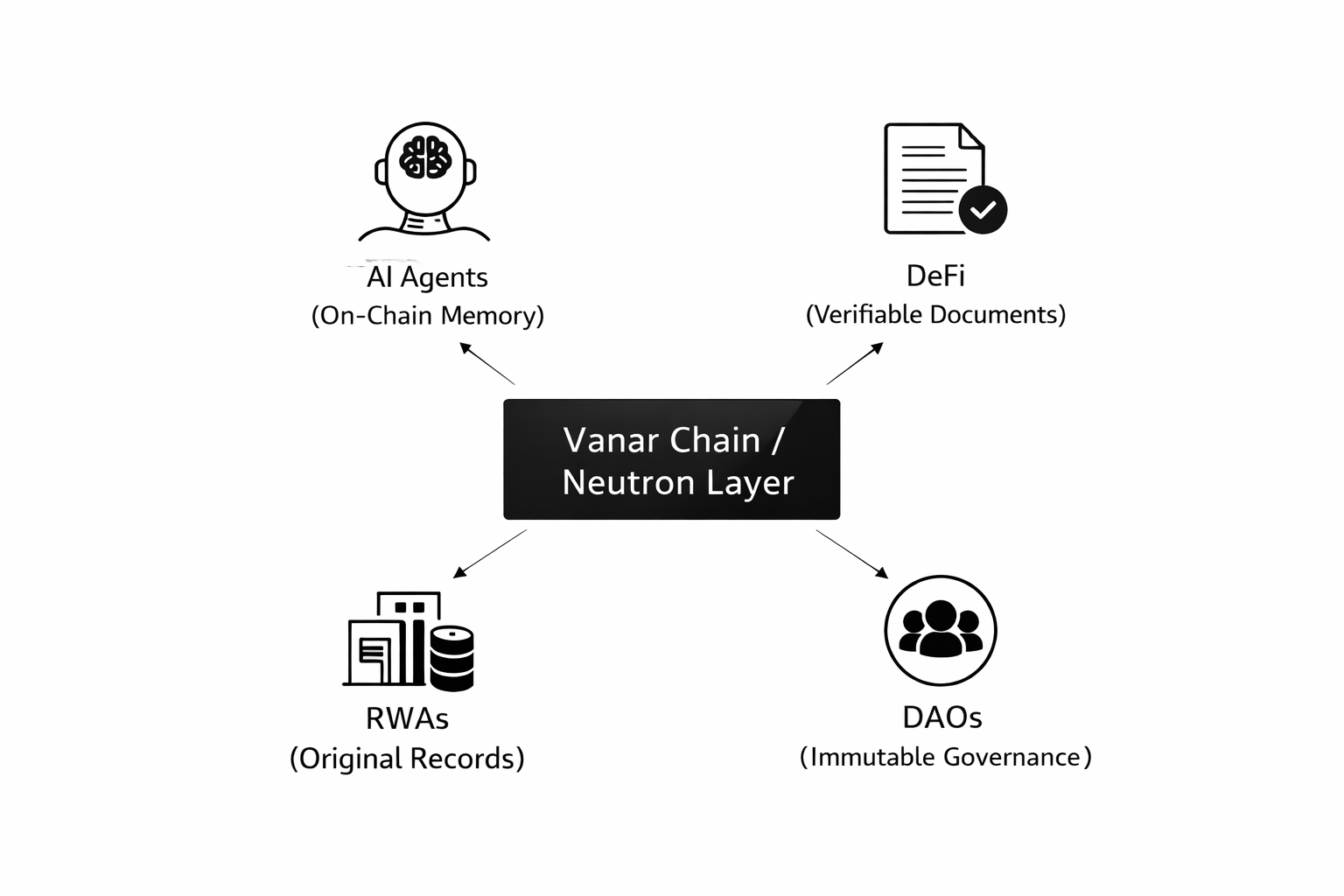
At the same time, this approach carries real risks and trade-offs. On-chain storage, even when compressed, increases protocol complexity and introduces new attack surfaces. AI-based compression systems must be rigorously validated to ensure determinism and long-term reproducibility. Adoption is another open question. The benefits of this model only materialize if developers choose to build with these primitives and users demand the guarantees they provide.
Viewed over the long term, Vanar Chain’s design reflects a broader shift in Web3 infrastructure thinking. As blockchain applications expand into data-heavy domains such as AI, gaming, digital identity, and real-world assets, the limitations of off-chain dependence become harder to ignore. By treating data as a first-class citizen of the blockchain, Vanar explores a path toward assets whose existence and meaning are inseparable from the ledger itself. Whether this model becomes standard remains uncertain, but the questions it raises about trust, permanence, and infrastructure independence are likely to shape the next phase of blockchain design.
@Vanarchain #Vanar #vanar $VANRY
