

In crypto, we’ve seen this story repeat itself many times.
A new chain launches.
Big promises follow.
Buzzwords fly around “scalable,” “fast,” “next-gen.”
But when builders arrive, they hit friction.
When users show up, fees spike.
And when enterprises look closer, transparency and compliance fall apart.
@Vanarchain is quietly taking a different route.
Instead of chasing hype, Vanar focuses on something much more difficult: building practical infrastructure that actually works at scale and making it accessible through full EVM compatibility.
Let’s unpack what that really means for developers, businesses, and everyday users.

What EVM Compatibility Really Unlocks on Vanar
EVM compatibility isn’t just a technical checkbox.
It’s a bridge between innovation and adoption.
By supporting the Ethereum Virtual Machine, Vanar allows developers to deploy existing Solidity smart contracts directly onto Vanar with minimal changes. That means:
Ethereum tools work out of the box
MetaMask connects seamlessly
Hardhat, Remix, Truffle already supported
Existing dApps can migrate without rewriting everything
For builders, this removes months of development friction.
Instead of learning a brand-new environment, teams can use what they already know — but run it on a chain optimized for speed, cost efficiency, and enterprise-grade performance.
This is how real ecosystems grow: not by forcing developers to start from zero, but by meeting them where they already are.
Lower Costs, Faster Execution, Same Ethereum Logic
Ethereum set the standard for smart contracts.
But it also brought congestion, unpredictable fees, and slow confirmation times.
Vanar keeps Ethereum’s proven execution model while solving its biggest operational problems.
On Vanar:
Transactions finalize faster
Fees remain consistently low
Network congestion is drastically reduced
Performance stays stable even during peak demand
For users, this means smoother experiences.
For developers, predictable costs.
For businesses, reliable infrastructure.
EVM compatibility on Vanar doesn’t copy Ethereum it improves on it.
Built for Real Utility, Not Just DeFi Experiments
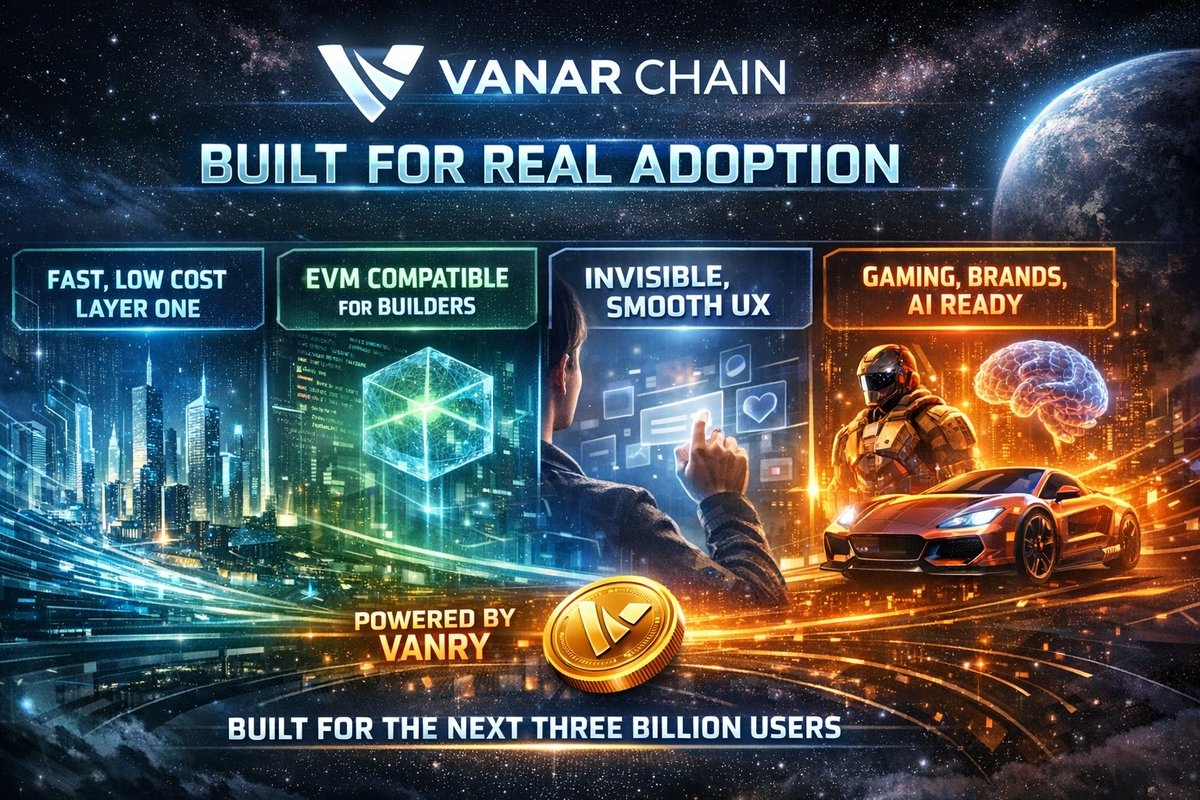
Most EVM chains mainly attract DeFi clones.
Vanar is aiming far wider.
The network is designed to support:
Gaming economies
NFT platforms with high transaction volume
Enterprise applications
Digital identity systems
AI data pipelines
Metaverse infrastructure
Real-world asset tokenization
These aren’t theoretical ideas. Vanar is actively positioning itself as a foundation layer for next-generation digital experiences.
Gaming studios can deploy smart contracts for in-game assets without worrying about gas spikes.
Brands can build NFT campaigns without exposing users to complex wallet interactions.
Enterprises can leverage blockchain transparency while keeping operational efficiency.
This is where EVM compatibility becomes powerful: it lets familiar Ethereum tooling power entirely new industries.
Transparency by Design
One of Vanar’s strongest points is its transparent architecture.
Every transaction is verifiable.
Every smart contract is auditable.
Every interaction leaves an on-chain footprint.
But transparency doesn’t mean sacrificing performance or user experience.
Vanar balances both.
Developers can build applications that are:
Fully on-chain and traceable
Compliant-friendly for institutions
Easy to audit
Simple for users to interact with
This matters because mass adoption won’t come from anonymous experiments alone. It comes when companies, creators, and communities can trust the underlying system.
Vanar understands that.
Why $VANRY Matters in This Ecosystem
$VANRY isn’t just a speculative token.
It’s the operational fuel of the network.
VANRY is used for:
Gas fees
Smart contract deployment
Network participation
Ecosystem incentives
Validator operations
As EVM-based apps grow on Vanar, demand for $VANRY naturally increases because every transaction, deployment, and interaction relies on it.
Instead of artificial hype cycles, Vanar’s token utility is directly tied to real network activity.
That’s how sustainable ecosystems are built.
Seamless Migration for Existing Ethereum Projects
One of the most underrated advantages of Vanar’s EVM compatibility is migration simplicity.
Projects already running on Ethereum can:
Port contracts with minimal changes
Keep existing logic intact
Maintain familiar dev workflows
Instantly benefit from lower fees and higher throughput
This gives startups and established protocols an easy path to scale without rebuilding from scratch.
For many teams, Vanar becomes a natural extension of Ethereum not a replacement, but an upgrade.
A Chain Built for Builders First
Vanar’s approach feels refreshingly builder-centric.
Instead of flashy marketing, the focus is on:
Developer documentation
Infrastructure stability
Tooling support
Real partnerships
Long-term scalability
This signals maturity.
The strongest blockchains aren’t the loudest ones.
They’re the ones developers quietly choose to build on.
Vanar is positioning itself exactly there.
Final Thoughts
EVM compatibility is often treated as a feature.
On Vanar Chain, it’s a strategy.
It connects Ethereum’s massive developer ecosystem with Vanar’s scalable, low-cost, high-performance infrastructure. It enables real applications beyond speculation. It supports transparency while maintaining usability.
Most importantly, it gives builders freedom.
Freedom to innovate.
Freedom to scale.
Freedom to create products that actually reach users.
As adoption grows, VANRY becomes more than a token it becomes the backbone of a network designed for real-world utility.
Vanar isn’t trying to reinvent blockchain.
It’s refining it.
And sometimes, that’s exactly what the space needs.