


On Dusk, nothing explodes when you don’t explain something.
A close settles. Moonlight keeps the view tight. Committees attest. Phoenix keeps producing blocks. The ticket moves to “done” with the same three artifacts it always does: an attestation reference, a timestamp, and the line that passes review without friction.... cleared within scope.
That’s enough to ship.
No one asks for more, because the last few times no one needed more.
At first, the silence is intentional. You don’t explain because you can’t without widening who’s allowed to see what. The boundary is real. The constraint is doing work. The release controller closes the template, leaves classification / rationale blank, and nobody pushes back because nothing failed and nothing looks fragile.
The next close lands the same way. Then another.
The rationale field keeps getting skipped, not by policy, but by rhythm. Nothing broke. There’s no incident number forcing a sentence into existence. The explanation still exists, but only where it was seen, in a Dusk credential-scoped view, during a committee discussion, inside a meeting that ended with “looks good” and no notes.
Then a review ping lands from someone who wasn’t on the viewer set.
“Can you summarize the rationale for clearance?”
You stare at the ticket like it might grow a sentence.
It doesn’t.
Just outcomes. Just links. Just within scope.
Someone starts drafting an answer in the thread. Deletes the line that mentions why. Keeps the part that’s safe. Pastes the attestation reference again. Adds a timestamp. Ends with “cleared within scope,” like repetition can do the job.
It can’t.
The reviewer asks the next question, the only one that matters:
“Okay, but what rule made it admissible?”
Now the room stalls.
Not because anyone doubts the state. Because the words that would make it legible don’t belong to this audience. The people who were there remember. The people who weren’t have nothing to read. And nobody wants to be the person who widens entitlements just to make a sentence forwardable.
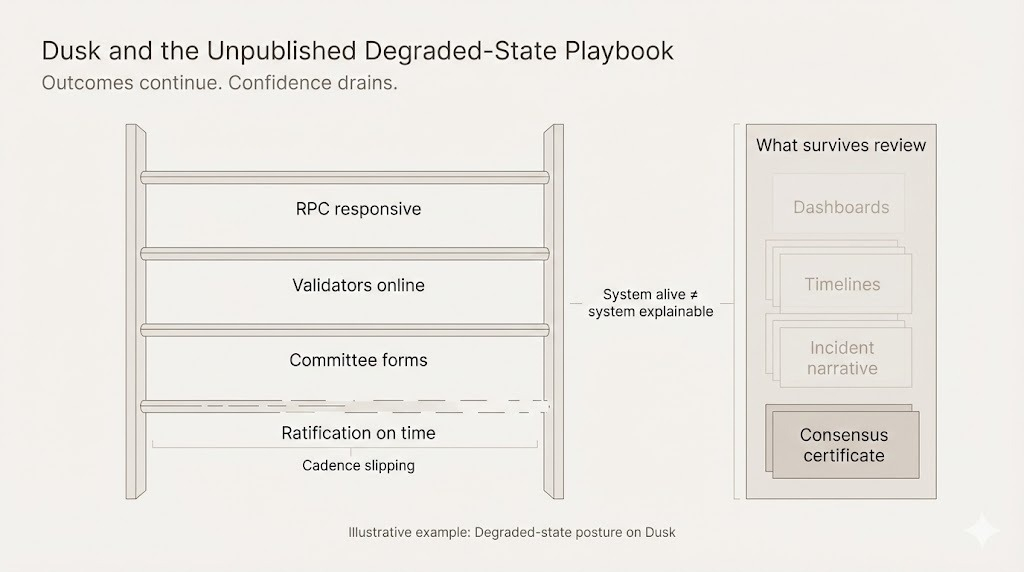
Someone suggests escalation. Someone else asks if legal should be added. A third pings the disclosure owner with the cheapest request they can phrase: “Any ticket-safe language we can use here?”
Minutes pass. Finality doesn’t move.
The disclosure owner replies with something that will survive review and disappoint everyone: a thin line, scoped on purpose. Accurate. Incomplete. It closes the ticket without closing the question.
That’s when you feel the debt.
Not on-chain. Not in ops. In the time it takes to re-walk a thing that already happened, because nobody saved a portable explanation when it would’ve been cheap.
Next cycle, the change shows up without an announcement.
That class of action stops running near cutoff on Dusk. Anything that might trigger a “what rule” question gets pre-cleared earlier, while the right people are still in the room and scope decisions are still reversible. The close-out template still ships thin, but the decisions migrate upstream so you don’t end up begging for words after the state is already done.
Nothing gets written down. No rulebook update. Just a new rhythm.
The next close is already in flight.
The template opens again.
Classification / rationale is still empty.
And the review inbox is already refreshing.