
In an industry where token economics are often driven by emissions, incentives, and short-term narratives, Vanar is taking a fundamentally different path. The $VANRY buyback and burn program is not a cosmetic mechanism designed to influence price—it is the structural engine behind a new, sustainable token economy.
This is not about speculation.
This is about economic discipline.
The Philosophy Behind $VANRY Buybacks
Most Web3 projects distribute tokens first and search for utility later. Vanar reverses that order.
Vanar is building real infrastructure across:
AI-driven services
Enterprise-grade applications
Scalable blockchain tooling
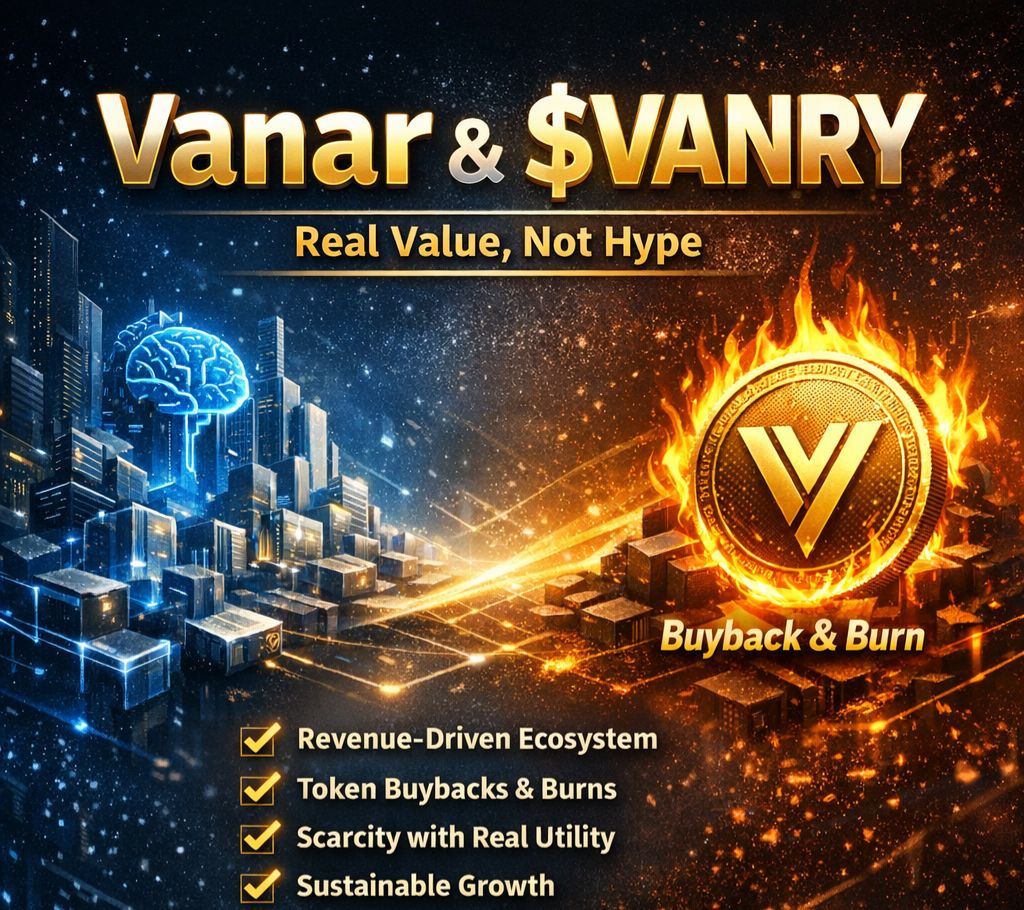
As this ecosystem generates real protocol revenue, a portion of that value is systematically routed back into the $VANRY economy through buybacks.
This creates a closed-loop system:
Usage generates revenue
Revenue funds buybacks
Buybacks reduce circulating supply
Reduced supply strengthens long-term value alignment
This is how mature financial systems behave. Vanar is applying that logic natively to Web3.
Buybacks and Burns as Infrastructure, Not Marketing
What makes Vanar’s approach stand out is intentional design.
The buyback program is not discretionary hype—it is embedded into how the ecosystem scales. As more builders, enterprises, and AI-powered platforms deploy on Vanar, the economic throughput of the network increases. That growth directly benefits the token economy rather than diluting it.
Burns, when applied, act as permanent supply reduction, reinforcing scarcity based on actual demand—not artificial narratives.
This aligns incentives across:
Builders who drive adoption
Users who rely on the network
Long-term holders who believe in fundamentals
No extractive middle layer.
No inflation-first model.
Just value recycling back into the ecosystem.
Why This Matters in a Crowded Market
The crypto market is saturated with chains that promise growth but rely on constant issuance to maintain momentum. That model works—until it doesn’t.
Vanar is positioning $VANRY as:
A representation of network participation
A claim on ecosystem value creation
A long-term asset backed by real economic activity
This is especially important as AI and enterprise workloads demand predictable costs, trust, and sustainability. Institutions don’t adopt ecosystems that erode their own economic base.
Vanar understands this.
Vanar as an Economic Layer
The $VANRY buyback program is not an isolated event—it’s a signal.
It signals that Vanar sees itself not just as a blockchain, but as an economic layer where:
Revenue matters
Incentives are balanced
Growth compounds instead of dilutes
As more applications go live and more value flows through the network, the feedback loop strengthens. The protocol doesn’t chase liquidity—it earns it.
Final Thought
Anyone can launch a token.
Anyone can promise utility.
Very few can design an economy that sustains itself.
Vanar is doing the hard part aligning infrastructure, revenue, and token value into a single coherent system. The $VANRY buyback and burn mechanism isn’t a headline—it’s a foundation.