

Most Layer 1 blockchains started from a broad ambition. They wanted to be general purpose systems where anything could be built, from games to NFTs to complex financial instruments. Stablecoins arrived later and were expected to fit into architectures that were never really shaped around payments. Over time, this mismatch became obvious. Stablecoins are not speculative assets. They are used for settlement, salaries, remittances, treasury flows, and everyday transfers. They demand consistency, neutrality, and reliability in ways that most chains struggle to deliver.
Plasma starts from a much narrower and more honest premise. It is a Layer 1 blockchain built specifically for stablecoin settlement. Instead of trying to optimize for every possible use case, it optimizes for how digital dollars actually move in the real world.
One of the clearest signals of this focus is Plasma’s decision to remain fully EVM compatible while rethinking everything around execution and finality. Using Reth as its execution layer means developers are not forced into a new environment. Existing tooling, smart contracts, and developer habits carry over naturally. This lowers friction for builders and shortens the path from idea to production. However, Plasma does not stop at compatibility. It pairs the EVM with PlasmaBFT, a consensus mechanism designed to deliver sub-second finality. For stablecoin settlement, this combination matters more than headline throughput numbers. Payments need to feel immediate and conclusive. When a transfer is sent, users need confidence that it is final, not pending behind probabilistic confirmations.
Finality at this speed changes behavior. Merchants do not need to wait. Treasury systems do not need complex monitoring logic. Payment processors can treat onchain settlement as a reliable backend rather than a best-effort system. Over thousands or millions of transactions, that certainty becomes operational savings.
Plasma also introduces features that directly reflect stablecoin usage patterns. Gasless USDT transfers are a good example. In many high-adoption markets, users hold stablecoins but do not necessarily hold native gas tokens. Requiring an extra asset just to move money adds friction and explains why many real users rely on custodial services. Gasless transfers remove that barrier. Users can send stablecoins as money, not as a crypto workflow.
Stablecoin-first gas follows the same logic. Instead of forcing every interaction to be priced in a volatile native token, Plasma allows fees to be paid in stablecoins. This keeps costs predictable and aligns incentives with how users already think. A payment system where fees fluctuate wildly undermines trust. A system where fees are stable feels closer to traditional financial infrastructure, but without sacrificing onchain transparency.
Security is another area where Plasma takes a deliberate stance. By anchoring security to Bitcoin, the design aims to increase neutrality and censorship resistance. Bitcoin’s security model is not optimized for speed, but it is unmatched in terms of political and economic neutrality. Anchoring Plasma to this base layer is less about raw performance and more about credibility. For a settlement layer handling real economic activity, the question is not just whether it works today, but whether it remains trustworthy under pressure. Bitcoin anchoring is a signal that Plasma prioritizes long-term guarantees over short-term convenience.
This matters for institutions as much as for retail users. Payment companies and financial firms care deeply about neutrality. They need assurance that settlement infrastructure cannot be arbitrarily changed or influenced. At the same time, retail users in high-adoption regions care about availability and cost. Plasma’s design speaks to both groups by separating execution speed from security anchoring, rather than forcing a trade-off between them.
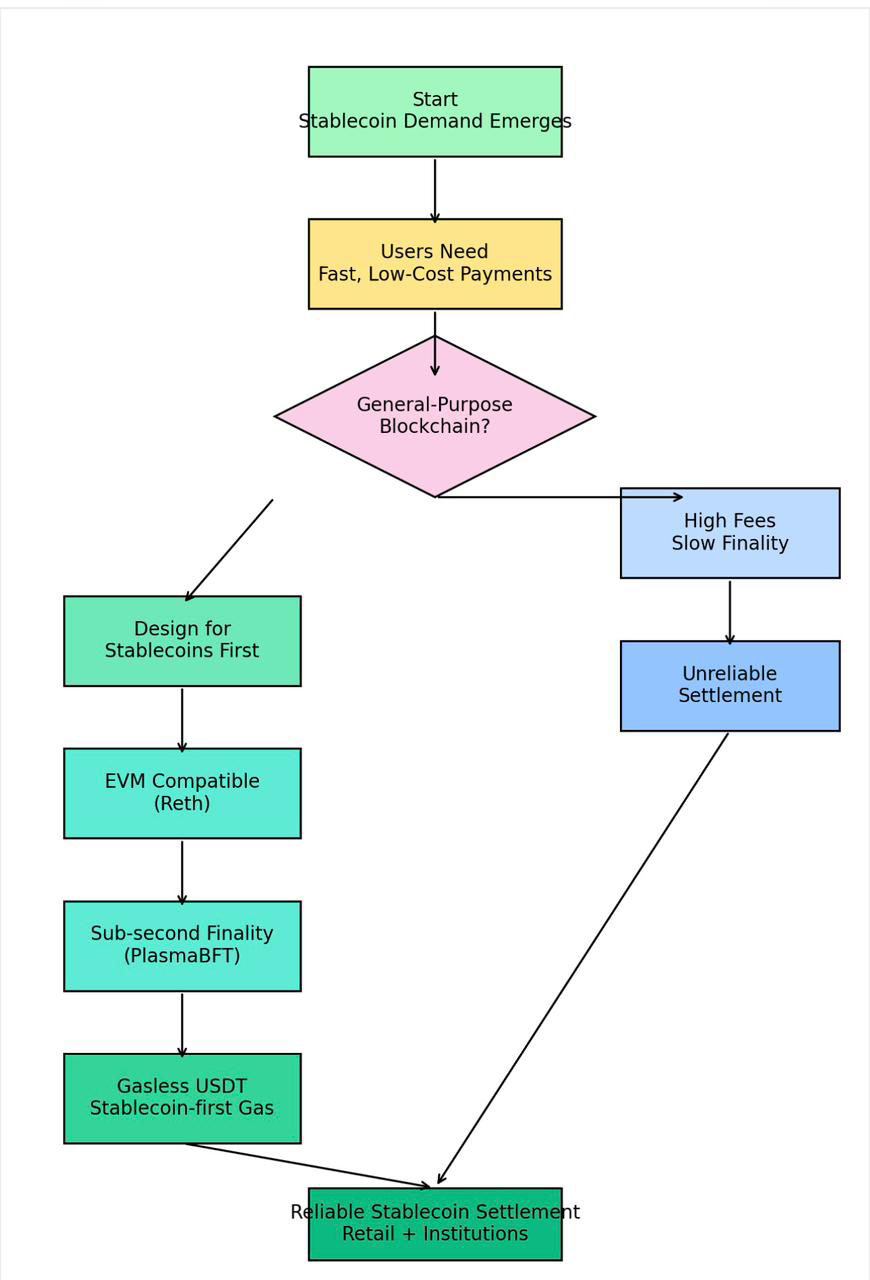
The target user base reflects this dual focus. In high-adoption markets, stablecoins are already used as everyday money. People use them to store value, send remittances, and pay for services. These users need a system that works under load, keeps fees low, and does not require constant technical management. Plasma’s stablecoin-centric design directly addresses those needs.
On the institutional side, the requirements are different but compatible. Institutions need predictable settlement, clear finality, auditability, and strong security assumptions. They also need integration with existing EVM-based systems and workflows. Plasma’s architecture allows institutions to interact with stablecoins onchain without redesigning their entire stack. Over time, this creates a bridge between retail-driven usage and institutional-grade settlement.
What stands out most about Plasma is not any single feature, but the discipline behind its design. Every major choice points back to one core question: how should a blockchain behave if stablecoins are the primary workload, not a side effect. By answering that question consistently, Plasma avoids many of the compromises that emerge in more generalized systems.
My take is that this kind of specialization is not a limitation. It is a recognition that the market has matured. Stablecoins are no longer an experiment. They are already one of the most successful products in crypto, moving trillions of dollars each year. Infrastructure that treats them as first-class citizens will quietly become more important than chains that chase the widest possible narrative. Plasma feels aligned with that reality. It is not trying to redefine money. It is trying to make digital money work the way people already expect it to.

