
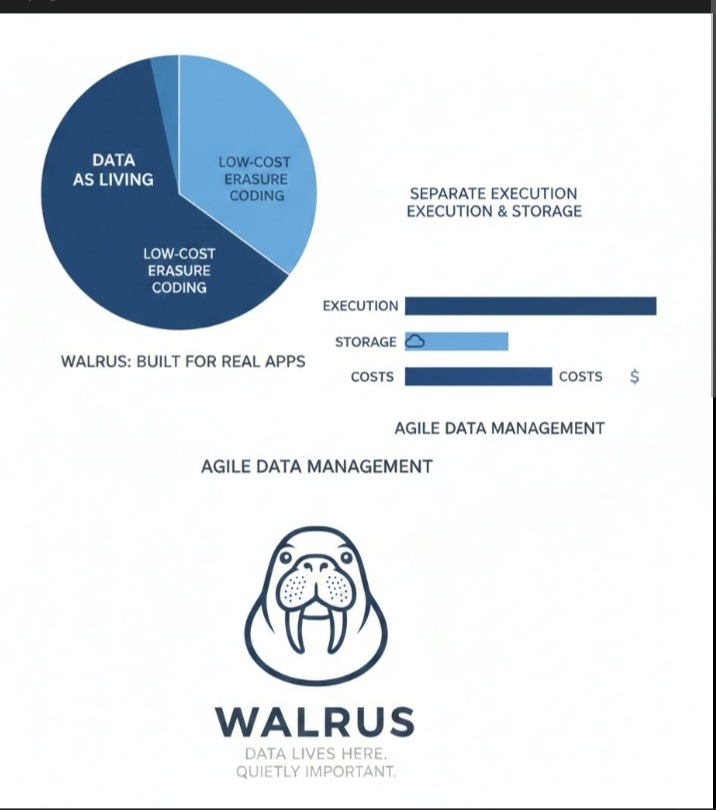
 Walrus ($WAL) is a decentralized storage and data-availability protocol built on the Sui blockchain, specifically designed to handle large, unstructured data blobs like AI datasets, media files, and archives.
Based on recent market activity as of early 2026, here is an overview of the $WAL "money flow" and accumulation trends:
🐋 Data Flow & Accumulation Analysis
Gradual Accumulation: Recent 15-minute trading data indicates a positive inflow, suggesting more money is entering the market than leaving, even during price pullbacks.
Whale Activity: While large, institutional-level, orders have been quiet, "stealthy" or, more accurately, steady accumulation is observed from medium and small traders.
Market Sentiment: Despite broader crypto market volatility, the "green" (buying) areas in trading charts have recently been stronger than "red" (selling) areas, indicating sustained interest.
Volume Drivers: The recent price activity is supported by campaigns like the Binance CreatorPad, which incentivized trading and social engagement.
$WAL Token FundamentalsPurpose: $WAL is used to pay for storage, stake to secure the network, and participate in governance.
Supply Dynamics: The maximum supply is 5 billion tokens. The protocol includes a deflationary mechanism that burns tokens through "churn fees" and slashing penalties for underperforming nodes.
Staking: Users can delegate their stake to storage nodes, earning rewards and securing the network.
Positioned as a "data vault" for Web3 and AI, filling the gap for efficient, scalable, and decentralized storage.
Uses a unique encoding algorithm called "Red Stuff" to break data into small, manageable pieces (slivers) for faster access and high resiliency.
While facing high competition and volatility typical of new altcoins, its focus on on-chain data ownership has gained attention.