
Most Web3 products don’t die in dramatic ways.
There’s no exploit. No chain halt. No angry post-mortem thread.
They just… empty out.
A button stops responding.
An image takes too long to load.
A feed feels slightly unreliable.
And users don’t complain. They leave.
That’s the part Web3 still underestimates: retention is not ideological. Users don’t stay because something is decentralized. They stay because it works every single time, especially when the network is under stress.
This is where infrastructure stops being abstract.
If your chain finalizes perfectly but the content it points to disappears, the user experience still collapses. From the outside, it doesn’t matter where the failure happened. The product feels broken.
That’s not a storage problem.
That’s a product trust problem.
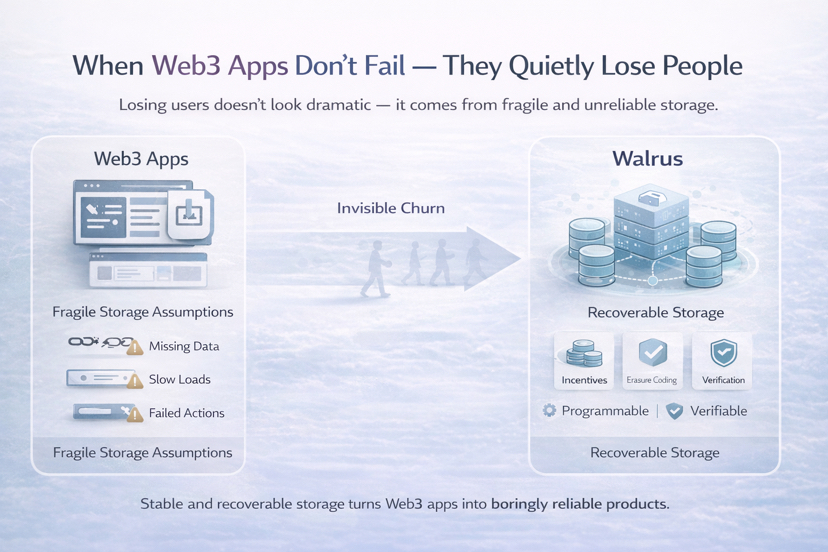
Walrus is interesting because it doesn’t treat storage as an accessory. It treats it as state that must behave predictably under pressure.
Most decentralized storage systems optimize for existence: is the data somewhere, yes or no. Walrus optimizes for something more subtle availability over time, with incentives that don’t assume perfect conditions.
Nodes churn. Networks stall. Reads collide with repairs. Real systems degrade. Walrus is designed around that reality instead of pretending it won’t happen.
By encoding blobs in a way that prioritizes recoverability without brute-force replication, and by tying storage behavior directly to staking and verification, Walrus turns storage into something applications can reason about not just hope for.
That matters because modern Web3 apps aren’t just smart contracts.
They’re games. Media feeds. AI agents. Compliance flows. Tokenized assets.
In all of those, data isn’t content it’s continuity.
When storage lives offchain with fragile assumptions, the app inherits that fragility. When storage becomes programmable, verifiable, and economically enforced, the app gains something rare in Web3: boring reliability.
That’s how infrastructure actually wins.
Not by being visible.
Not by being exciting.
But by quietly removing reasons for users to leave.
This doesn’t automatically create token demand. It doesn’t guarantee price action. And it doesn’t solve governance or distribution by itself.
What it does is remove one of the biggest sources of silent churn the kind no dashboard alerts you to until it’s too late.
If Walrus succeeds, it won’t be because people talk about decentralized storage more.
It’ll be because fewer Web3 apps feel flaky.
And in a space where trust erodes silently, that’s how something becomes backbone infrastructure not by narrative, but by staying invisible when everything else is under stress.