
For years, digital advertising has been plagued by hidden fees, opaque measurement, slow payments, and rampant fraud. Alkimi — a decentralized advertising platform — aims to address these problems by moving the entire advertising supply chain on-chain. At the heart of this transformation is Walrus, a scalable on-chain data layer designed to store and make advertising data transparent, verifiable, and audit-ready. 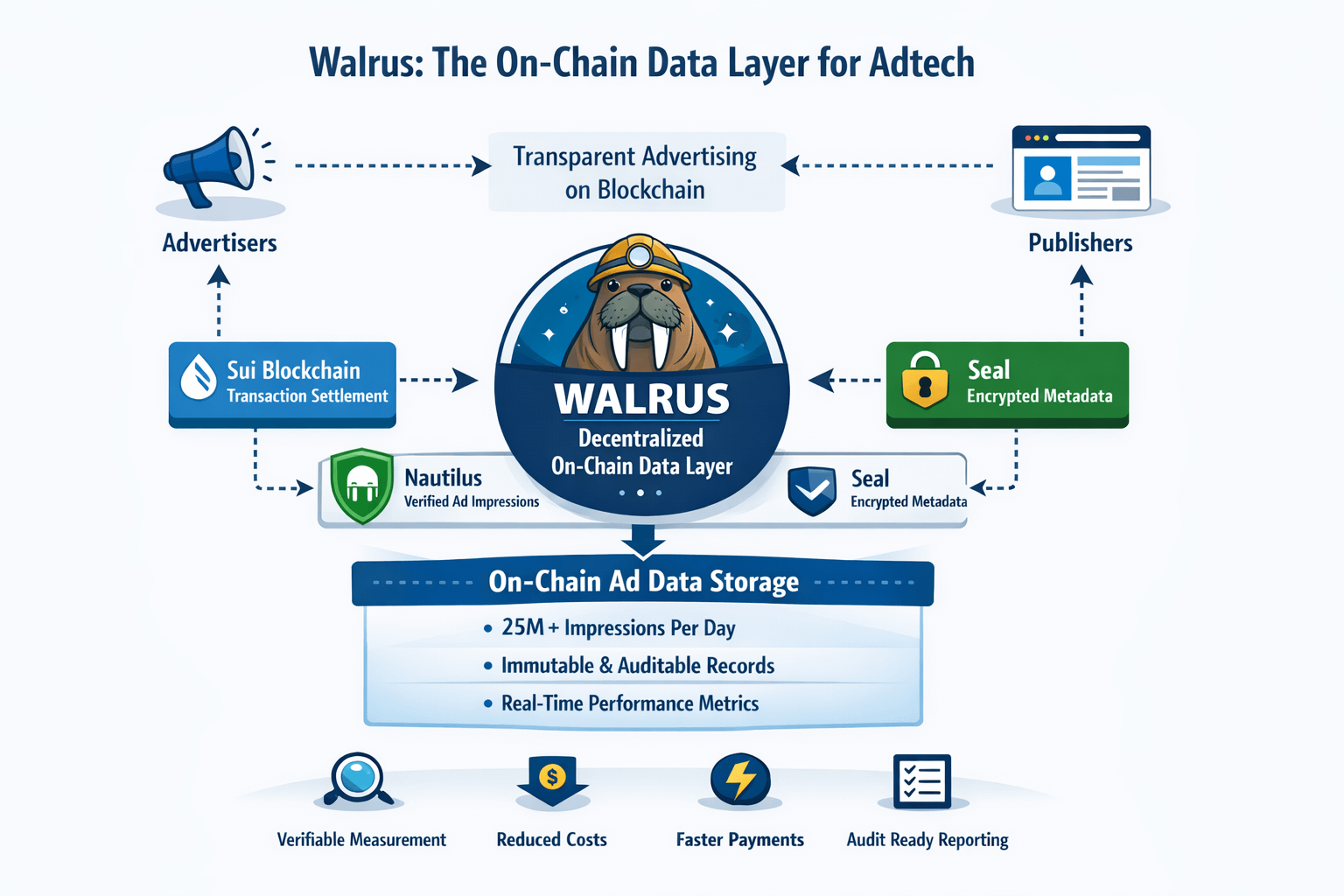
Why Data Infrastructure Matters in Advertising
Traditional adtech depends on centralized servers and third-party tracking systems to store and report impressions, clicks, and conversions. These systems:
generate opaque performance metrics,
delay reconciliation between advertisers and publishers,
and create opportunities for fraud and discrepancies that are hard to resolve.
Alkimi’s approach is to eliminate these issues by recording advertising data directly on a blockchain, where it can be independently audited and freely verified without intermediaries.
Walrus is the technology that makes this possible at scale.
What Walrus Is
Walrus is a decentralized data storage layer built as part of the Sui blockchain stack — the same suite of technologies that power Alkimi’s on-chain advertising infrastructure.
Unlike traditional adtech data systems where logs are stored behind closed doors, Walrus puts large volumes of ad impression and performance data directly on-chain. This makes the data transparent, immutable, and auditable, enabling advertisers and publishers to verify outcomes without trusting a centralized operator.
Key facts about Walrus in the context of Alkimi:
Large-Scale On-Chain Storage: Walrus currently supports over 25 million ad impressions per day recorded on chain, demonstrating real-world scalability for high-volume advertising workloads.
Transparent Performance Tracking: Recording impressions on-chain allows both advertisers and publishers to directly audit delivery and performance metrics without reconciling multiple off-chain reporting feeds.
Cost-Effective Infrastructure: Walrus is designed to be more cost-efficient and scalable than legacy centralized data storage systems, helping ensure that the underlying data layer doesn’t become a bottleneck even as ad volumes grow.
How Walrus Enables Transparency and Trust
Walrus works in concert with other components in Alkimi’s stack:
Sui blockchain handles transaction settlement and coordination.
Nautilus independently validates ad impressions in secure environments and feeds this verified data into Walrus.
Seal encrypts sensitive metadata and controls access to the data stored in Walrus, ensuring confidentiality alongside transparency.
By anchoring both ad performance data and reconciliation logic on-chain, Walrus allows every party in the advertising ecosystem to verify the same source of truth rather than relying on proprietary dashboards or third-party trackers.
Why On-Chain Storage Is a Game Changer
Putting ad impression data on a public, decentralized ledger brings measurable advantages over legacy systems:
1. Verifiable Measurement
Advertisers and publishers can independently confirm that impressions were delivered and billed correctly, reducing disputes and reconciliation delays.
2. Reduced Intermediary Costs
With transparent on-chain data, fewer middle-men are needed to generate reports or manage data pipelines, potentially lowering fees that often consume a large slice of ad budgets.
3. Faster Settlements
Because data on Walrus is final and shareable, financial settlements between advertisers and publishers can happen more quickly and with less dispute.
4. Better Auditability
Walrus enables audit-ready advertising performance records that can be independently examined — a stark contrast to black-box reporting of current programmatic systems.
Beyond Advertising: Walrus as a Decentralized Data Layer
Although its integration with Alkimi’s ad platform is a high-profile use case, Walrus itself is a general decentralized storage layer on Sui that can support other applications requiring large-scale on-chain data storage — such as content delivery, AI model storage, gaming assets, and more.
This positions Walrus as both a critical infrastructure piece for decentralized advertising and a foundational layer for broader Web3 data applications.
Challenges and Market Reception
While the technical promise of Walrus is significant, it exists in an ecosystem where adoption, tooling, and real-world demand will ultimately determine its success. Onchain storage systems like Walrus compete with legacy centralized providers and other decentralized storage protocols, and their long-term impact depends on performance, cost, and ecosystem growth.
Conclusion
Walrus is more than just a backend data store — it’s the on-chain foundation for transparent, verifiable advertising in Alkimi’s decentralized system. By recording billions of impressions in a publicly auditable ledger, Walrus enables advertisers and publishers to trust the same data, bypass opaque intermediaries, and settle outcomes fairly and efficiently. While wide industry adoption remains a work in progress, Walrus represents a significant step toward real transparency in an industry historically defined by hidden costs and unverifiable reporting.