
Dusk Network did not come into existence because the world wanted another blockchain, but because too many people inside finance felt something deeply uncomfortable that no one was naming out loud. By the time 2018 arrived, the cracks were impossible to ignore. Traditional finance was suffocating under its own weight, buried beneath paperwork, reconciliation delays, and systems that demanded total exposure as proof of honesty, while public blockchains swung to the other extreme, placing every action, balance, and relationship under permanent global surveillance. For people whose daily decisions carried legal, ethical, and human consequences, neither option felt safe. It was not fear of innovation that kept institutions away from crypto, it was fear of being reckless with other people’s futures. Dusk emerged from that emotional gap, from the quiet realization that progress without responsibility is not progress at all, and that any financial system claiming to serve the real world must first respect the people living in it.
What makes Dusk feel different is that it was built with an understanding of emotional weight, the kind that comes with signing documents that move millions, managing funds that represent decades of someone else’s labor, or enforcing rules that exist to protect societies even when they are unpopular. Instead of treating regulation as an enemy or an inconvenience, Dusk treats it as evidence that systems matter, that actions ripple outward, and that trust cannot be improvised. Its modular architecture reflects this mindset, acknowledging that laws change, markets evolve, and technology never stands still, so the foundation itself must be able to adapt without collapsing. This is not the architecture of impatience, but of endurance, designed to still make sense years later when the excitement fades and only reliability remains.
Privacy on Dusk does not feel like secrecy, and that distinction matters more than it seems. Using zero knowledge cryptography, the network allows transactions and smart contracts to be verified without exposing sensitive details, which means participants can prove correctness without surrendering identity, intent, or strategy. In a world where exposure is often mistaken for integrity, Dusk quietly reminds us that trust does not require humiliation. Financial privacy, when done right, protects not just institutions, but people, shielding them from front running, misinterpretation, and unnecessary scrutiny. There is something deeply human about that choice, because it aligns technology with how trust works in real relationships, where boundaries exist not to deceive, but to function.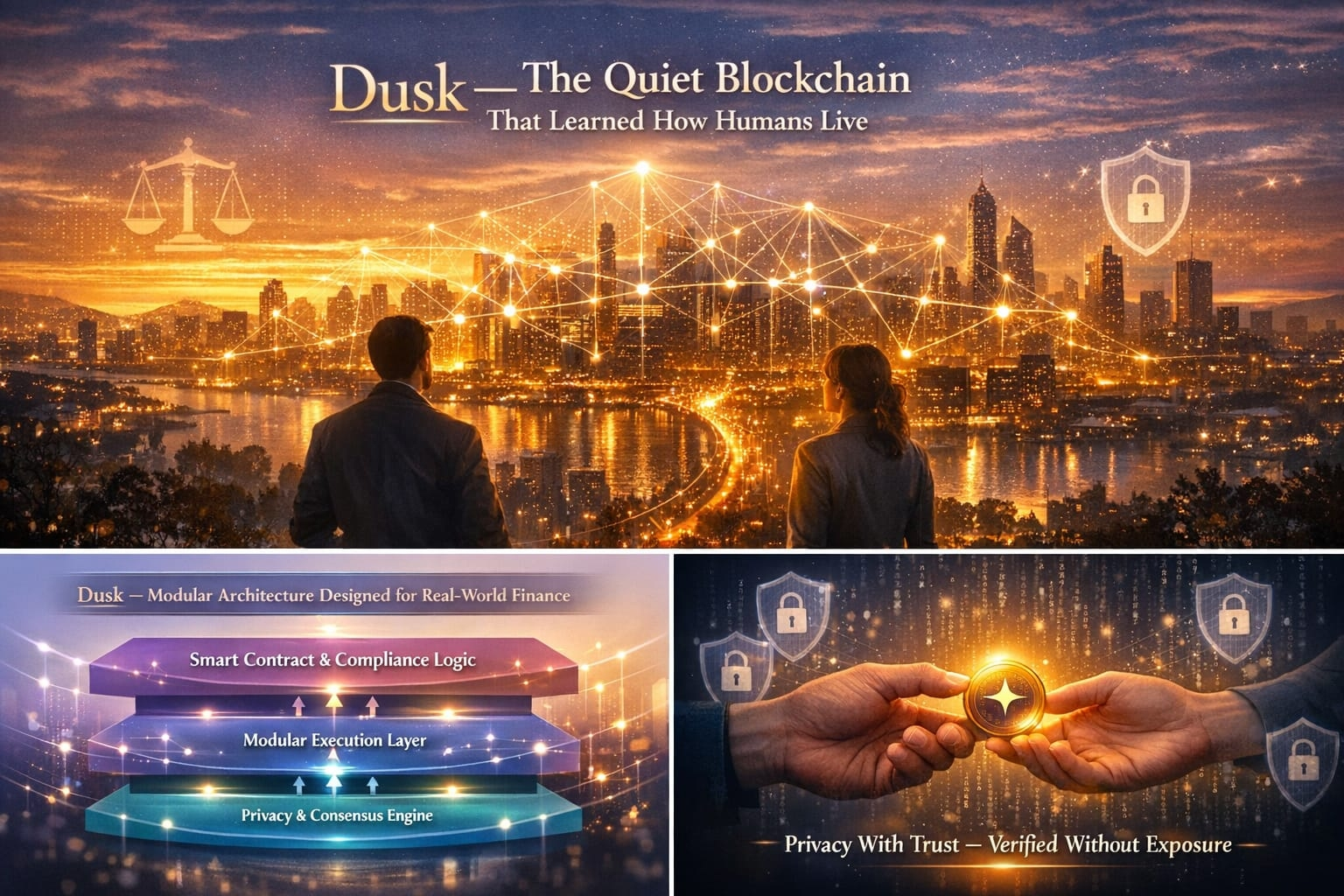
The way Dusk approaches consensus carries that same emotional intelligence. Its proof of stake model is designed to hold participants accountable without forcing vulnerability, aligning incentives through economic responsibility while allowing validators to operate without revealing information that could be exploited. This balance is critical in professional markets, where visibility can distort behavior and power dynamics. Dusk does not rely on blind faith, nor does it weaponize transparency. Instead, it builds quiet assurance into the system itself, allowing participants to trust outcomes without constantly watching each other, which is often the difference between a system that scales socially and one that collapses under suspicion.
Smart contracts on Dusk feel less like cold automation and more like agreements that understand consequences. Compliance is embedded directly into logic, allowing assets to carry rules about ownership, transferability, and disclosure, which makes the tokenization of real world assets not just possible, but sane. This matters because finance is not abstract. It touches pensions, salaries, housing, and opportunity. When systems behave predictably and within known boundaries, people sleep better. There is relief in knowing that rules are enforced by design rather than by endless manual checks, and Dusk leans into that relief, offering not just efficiency, but peace of mind.
Even the economics of the DUSK token reflect restraint. It is not designed to seduce crowds or manufacture urgency, but to quietly support the network through staking, fees, and governance. Rewards are structured to sustain participation rather than inflate excitement, and success is measured through stability, uptime, and trust instead of short lived price movement. In an industry that often feels emotionally volatile, this slower rhythm feels grounding, like infrastructure that continues working even when markets panic elsewhere. It may not thrill speculators, but it speaks directly to those who value continuity over adrenaline.
The ecosystem growing around Dusk mirrors this philosophy. It does not expand through noise or spectacle, but through necessity. Builders who choose Dusk often do so because they have run out of alternatives that respect their constraints. They are not chasing trends, they are solving problems that exist right now, in issuance, settlement, and compliant decentralized finance. This kind of growth is quieter and slower, but it is also sturdier. It creates depth instead of surface area, and over time that depth becomes resilience.
None of this makes Dusk immune to reality. Regulation is unpredictable, jurisdictions disagree, and educating the world about privacy preserving compliance takes patience in a market that rewards immediacy. Zero knowledge systems are complex and demand constant care, and being serious in a space addicted to spectacle is its own kind of risk. Yet Dusk continues forward, not because the path is easy, but because ignoring these challenges would be dishonest. There is courage in choosing the harder, slower road when the faster one leads somewhere hollow.
The future Dusk points toward is not loud. It is a future where finance feels less hostile, where privacy is respected without suspicion, and where compliance stops being a battle and starts being a feature of good design. It is a world where assets move efficiently without exposing the humans behind them, where trust is built into infrastructure rather than extracted through fear, and where innovation no longer demands recklessness as proof of ambition. Dusk does not promise to replace everything. It promises to make something essential feel safer, calmer, and more humane.
In a landscape defined by urgency, Dusk feels like a pause, a long breath taken before making decisions that matter. It reminds us that not all progress announces itself with noise, and that some of the most meaningful changes arrive quietly, by making life feel a little less tense and systems a little more fair. If the future of finance is meant to serve people rather than overwhelm them, then Dusk stands as a careful, patient attempt to build that future with respect, dignity, and a deep understanding of what it actually means to carry responsibility in the real world.
