
Most blockchains assume users will adapt to them.
They assume people will learn new terminology, tolerate strange UX, accept occasional failures, and mentally separate “this is broken” from “this is decentralized.” That assumption has quietly capped adoption for years.
Vanar seems to start from the opposite premise: systems should adapt to users, not the other way around.
That sounds obvious, but in crypto it’s almost heretical.
If you design for that premise, you stop treating volatility, congestion, and unpredictability as unavoidable side effects. You treat them as problems that need to be engineered around. Vanar’s architecture reflects that mindset at multiple levels, not through slogans but through constraint-based decisions.
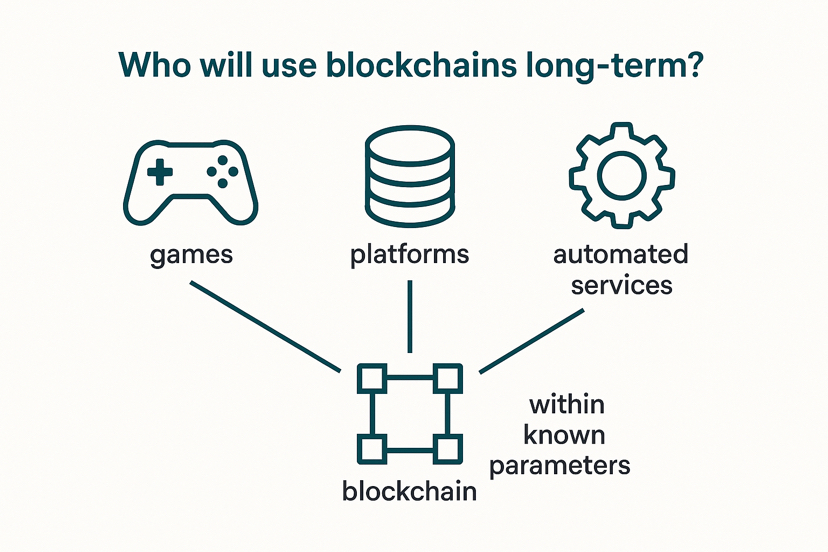
Consider who the real long-term users of blockchains will be. Not individuals manually signing transactions all day, but systems acting on their behalf: games executing logic continuously, platforms settling microtransactions, automated services reconciling state in the background. These systems don’t “opt in” to chaos. They either work within known parameters or they don’t deploy at all.
That’s where Vanar differentiates itself.
Transaction costs on most chains behave like a market experiment. Sometimes cheap, sometimes painful, always uncertain. Vanar treats fees as a known variable. The intention is not just affordability, but consistency. That makes the chain usable in planning, budgeting, and automation contexts where uncertainty is unacceptable.
This isn’t about winning benchmarks. It’s about making sure a system behaves the same way on a quiet Tuesday as it does during peak demand.
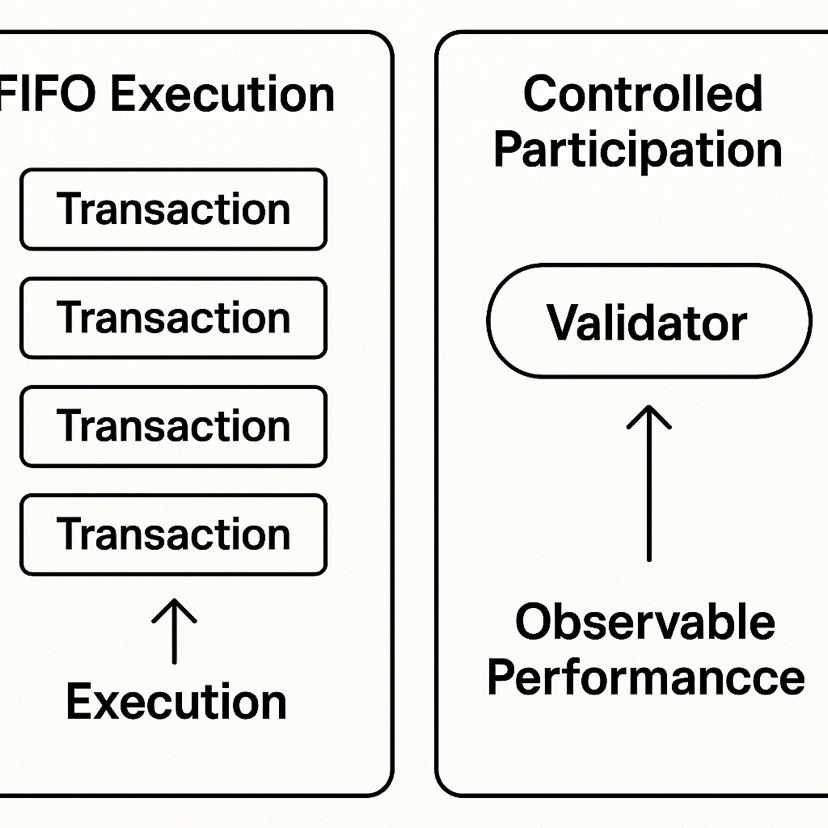
Execution ordering follows the same logic. By removing competitive bidding for transaction priority, Vanar strips out strategic behavior that machines can’t safely reason about. FIFO execution may sound mundane, but mundanity is exactly what large-scale systems need. Predictability beats cleverness when the goal is reliability.
The validator model reinforces this philosophy. Rather than maximizing openness immediately, Vanar prioritizes controlled participation and observable performance. Accountability exists before ideology. That choice may limit early narrative appeal, but it aligns with how real infrastructure earns trust.
Banks, payment processors, and content platforms don’t decentralize first and stabilize later. They stabilize first. Vanar’s sequencing suggests an awareness of that reality rather than a rejection of decentralization altogether.
What makes the design coherent is how it treats information itself. Most chains are excellent at immutability and terrible at usability. They record events but leave meaning fragmented across off-chain systems. Vanar’s focus on compressing and verifying contextual data suggests a different ambition: to act as a reference layer that applications can reliably query without reconstructing state from scratch.
That matters in environments where transactions are part of longer narratives—games, digital ownership, branded experiences, and eventually automated decision-making systems. Context isn’t optional there. It’s operational.
This is also where Vanar’s AI positioning feels grounded rather than promotional. Intelligence lives off-chain. Decision-making happens elsewhere. The blockchain’s role is to provide consistency, memory, and settlement guarantees. That’s a realistic division of labor, and one most AI-blockchain projects gloss over.
$VANRY sits inside this framework as an enabler, not a distraction. Its utility scales with system usage rather than hype cycles. Interoperability reinforces the idea that Vanar doesn’t expect to be the only environment users touch. It expects to be one they rely on, even as they move across ecosystems.
That expectation signals maturity.
The risk, as always, is execution. Predictability must hold under pressure. Governance must resist capture. Context layers must remain useful beyond demonstrations. But the direction is clear: Vanar is building for a future where blockchain is not something people argue about, but something systems quietly depend on.
If that future arrives, the winning infrastructure won’t be the loudest.
It will be the one that never asks for attention in the first place.