
You hear the payment sound.
The customer relaxes.
The cashier starts packing the bag.
Then the POS screen freezes.
On Plasma, this is the moment where you really understand what “after submission” means. By the time the freeze shows up, the USDT transfer may already be fully settled. PlasmaBFT might already have finalized it. The receipt exists. The timestamp is real. It doesn’t care that the loading spinner is still spinning.
The screen might still be “thinking,” but the chain is done.
The counter doesn’t care why the screen froze.
It only cares about one thing: has the money moved or not?
“Still processing,” the terminal says.
It sounds confident.
But it’s lying.
The customer asks the same question every time:
“Can I cancel it?”
Not really. Not in the way people usually mean cancel.
There’s no half-confirmed state you can roll back. If you want to undo it, you don’t reverse the transaction—you create a new one. A refund. Store credit. A manual fix. You work around the settlement, because the settlement already happened.
On Plasma, the chain has moved on.
So the real problems show up elsewhere: inventory counts, refunds, POS logic, end-of-day reports.
What confuses teams is how normal everything looks.
The receipt is clean.
The settlement log is clean.
But the cashier is staring at a UI that’s still pretending the payment is “pending.”
Now compare that to an Ethereum L2 during a busy hour.
The transaction submits.
The UI shows “processing.”
Sometimes it even flashes “confirmed,” because someone thought that word would reduce user anxiety.
Ops teams don’t trust it.
They don’t ask, “Did it go through?”
They ask, “Is this going to stay true?”
So staff waits. They refresh. They stall the handover. Over time, an unwritten rule forms: don’t release goods until the status stays boring for long enough. Two refreshes. An extra minute. Maybe a manager check.
Nobody writes this rule down. It just happens.
Not because L2s are bad—but because that softness appears at the worst possible moment: after submission, before booking, where retail has zero tolerance for ambiguity.
When an L2 checkout fails, it usually doesn’t look like a crash.
It looks like a sale that was real long enough for someone to act on it—and soft enough to be questioned later.
That’s how disputes are born.
That’s how stories start.
Because the receipt didn’t feel final when it mattered.
Plasma doesn’t give you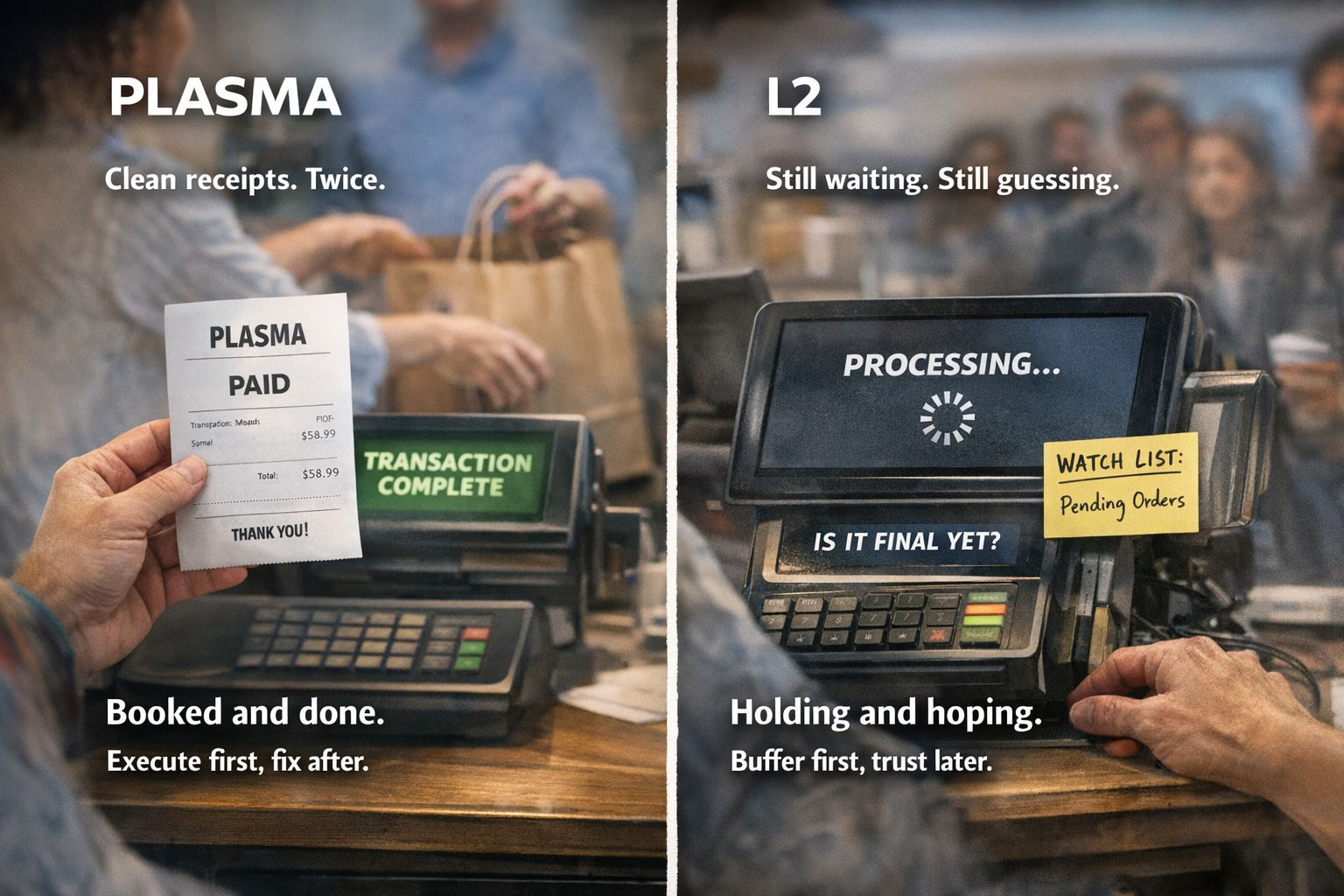
And if the POS auto-retries because the screen looks stuck, Plasma doesn’t “know” the system is nervous. It just executes what it receives. That’s how you end up with clean receipts… twice.
So the merchant failure mode on Plasma isn’t “will this revert?”
It’s “will our system double-act because the UI looked unsure?”
Different fear. Same counter.
On many L2 rails, “confirmed” still doesn’t mean “final enough for a merchant to sleep.” So teams keep a manual buffer alive—wait a bit, refresh, don’t release goods too fast.
On Plasma, that same buffer becomes the risk. It wants to exist out of habit, even though the rail doesn’t support it.
Because Plasma is EVM-familiar (Reth), teams ship integrations fast. The risky part is that the SOPs ship slower. You go live with old “pending” instincts on a system that doesn’t really have a pending state.
You see it on the first real rush day:
crowded Wi-Fi,
slow POS refreshes,
staff moving quickly,
customers staring at the spinner.
The chain is doing its job.
The wobble happens at the edge.
At close, it’s not a chart or a dashboard problem.
It’s a flagged sale,
a note in the register log,
and finance asking why the receipt says “paid” while the terminal screenshot still says “processing.”
On Plasma, the ledger is already ready for merchant reconciliation. Post-settlement accounting is basically the default state. You can close the day without waiting for things to “feel safe.” If something’s wrong, you fix it with a new entry—not a maybe.
On L2s, you can close the register and still keep a watchlist. Sales that are probably fine, but not fine enough to explain confidently to finance. You hedge because the system allows hedging.
So ops does what it always does.
Not heroically.
Just defensively.
Plasma gets booked.
L2 gets held.
Same USDT.
Same purchase.
Same human intent at the counter.
Different failure paths after submission.
One chain forces the argument after settlement, through refunds and reconciliation.
The other lets the argument live inside settlement, until everyone is tired enough to call it final.#Plasma