There’s an uncomfortable truth most of us in Web3 avoid saying out loud.
For an industry obsessed with permanence, we are surprisingly bad at keeping things around.
We talk about decentralization as if it automatically guarantees resilience.
We talk about ownership as if data can’t vanish once it’s “on-chain.”
We talk about innovation as if shipping fast excuses breaking quietly.
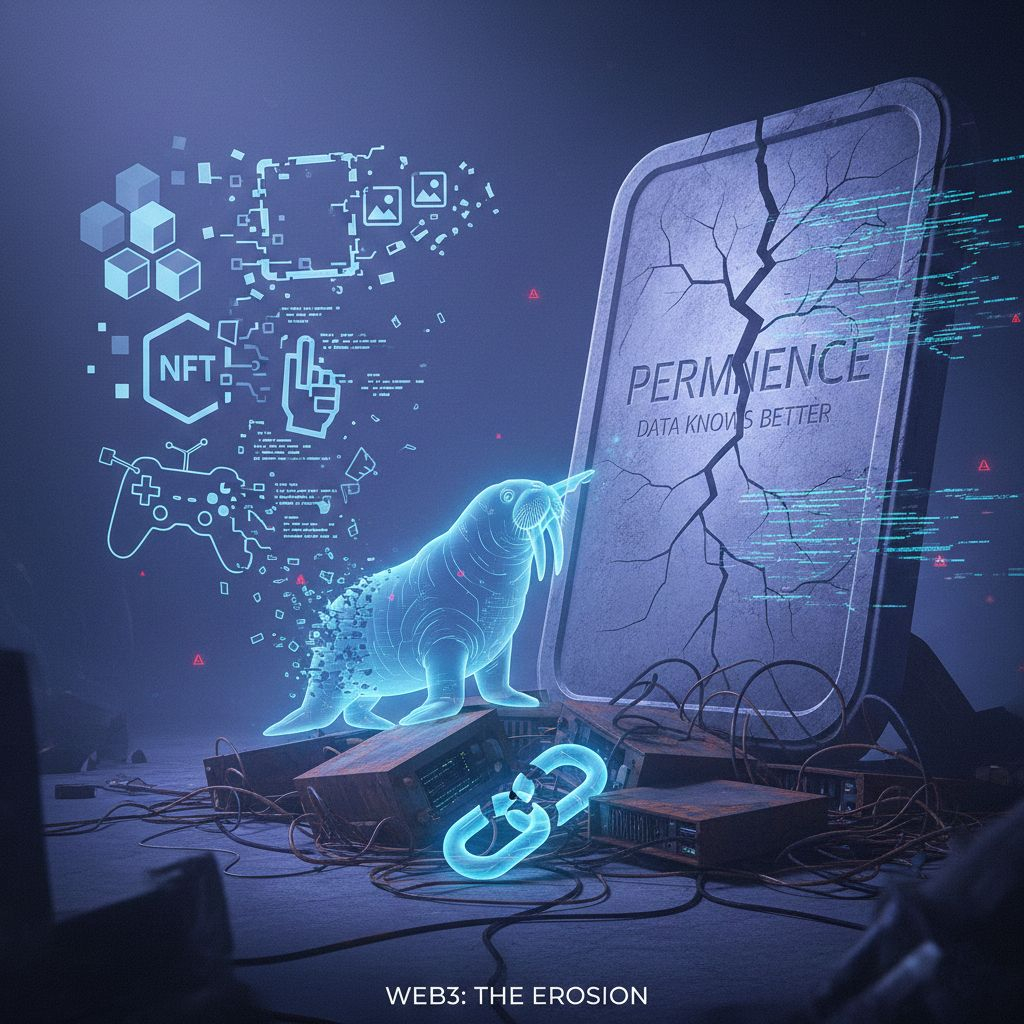
But files disappear.
NFT metadata goes missing.
DAO records become unreadable.
Games lose assets.
Frontends break, links rot, and suddenly the thing we swore was immutable depends on a server someone forgot to renew.
This isn’t a fringe problem. It’s normal. And that should bother us more than it does.
Web3 has spent years building convincing stories about trustlessness while quietly outsourcing its most fragile layer. Data. Storage. Memory. The boring parts. The parts that don’t fit into a tweet.
We say blockchains are forever. Then we store the important stuff somewhere else and hope for the best.
The consequences aren’t dramatic. They’re worse. They’re quiet.
A collectible still exists, technically, but the image is gone.
A DAO vote happened, but the context disappeared.
A game asset can’t load anymore.
A “permanent” record becomes a hash pointing to nothing.
No scandal. No headline. Just erosion.
When this happens, we usually blame users for not understanding the risks. Or we blame “early tech.” Or we shrug and say the ecosystem is still maturing. That shrug has become a habit.
In response, the industry offers solutions. Or what we call solutions.
Centralized storage with decentralized branding.
Temporary pinning services we assume will always be there.
Economic models that rely on goodwill instead of consequences.
Systems that work fine until incentives drift, operators leave, or costs rise.
A lot of this is based on blind trust. Trust that someone else will keep paying. Trust that nodes will behave. Trust that “community” is a substitute for accountability.
It’s not malicious. It’s lazy. Or maybe just tired.
What’s missing isn’t vision. It’s follow-through.
This is where projects like Walrus enter the conversation. Not loudly. Not as a savior. More like someone pointing at the mess and saying, “We should probably fix this part.”
Walrus is focused on decentralized, privacy-preserving data storage. Not in the abstract, but in the practical sense. Files. Large ones. Important ones. Distributed across a network in a way that doesn’t depend on a single machine, company, or promise.
It uses simple ideas that don’t sound exciting but matter a lot.
Data is split. Stored redundantly. Verified.
Participants are incentivized to behave correctly, not just encouraged to.
Failure isn’t ignored. It has consequences.
There’s no magic here. Just structure.
Operating on Sui, Walrus treats storage as a first-class problem instead of an afterthought. It assumes that data will be attacked, lost, or neglected unless the system actively resists that outcome. That assumption alone puts it ahead of much of the space.
What’s important is not the architecture details, but the mindset behind them. The recognition that decentralized systems fail not because they’re decentralized, but because no one is clearly responsible when something goes wrong.
Walrus tries to make responsibility explicit.
This matters more than we like to admit.
NFTs are not just tokens. They’re references to media, history, and context. Without reliable storage, they’re fragile receipts.
DAOs are not just governance tokens. They’re conversations, proposals, and collective memory. Lose the records and you lose legitimacy.
Games are not just smart contracts. They’re assets, worlds, and continuity. Break the storage layer and the experience collapses.
Long-term Web3 use depends less on faster chains or clever mechanics and more on whether things still work five years later without someone babysitting them.
That’s the bar most projects quietly fail.
Walrus doesn’t pretend to solve everything. It doesn’t promise cultural change or instant adoption. It just focuses on making data harder to lose and easier to trust without asking users to rely on vibes.
The token, WAL, exists inside this system to align incentives. Not as a lottery ticket, but as a way to ensure participants have skin in the outcome. If storage providers misbehave, it costs them. If they contribute reliably, they’re rewarded. Simple. Unromantic. Necessary.
This is the kind of infrastructure that rarely gets celebrated. No one brags about storage until it breaks. No one markets reliability until it’s gone.
But if Web3 is serious about growing up, this is exactly the layer it needs to take seriously.
Less storytelling. More responsibility.
Less abstraction. More consequences.
Less faith. More structure.
We don’t need louder narratives about decentralization. We need systems that don’t quietly decay when attention moves elsewhere.
Web3 doesn’t fail because it’s too ambitious. It fails because it ignores the boring work required to make ambition last.
Projects like Walrus feel important not because they’re exciting, but because they accept that reality. They build for endurance, not applause.
And maybe that’s what maturity looks like in this space. Not another promise of revolution. Just fewer things disappearing when no one is watching.