

I didn’t come across Walrus through a price chart, a trending thread, or a conference headline. It showed up the way more serious infrastructure projects usually do: while I was trying to understand where data actually lives when blockchains grow up. Not transactions, not narratives , that is data. The unglamorous substrate that every system quietly depends on and that almost no one wants to think about until it breaks.
What caught my attention wasn’t novelty. It was restraint. Walrus wasn’t trying to reinvent finance or promise a new internet. It was asking a much simpler, more uncomfortable question, who pays to store all this data over time, and why would they keep doing it when speculation fades?
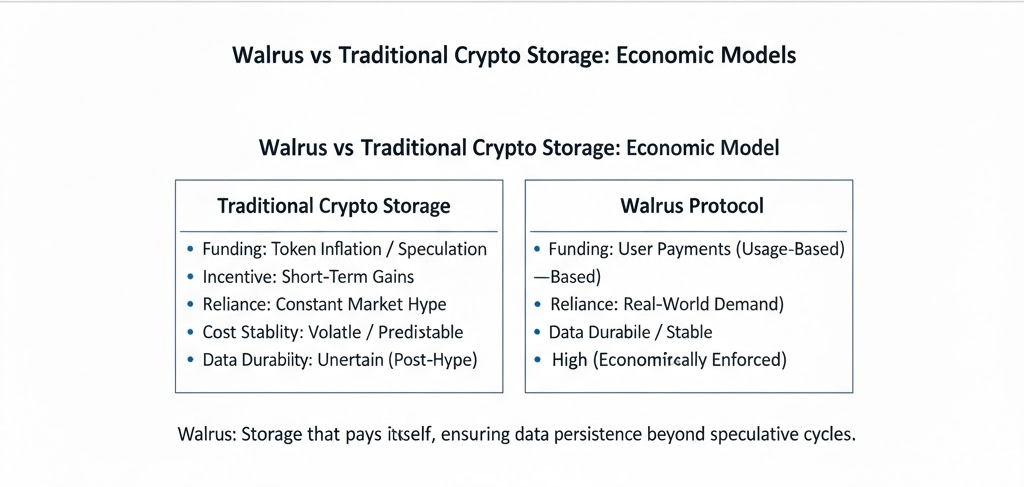
In the real world, storage is not optional. Banks, enterprises, regulators, and platforms all generate data that must persist for years. Logs, records, proofs, state, history. Someone pays for that persistence, and someone is accountable when it disappears. In much of crypto, storage is treated as an afterthought, subsidized by inflation or optimism. That works during growth phases. It works far less well once systems mature and costs become real.
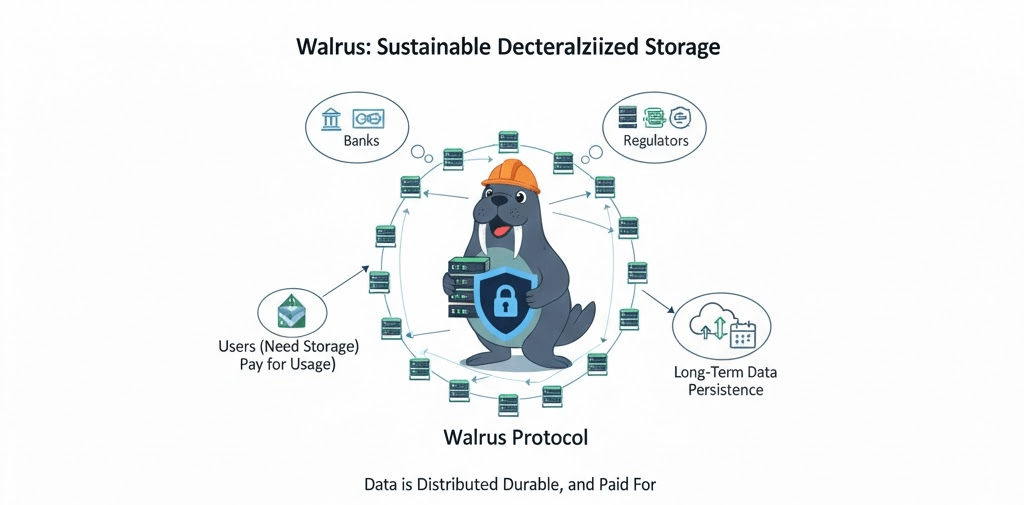
At its core, Walrus is addressing this basic mismatch. Blockchains are very good at agreeing on small pieces of state. They are much worse at handling large, persistent data in a way that is economically sustainable. Walrus approaches storage as infrastructure, not as a speculative side effect. Data is stored because someone needs it, and the network is compensated because it provides a real service. That sounds obvious, but in crypto it’s surprisingly rare.
The design is intentionally practical. Data is distributed across a network rather than sitting in one place. Participants who provide storage are paid for doing so. Those payments are tied to actual usage, not abstract promises about future demand. From a user’s perspective, the system is meant to feel dependable rather than clever. You store something, it stays there, and the incentives to keep it there don’t evaporate when market sentiment changes.
What’s equally important is what Walrus is not optimizing for. It’s not built for speed at all costs. It’s not designed to juice short-term activity. It doesn’t assume that every piece of data should be globally visible or permanently subsidized. Instead, it assumes that as crypto intersects more seriously with the real world, storage needs will look a lot more like traditional systems: controlled access, long retention periods, and predictable economics.
There’s also a quiet acknowledgment embedded in the design that not all users are the same. Some data needs to be shared widely. Some needs to be available only under specific conditions. Walrus doesn’t try to solve every policy question itself. It focuses on being a reliable base that applications can build on, rather than dictating how those applications should behave.
The token plays a role here, but not an overstated one. It exists to align incentives between those who need storage and those who provide it. It’s part of the machinery, not the story. You don’t need to believe in dramatic appreciation to see why a native mechanism for paying for long term resources matters. You just need to believe that data will continue to accumulate.
What makes projects like this easy to overlook is that they don’t offer a rush. There’s no obvious moment where everything changes overnight. Instead, their value shows up slowly, as systems scale and the hidden costs of poorly designed infrastructure become impossible to ignore. When storage stops being free. When data availability becomes a liability. When reliability matters more than experimentation.
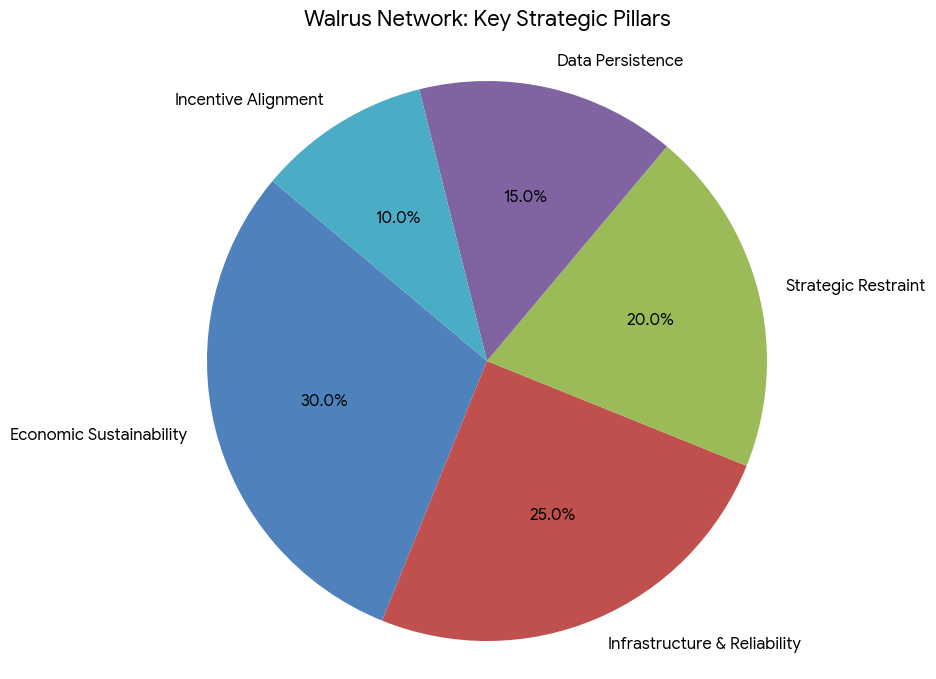
From the perspective of someone who has watched multiple cycles come and go, that patience is a feature, not a flaw. The most important infrastructure is rarely the loudest. It’s the part that holds when attention moves elsewhere.
Walrus feels like it was built with that assumption in mind. Not that the market will always be generous, but that the ecosystem will eventually need things that work quietly, pay for themselves, and don’t rely on constant excitement to survive. In the long run, that kind of thinking tends to matter more than whatever is loud today.

