
Most crypto projects compete the same way: louder narratives, faster timelines, bigger promises. It’s an arms race of attention. The problem is that attention isn’t the same thing as trust, and in regulated finance, trust is the only currency that matters.
Dusk doesn’t seem interested in winning that race.
That became obvious to me when I stopped reading Dusk updates as “announcements” and started reading them as signals. The language is cautious. The scope is narrow. The delivery cadence feels almost conservative. In a market addicted to urgency, that restraint looks like weakness. In infrastructure, it’s often the opposite.
Dusk behaves like a system that assumes it will be scrutinized.
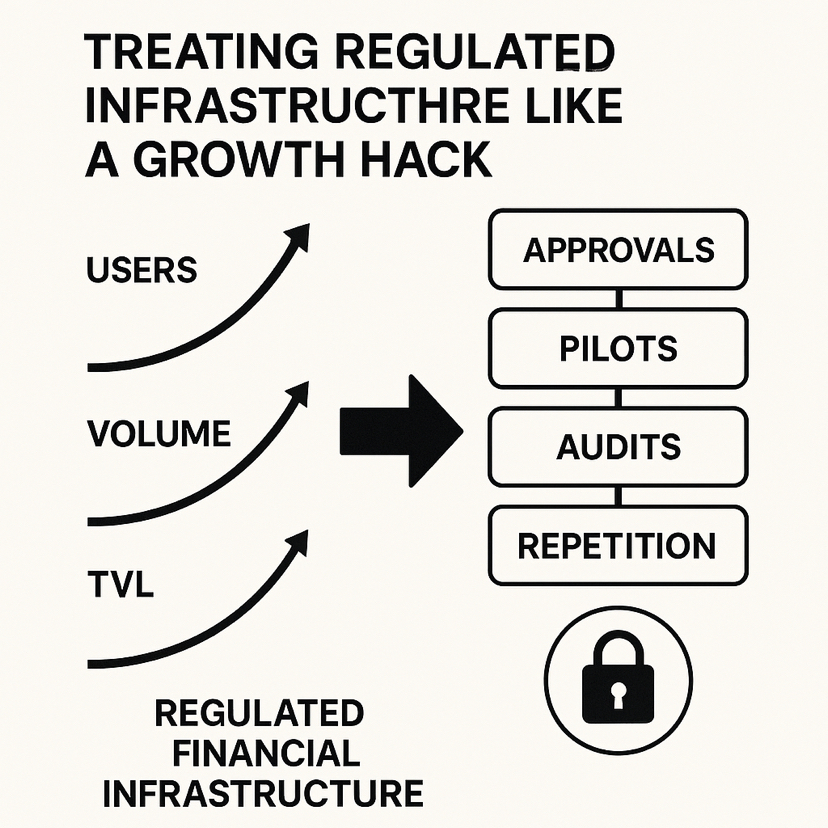
The Market Mistake: Treating Regulated Infrastructure Like a Growth Hack
Crypto investors are trained to look for explosive curves: users up, volume up, TVL up. That mindset works for consumer apps and speculative cycles. It breaks down when applied to regulated financial rails.
Regulated finance doesn’t expand through virality. It expands through approvals, pilots, audits, and repetition. The same processes that slow growth also lock it in once it starts.
Dusk’s design choices make more sense through that lens.
Privacy on Dusk isn’t a bolt-on feature. It’s integrated at the protocol level, with explicit room for disclosure when rules demand it. That’s not exciting to market — but it’s exactly what regulators expect. And regulators are the gatekeepers for the kind of capital Dusk is targeting.
Why Dusk’s Privacy Model Is Structurally Different
Most privacy chains sell a binary world: public or hidden. Dusk sells something more nuanced — privacy with conditions.
That matters because financial systems don’t operate on absolutes. They operate on permissions. Who can see what, when, and why is the entire game.
Dusk privacy isn’t about avoiding oversight. It’s about avoiding unnecessary exposure while preserving auditability. That framing aligns with how real institutions already think. They don’t fear transparency; they fear uncontrolled transparency.
This is why Dusk keeps returning to the same idea, even if it sounds repetitive: selective disclosure. It’s not a slogan. It’s a design constraint.
Infrastructure That Assumes Failure, Not Perfection
Another quiet signal in Dusk’s approach is how much effort goes into stability. Not performance theater — stability.
Most chains are optimized for ideal conditions. Dusk feels optimized for imperfect ones: partial participation, regulatory friction, slow onboarding, cautious users. In other words, reality.
That shows up in how execution environments are separated from settlement, how privacy doesn’t break verification, and how changes are incremental instead of sweeping. The system assumes that things will go wrong sometimes — and builds around that assumption.
That mindset doesn’t produce dramatic headlines. It produces systems that survive scrutiny.
Why the Token Feels Boring — on Purpose
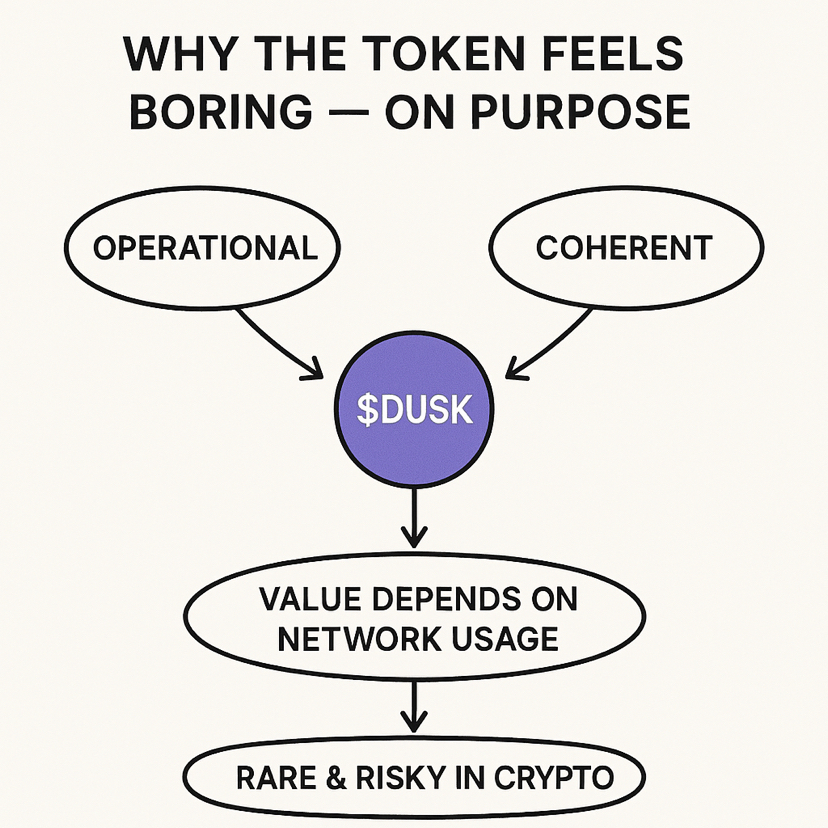
$DUSK doesn’t tell a thrilling story on its own. It doesn’t promise reflexive growth or viral mechanics. Its role is operational: securing the network, enabling execution, anchoring participation.
For speculators, that’s frustrating. For infrastructure, it’s coherent.
The value of $DUSK depends on whether the network becomes useful, not popular. That’s a slower feedback loop, but a more defensible one. If usage shows up, demand follows. If it doesn’t, no amount of narrative engineering will save it.
That honesty is rare — and risky — in crypto.
The Real Competitive Set Isn’t Other L1s
Here’s the part people often miss.
Dusk isn’t really competing with fast chains or meme ecosystems. Its real competition is doing nothing — staying on legacy systems because blockchain introduces too much uncertainty.
To win, Dusk doesn’t need to be better than every chain. It needs to be less risky than existing workflows. Privacy that doesn’t scare regulators. Predictability that doesn’t exhaust compliance teams. Architecture that doesn’t demand philosophical alignment.
That’s a very narrow path. But if you walk it successfully, you don’t need mass adoption. You need the right adoption.
Closing Thought
Dusk feels like a project that understands an uncomfortable truth: in finance, being impressive matters less than being acceptable.
If crypto keeps pushing toward regulated, real-world usage, systems like Dusk won’t look slow — they’ll look prepared. And preparation, unlike hype, compounds quietly.