
Vanar comes across like a project built by people who’ve spent enough time around games, entertainment, and consumer brands to know one thing: most blockchains aren’t hard to use because users are “early.” They’re hard to use because the infrastructure wasn’t designed to feel like a product.
That’s the heart of Vanar’s story. It positions itself as a Layer 1 built for real-world adoption, but not in the usual copy-paste way. The direction is clear: make Web3 usable for the next wave of consumers by building a stack that feels closer to modern software infrastructure than a standalone chain.
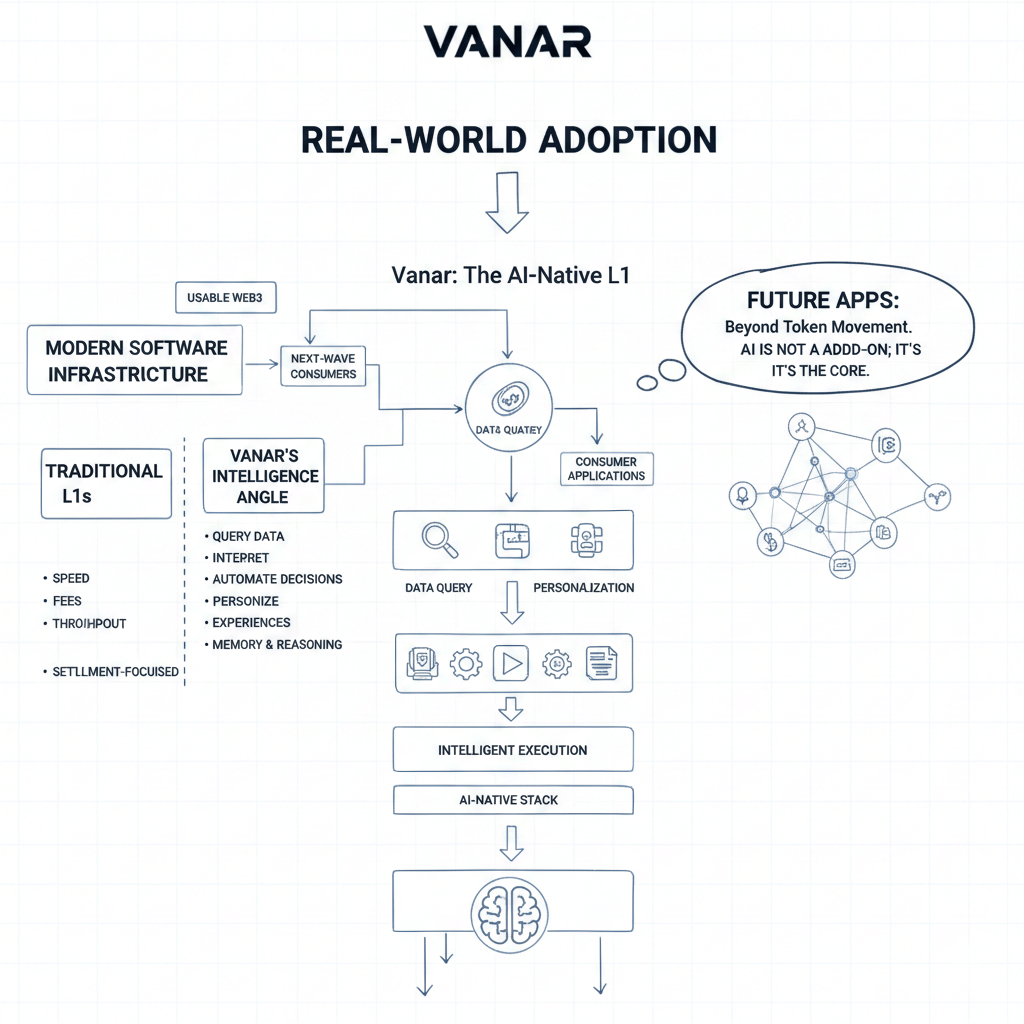
A lot of L1s compete on speed, fees, and throughput. Vanar’s angle leans into something else: intelligence. The idea is that the future apps people actually use won’t just move tokens around. They’ll query data, interpret it, automate decisions, and personalize experiences. They’ll need memory and reasoning, not just settlement. Vanar tries to meet that moment by building an “AI-native” stack where AI isn’t an add-on — it’s part of the foundation.
That’s where the structure gets interesting. Vanar doesn’t describe itself as just a chain. It describes layers. The base is the L1 itself, and then it introduces components that sound more like a platform roadmap: memory, reasoning, automation, and packaged workflows. Whether you’re a builder or just watching from the outside, that framing matters because it sets expectations: they aren’t just chasing transactions; they’re trying to build an ecosystem where applications can store information in a way that’s useful, make sense of it, and then act on it.
Neutron is a good example of what they’re aiming for. Most crypto projects talk about data storage like it’s a checkbox. Store a hash on-chain, pin a file somewhere, call it “decentralized.” But that doesn’t really help if what you want is understanding. Neutron is presented as a semantic memory layer — meaning-based, AI-ready. Instead of treating data as inert blobs, it’s described as being converted into “Seeds,” compressed and structured so it becomes searchable and usable for AI systems. The pitch is basically: don’t just prove a file existed; make the content retrievable and meaningful in a way AI can work with.
Then Kayon sits on top as the reasoning layer. This is where Vanar shifts from “a chain with features” into something that feels closer to an operating layer for intelligent apps. Kayon is framed as the component that can interpret what’s stored, respond to natural-language queries, and produce real outputs that teams can act on. It’s not hard to see why they emphasize compliance and enterprise-style workflows here. If you want mainstream adoption, you eventually collide with the real world: reporting, controls, audit trails, monitoring, and rules that change depending on region and industry. Vanar’s messaging leans into that reality, not away from it.
The broader ecosystem vision is built around the idea that distribution beats perfection. A chain can have flawless tech and still fail if nobody builds on it. So Vanar keeps orbiting mainstream verticals — gaming, metaverse, AI tooling, brand integrations, eco narratives — because those are areas where consumer attention already exists and where Web3 can quietly become “part of the product” instead of the product itself. Their builder programs and partnership pushes fit into that strategy: attract teams that already know how to ship consumer experiences, then give them infrastructure that doesn’t break when real users arrive.
On the token side, VANRY is presented as the network’s engine. It’s the asset tied to participation, staking narratives, and network activity, and it also exists in the broader liquidity world through its ERC-20 contract on Ethereum (the one you linked). That setup isn’t unusual anymore, but it’s important. It makes the token usable where liquidity already lives while the chain builds its own gravity and application demand.
What makes Vanar matter, if you strip away the marketing and focus on the direction, is the attempt to move beyond “blockchain as a ledger” toward “blockchain as a system that can store meaning, reason over information, and eventually automate outcomes.” That’s the path to Web3 feeling less like a tool for insiders and more like infrastructure for everyday digital life — where users don’t need to understand chains, bridges, or gas because the product experience does the heavy lifting.
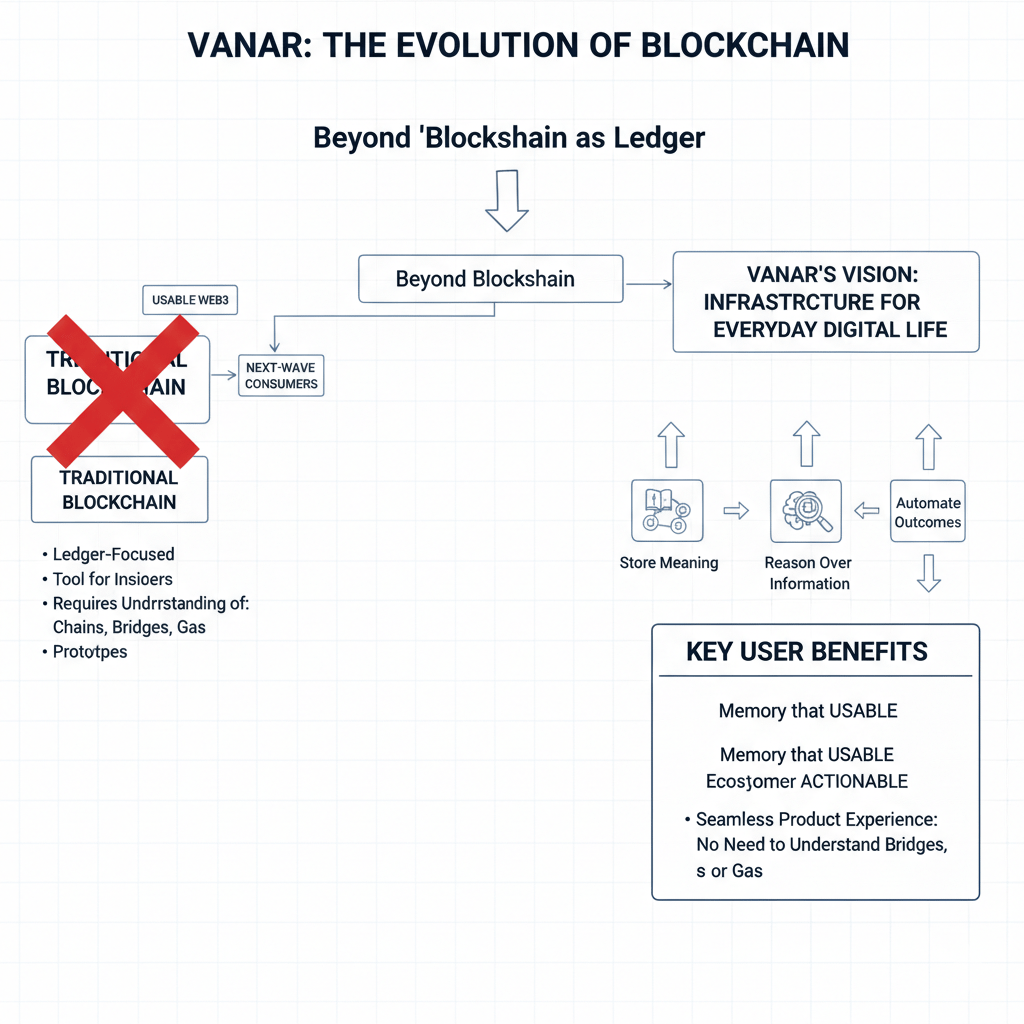
If their execution matches the vision, the story becomes simple: memory that’s actually usable, reasoning that’s actually actionable, and an ecosystem that’s designed to ship consumer-facing experiences rather than just prototypes.
And if you’re tracking what’s “next,” the most honest signals won’t be slogans — they’ll be releases and adoption. New integrations that prove Neutron is being used, real developer activity that proves Kayon is more than a concept, and ecosystem products that bring non-crypto users in without making them feel like they’re learning a new world.