
When I first came across Vanar Chain back in its early days, the project was heavily positioned around gaming infrastructure low cost transactions, fast finality, and tools that made on chain asset ownership feel seamless for players and studios. I remember thinking it was one of the more realistic attempts to bring real Web3 utility to gaming without overpromising. Over the following months, I watched the roadmap quietly shift focus. The gaming roots never disappeared, but the emphasis moved toward building a full cognitive layer on top of that foundation. It wasn’t a loud pivot; it was a measured evolution that now defines the chain.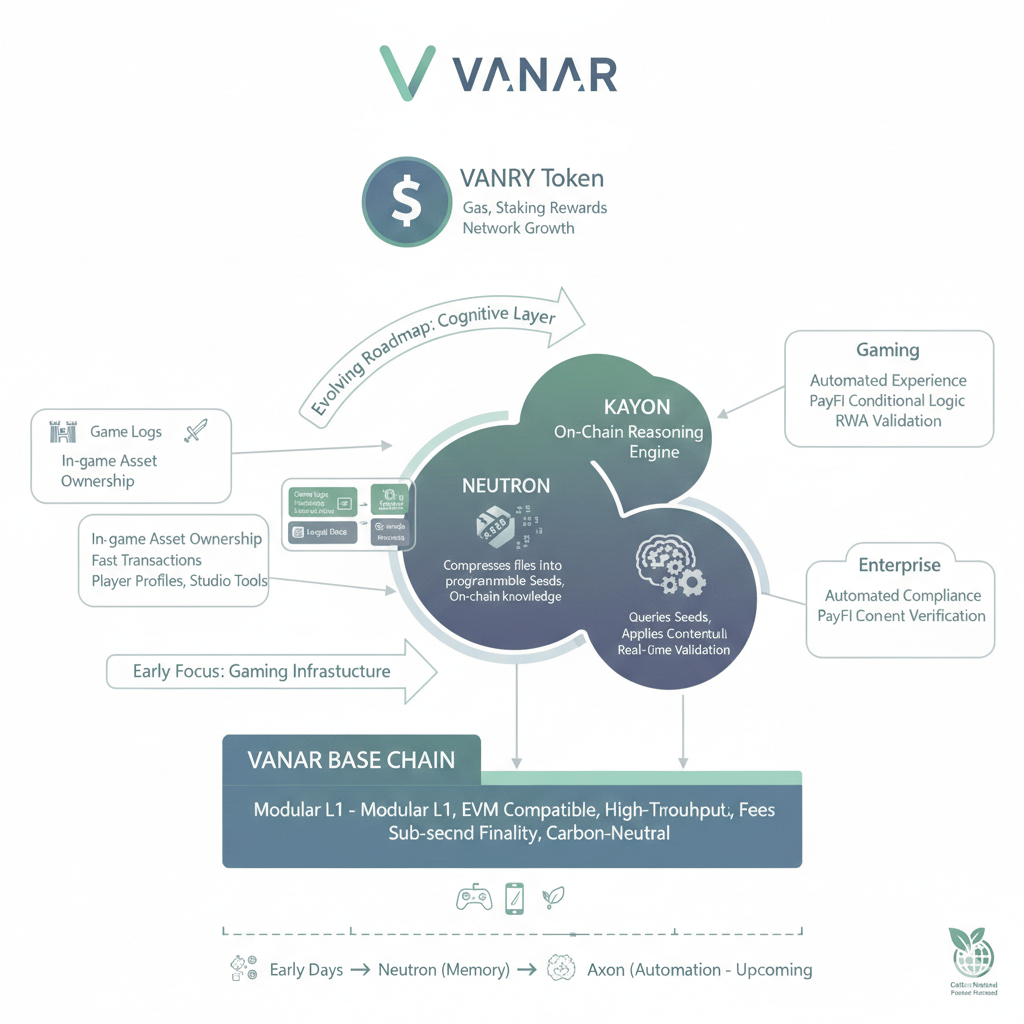
Vanar Chain started as a modular Layer 1 blockchain that is fully EVM compatible, with an architecture optimized for high throughput, low fee operations. The base layer was engineered to support the kind of frequent, micro scale interactions that mobile and casual gaming require fixed fees around $0.0005 per transaction, sub second confirmations in many cases, and carbon neutral validation through renewable energy. Early partnerships with gaming studios and platforms helped prove this infrastructure in real environments, showing that on chain assets could be owned, traded, and used without frustrating costs or delays.
As the project progressed, the roadmap introduced Neutron, the semantic memory layer. Neutron takes raw files game logs, player profiles, legal documents, invoices, or any structured data and compresses them into compact, programmable objects called Seeds. These Seeds are stored natively on chain, preserving meaning, context, and relationships while eliminating external storage dependencies. What began as a way to make in game data persistent and verifiable gradually revealed broader potential: a foundation for persistent knowledge that AI systems could reliably access.
The introduction of Kayon marked the clearest step into cognitive territory. Kayon is the on chain reasoning engine that queries Seeds and applies contextual logic in real time. In gaming, this could adjust difficulty, personalize experiences, or verify achievements based on stored player history. But the same mechanism also enables automated compliance checks for tokenized real world assets and conditional validations in PayFi flows. The transition from gaming centric infrastructure to a general purpose cognitive blockchain happened through shared tooling: the same low cost, high availability base that served games now powers intelligent finance and asset management applications.
$VANRY remains the unifying token across this evolution. It covers gas for every operation from basic transfers and Seed creation to complex reasoning queries and staking. Validators and delegators earn rewards by securing the network under a reputation enhanced consensus model, keeping the chain stable as use cases expand. The token’s utility scales naturally with adoption: more cognitive applications mean more VANRY is needed for gas, creating alignment between network growth and token demand.
@Vanarchain has documented each phase of this roadmap clearly, with technical notes on Neutron, Kayon, and the upcoming Axon automation layer. The carbonneutral operations continue to underpin the entire system, reflecting a long term view on sustainability that fits both gaming communities and enterprise grade use cases.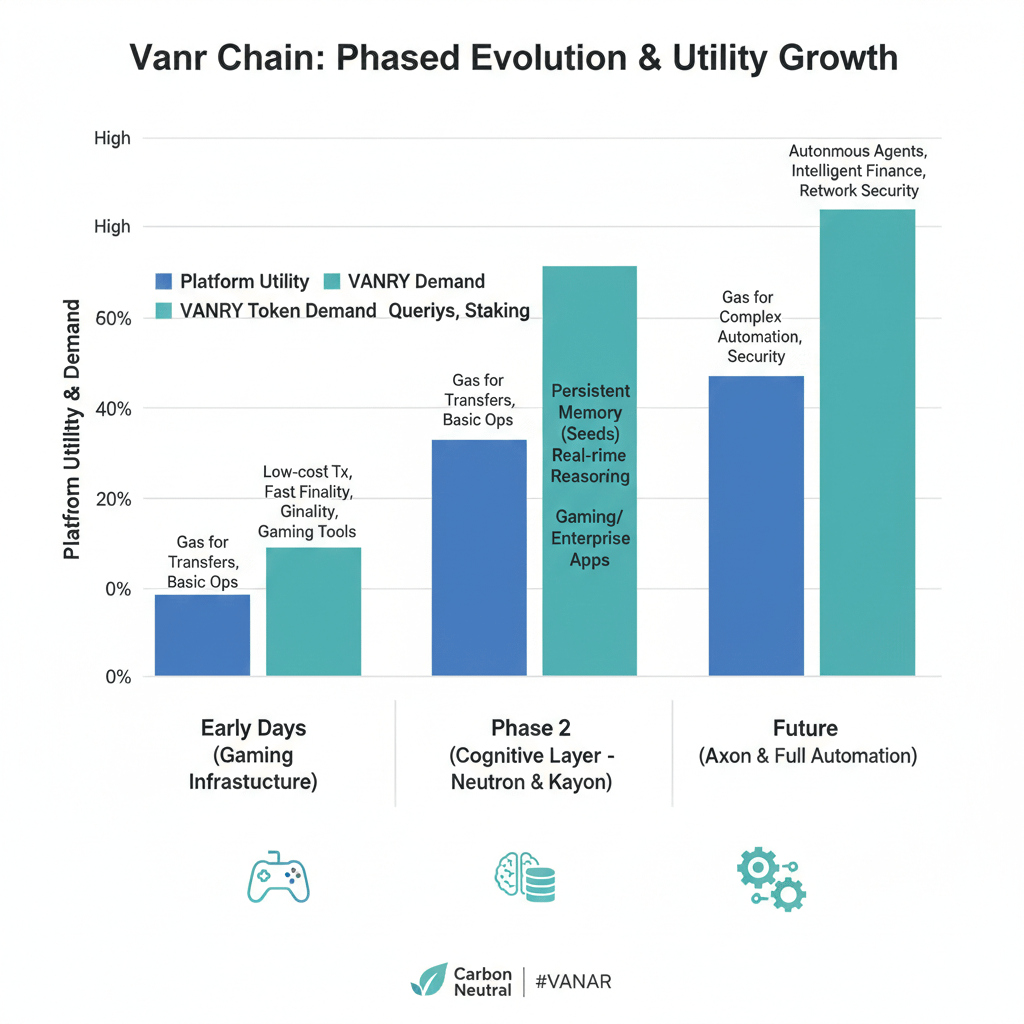
The subtlety of Vanar’s transition is what makes it effective. Instead of abandoning gaming, the project extended the same reliable infrastructure to support persistent memory and reasoning turning a gaming first chain into a cognitive platform capable of handling intelligent finance, RWAs, and agentic systems. This incremental roadmap has allowed real developer adoption to grow steadily rather than in sudden, unsustainable bursts.