Walrus is one of those projects that quietly solves a very real problem in crypto: where do you put massive amounts of data without trusting a centralized company? Built on the Sui blockchain, Walrus is a decentralized storage and data availability protocol made specifically for large files things like videos, images, AI datasets, NFT media, game assets, websites, and even entire blockchain histories.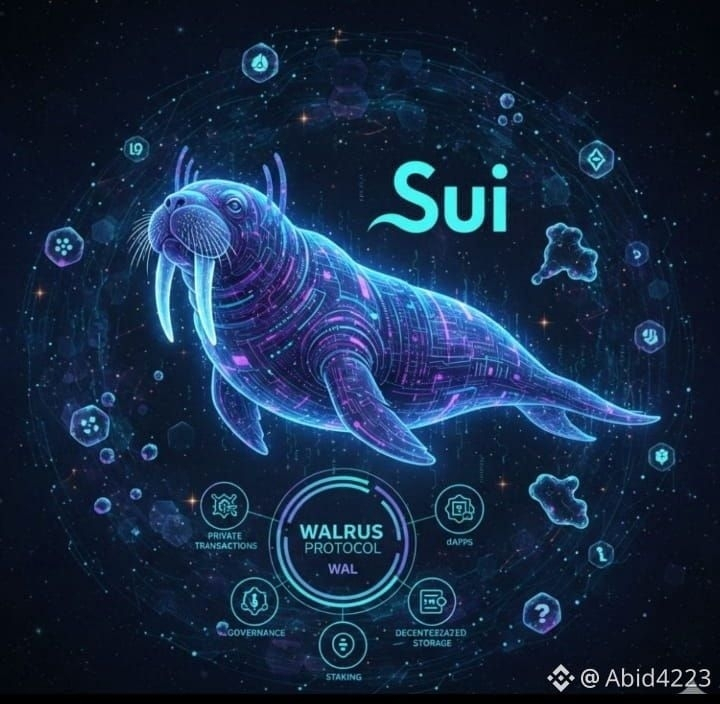
Instead of trying to cram data directly onto a blockchain (which is expensive and inefficient), Walrus takes a smarter route. It stores large files, called “blobs,” across a network of independent storage nodes, while keeping proof of their availability on Sui. This means the blockchain can verify that the data exists and can be retrieved, without actually holding the data itself. The result is a system that is both scalable and trustless.
At the heart of Walrus is a clever storage design. When someone uploads a file, it doesn’t get copied again and again like traditional systems. Instead, the file is broken into many encoded pieces using advanced erasure coding technology known as RedStuff. These pieces are spread across many nodes. Even if a large number of those nodes go offline or fail, the original file can still be rebuilt from the remaining pieces. This makes Walrus extremely resilient while keeping storage costs much lower than simple replication-based models.
This efficiency is one of Walrus’s biggest strengths. Because it doesn’t rely on full copies of data everywhere, the total storage overhead stays relatively low roughly four to five times the original file size. That might sound high at first, but in decentralized systems it’s actually very competitive, and it allows Walrus to aim for pricing that can compete with centralized cloud providers over time, while still keeping decentralization and censorship resistance intact.
Sui plays a key role behind the scenes. The blockchain coordinates payments, tracks storage metadata, manages resource allocation, and handles regular network rotations. Every storage action uploading data, extending storage time, or retrieving blobs — is triggered through smart contract transactions. This makes Walrus programmable by default. Developers can build applications that directly check whether data is stored, available, or still valid, all within smart contracts.
This programmability unlocks a wide range of real-world use cases. AI teams can store large datasets or model weights without relying on a single provider. NFT projects can store images and videos in a truly decentralized way instead of using fragile centralized links. Entire websites can be hosted directly on Walrus through Walrus Sites, making censorship-resistant web hosting practical. Layer-2 blockchains can use Walrus as a data availability layer to prove their transaction data exists. Even encrypted and private storage scenarios become possible for enterprises and subscription-based media platforms.
The WAL token powers everything inside this system. Users pay in WAL to store and retrieve data. Storage node operators stake WAL to participate in the network and earn rewards for providing reliable storage. Token holders can also take part in governance, voting on protocol changes and upgrades. Some protocol mechanics introduce token burning tied to usage, which can add deflationary pressure as adoption grows. The total maximum supply is around five billion WAL, and the network operates under a delegated proof-of-stake model where stakeholders help select storage committee nodes each epoch.
From a project maturity standpoint, Walrus is no longer just an idea on paper. The mainnet went live in early 2025, and the ecosystem has been steadily expanding since then. Developer documentation, SDKs, and command-line tools are publicly available, making it easier for builders to integrate blob storage directly into their applications. Testnet and DevNet environments allow teams to experiment before deploying to production. The project is also reported to be well-funded, with strong backing and ongoing ecosystem partnerships.
What makes Walrus especially interesting is how quietly essential it can become. As blockchains, AI systems, and decentralized apps generate more and more data, the need for a reliable, decentralized, and cost-efficient storage layer becomes unavoidable. Walrus isn’t trying to be flashy. It’s trying to be infrastructure the kind that works in the background, scales smoothly, and just keeps data available when it matters most.
In simple terms, Walrus is building the storage backbone for the next wave of decentralized applications. If Web3 is going to handle real-world data at real-world scale, projects like Walrus are not optional they’re necessary.