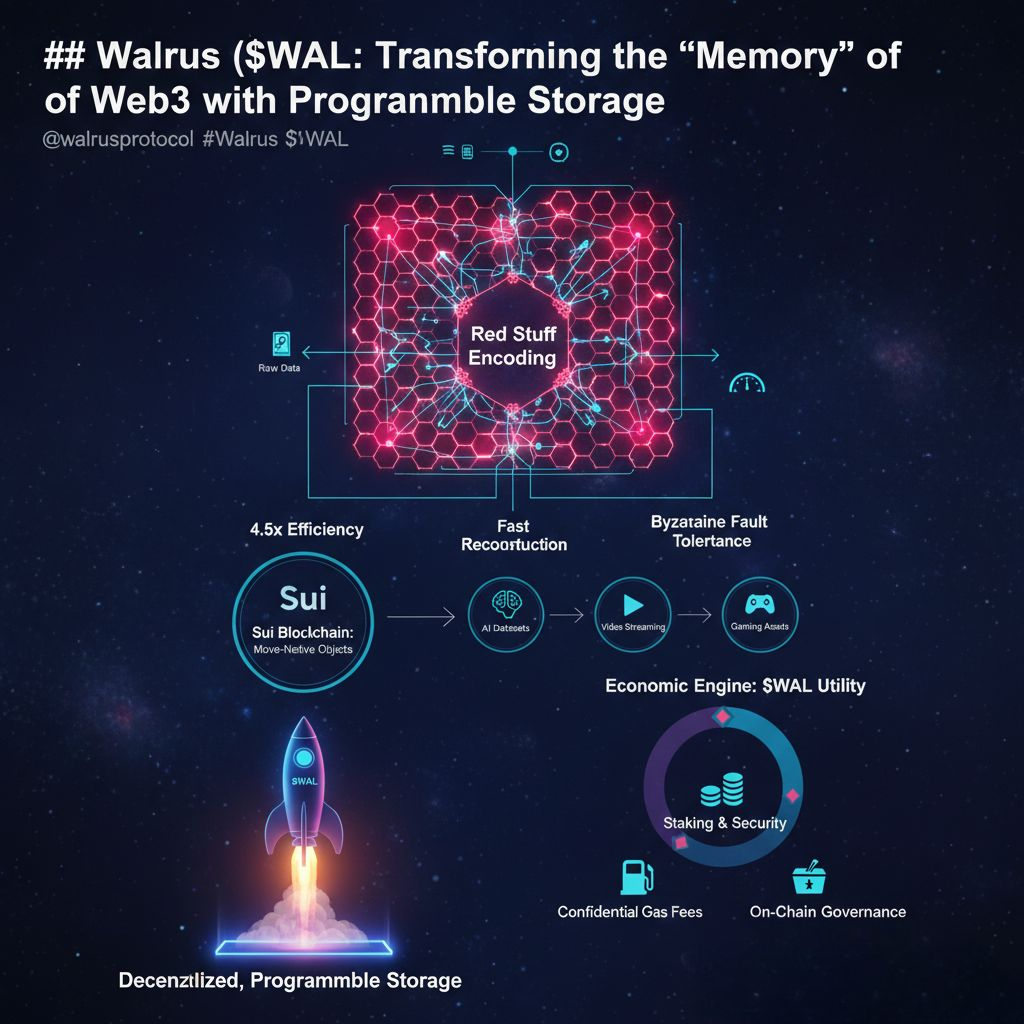
In the current Web3 landscape, we’ve mastered decentralized execution, but decentralized storage has often remained a bottleneck—expensive, static, and difficult to integrate. Walrus Protocol is changing this narrative by moving beyond simple "file hosting" to create a truly programmable storage layer built on the high-performance foundations of the Sui blockchain.
The "Red Stuff" Revolution
At the heart of Walrus’s technical superiority is its proprietary Red Stuff encoding algorithm. Unlike traditional storage that relies on massive replication (storing the same file 10+ times), Walrus uses advanced 2D erasure coding.
This technology breaks a file into fragments called "slivers." The beauty of this system is its efficiency and resilience:
* 4.5x Efficiency: It achieves high security with significantly less overhead than competitors like Filecoin or Arweave.
* Byzantine Fault Tolerance: Your data remains 100% retrievable even if up to two-thirds of the storage nodes go offline or act maliciously.
* Fast Reconstruction: Because the system uses lightweight XOR operations, file retrieval is incredibly fast, making it viable for "hot" data like video streaming and gaming assets.
Deep Integration with Sui
What truly sets @Walrus 🦭/acc apart is its deep coupling with the Sui Network. In the Walrus ecosystem, storage isn't just a passive archive; it's a Move-native object.
This means smart contracts can directly "own," reference, and control data blobs. Imagine an NFT that actually contains its 4K video file on-chain, or an AI agent that can autonomously update and version its own training datasets. By offloading the "heavy lifting" of data to Walrus while keeping the metadata and control plane on Sui, developers get the best of both worlds: infinite scalability and sub-second execution.
The Economic Engine: $WAL Utility
The $WAL token is the lifeblood that powers this decentralized data market. It is meticulously designed to align the interests of users and providers:
* Stable Storage Payments: Users pay for storage in $WAL, with a mechanism designed to keep costs predictable in fiat terms, protecting builders from token volatility.
* Delegated Staking: Security is underpinned by staking. Token holders can delegate their $WAL to high-performing storage nodes, securing the network and earning a share of the storage fees.
* Governance & Resource Allocation: WAL holders vote on key protocol parameters, such as pricing and penalty levels for underperforming nodes.
As we move into an era dominated by AI and rich media, the demand for a storage layer that is as "smart" as the blockchains it supports is skyrocketing. #walrus isn't just a place to keep your files; it's the infrastructure that allows Web3 to finally remember everything without breaking the bank.
How do you think programmable storage will change the NFT and AI landscape? Share your thoughts below! #walrus
This Walrus Protocol Overview explains the core technology and why it's a major development for the Sui ecosystem.