

Most blockchains try very hard to feel alive.
Blocks race each other. Fees surge and collapse. Dashboards pulse with activity. Even when nothing meaningful is happening, the system performs motion. It reassures users that something is always going on.
Dusk is uncomfortable with that idea.
On Dusk Network, movement is not the goal. Completion is. And the difference shows up most clearly in places people usually ignore: how costs behave, how time is priced, and how failure is handled when nobody is watching.
Start with fees.
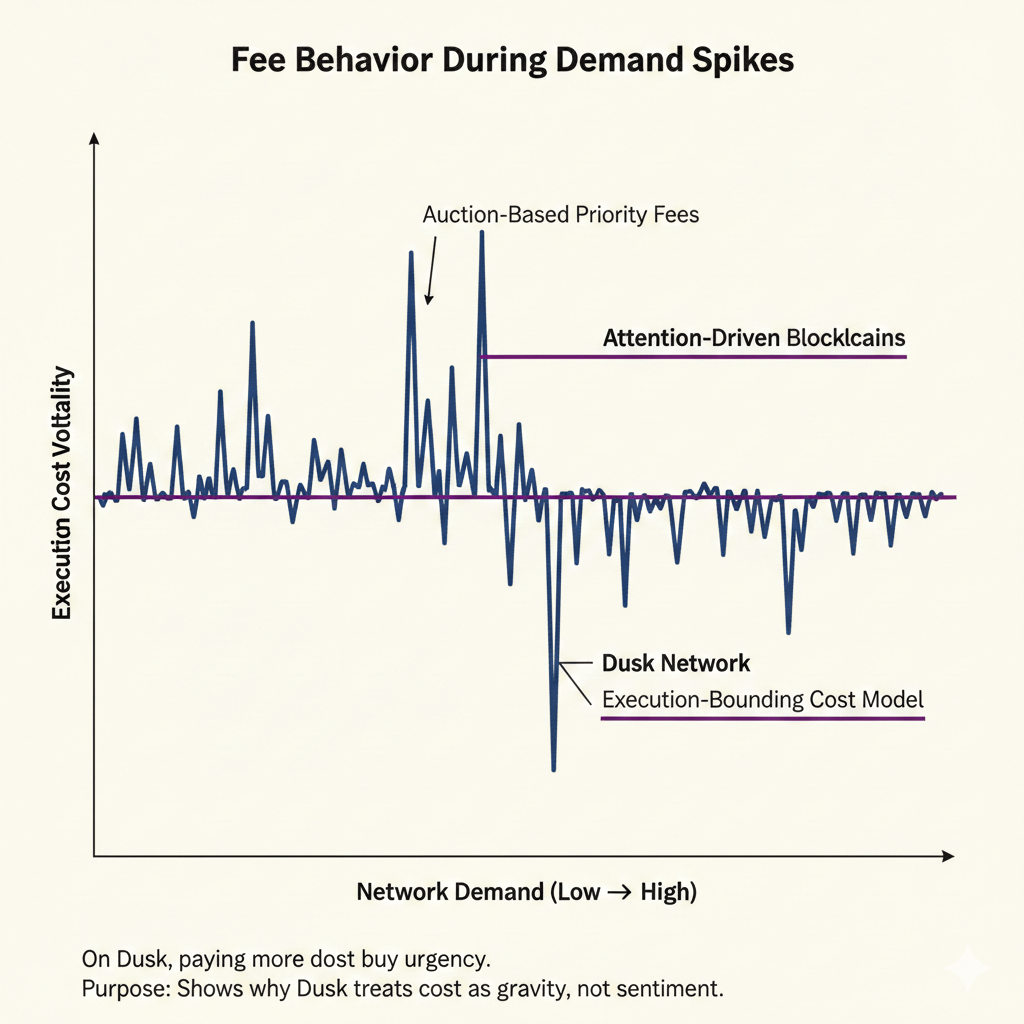
In many networks, fees are an emotional variable. They spike when attention spikes. They fall when interest fades. Users learn to time activity, batch actions, or simply wait. That behavior is invisible until you rely on the chain for operations instead of speculation.
Dusk treats cost as something closer to gravity. Present. Predictable. Uninterested in sentiment. Gas exists to bound execution, not to auction attention. You don’t win priority by paying more in a moment of stress. You either fit within the system’s constraints or you don’t execute at all.
That sounds restrictive until you consider who benefits from unpredictability. Traders can adapt. Bots thrive on chaos. Accounting systems don’t. Payroll doesn’t. Asset registries don’t. When fees fluctuate wildly, organizations start building workarounds instead of products.
Dusk’s approach quietly removes that incentive. There’s nothing to game. No surge to front-run. No window where paying more buys certainty. Execution becomes a question of correctness, not urgency.
Time works the same way.
Many chains sell speed as a headline metric. Lower latency. Higher throughput. Faster blocks. But speed without settlement is just motion. When finality is probabilistic, every action carries a shadow of doubt that must be managed off-chain.
Dusk doesn’t optimize for the fastest possible answer. It optimizes for the last one.
Once a state transition completes, it doesn’t linger in a maybe. It doesn’t ask you to wait a few more confirmations just in case. That decisiveness changes how systems integrate. Downstream processes don’t need buffers. Auditors don’t need disclaimers. There is no “temporary truth.”
What’s interesting is how unremarkable this feels when it works. Nobody celebrates a transfer that simply finishes and stays finished. But when you remove rollback risk, entire categories of contingency planning disappear. That absence is the signal.
Failure, too, behaves differently.
On most chains, failure announces itself loudly. Transactions revert. Errors propagate. Logs fill up. The system explains what went wrong, often in public, often in detail. That transparency is useful for debugging, but it also turns every mistake into broadcast data.
Dusk prefers refusal over failure.
If conditions aren’t met, state doesn’t advance. There’s no spectacle. No partial execution. No public autopsy of intent. From the outside, it looks like nothing happened. From the inside, everything worked exactly as designed.
This is not developer-friendly in the short term. It forces teams to think precisely. Assumptions can’t hide behind retries. Permissions can’t drift unnoticed. Execution paths must be explicit because the chain won’t smooth them over.
But over time, this friction reshapes behavior. Systems built on Dusk start resembling internal financial software more than consumer apps. Fewer surprises. Fewer edge cases papered over by UI logic. More responsibility pushed upstream, where it belongs.
What ties all of this together is restraint.
Dusk doesn’t try to entertain users with constant feedback. It doesn’t reward activity for its own sake. It doesn’t attempt to make infrastructure feel exciting. That restraint is easy to misinterpret as lack of ambition.
It’s the opposite.
By refusing to monetize volatility, attention, or confusion, Dusk narrows its scope deliberately. It chooses to be the layer that other systems can rely on when novelty fades. When compliance becomes non-negotiable. When costs need to be forecasted instead of guessed.
This also explains why Dusk doesn’t rush features into production. Upgrades are treated as state changes that must justify themselves, not marketing moments. Backward compatibility matters. Behavior consistency matters. Breaking changes are expensive—not in community sentiment, but in trust.
There is a quiet confidence in that posture. Not the kind that demands belief, but the kind that assumes scrutiny.
In a market that still confuses visibility with value, Dusk is building something that almost disappears once it’s doing its job. No fireworks. No drama. Just a system that prices cost, time, and failure as things that deserve respect.
That kind of infrastructure doesn’t trend well.
It endures.
And when the next wave of serious capital asks not how fast a chain can move, but how reliably it can stay still once it arrives, systems like Dusk won’t need to explain themselves.
They’ll already be in use.
