
For more than a decade cloud storage has been dominated by subscription-based platforms. Services such as AWS S3 G Cloud Storage and Azure Blob Storage transformed how companies handle data by abstracting away infrastructure management.
While this model enabled rapid scalability it also introduced rigid pricing structures vendor lock-in and opaque cost dynamics particularly around data transfer and long-term storage. As data volumes have grown exponentially these limitations have become increasingly visible.
Walrus proposes a fundamentally different approach to storage economics and infrastructure design one that replaces subscription dependency with a market-oriented protocol governed by cryptographic guarantees and open participation.
Walrus reimagines storage not as a recurring service fee but as a programmable market. Instead of paying monthly subscriptions users purchase storage time directly through smart contracts using the WAL token. This shift transforms storage from an ongoing operational expense into a verifiable digital asset with clear ownership guarantees. Data is no longer something rented from a centralized provider but something secured within an open protocol whose rules are enforced cryptographically rather than contractually.
Traditional cloud platforms rely on centralized control over both infrastructure and pricing. Users are billed for storage capacity network egress API requests and redundancy often with cost structures that are difficult to predict at scale. High transfer fees alone have become a major friction point discouraging data mobility and reinforcing platform lock-in. Once data is deeply embedded in a provider’s ecosystem migrating away becomes expensive and operationally complex. Walrus addresses this imbalance by designing storage as a protocol rather than a service removing the structural incentives that trap users within closed systems.
One of the most significant technical distinctions in Walrus is its use of erasure coding with a replication factor of approximately 4.5x. In traditional cloud architectures safety is achieved through full replication across multiple availability zones often resulting in far higher redundancy overhead. While effective this method significantly increases storage costs which are ultimately passed on to customers. Erasure coding allows Walrus to distribute fragments of data across a decentralized network in a way that maintains high durability and fault tolerance while dramatically reducing redundancy overhead. The result is a system that preserves data safety without imposing excessive storage chargeis
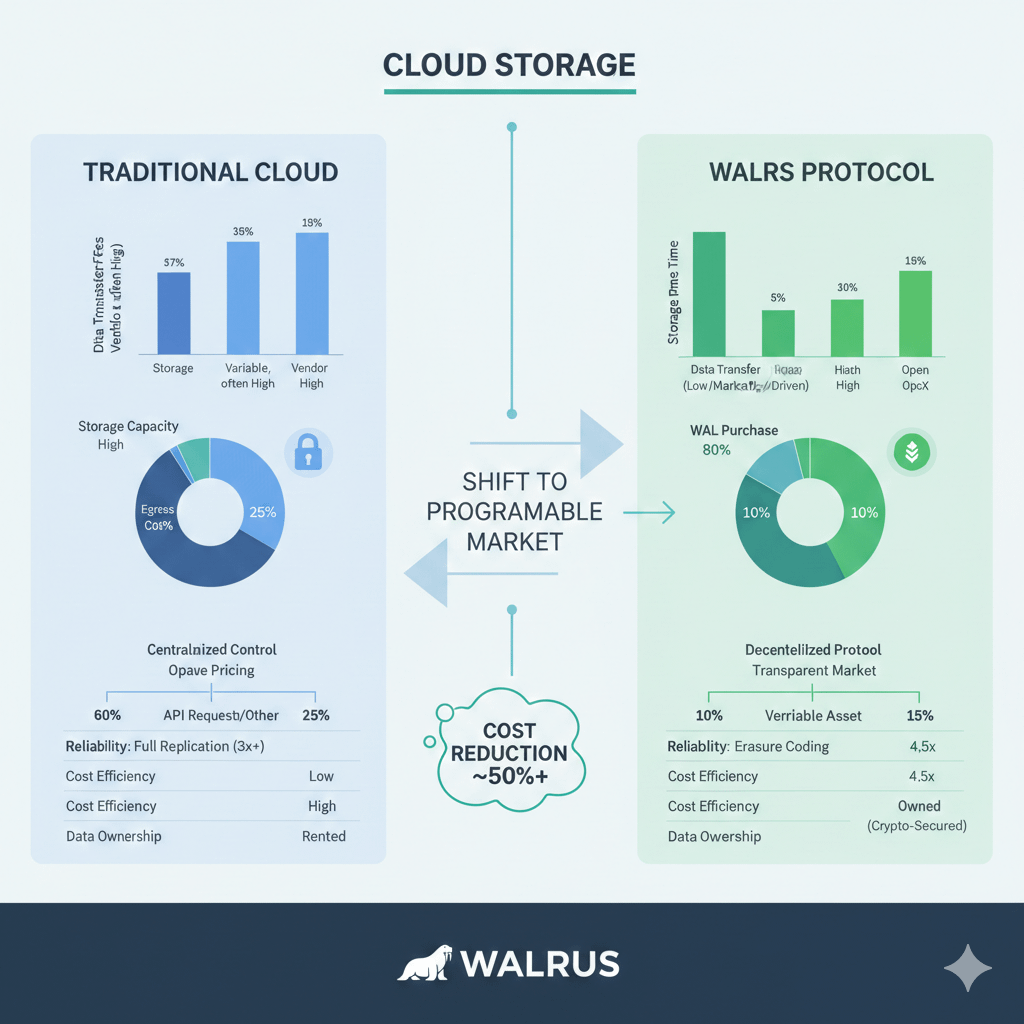
This architectural choice is not merely a technical optimization but a foundational economic decision. Lower redundancy overhead directly translates into lower storage costs making decentralized infrastructure competitive with centralized cloud services on price. At the same time data availability and resilience are maintained through cryptographic proofs and network incentives rather than trust in a single provider. This balance between efficiency and safety is critical for any storage system aiming to support internet-scale datasets.
Walrus also introduces a new model of accountability through staking and storage verification. Nodes participating in the network are required to stake WAL tokens creating a financial incentive to behave honestly. Storage providers are continuously challenged to prove that they are correctly storing the data they have committed to. These verification processes scale efficiently allowing the network to grow without linear increases in verification cost. Dishonest behavior results in penalties creating a self-enforcing system where reliability emerges from economic incentives rather than centralized oversight.
This mechanism allows Walrus to compete directly with centralized archival systems that have traditionally dominated large-scale data storage. Enterprises and institutions require long-term durability auditability and guarantees around data integrity. Walrus meets these requirements by making storage verifiable at the protocol level. Every dataset can be cryptographically proven to exist remain unaltered and be retrievable under predefined conditions. This capability fundamentally changes how trust is established in digital storage systems.
Another critical advantage of Walrus is the absence of platform lock-in. Because storage is governed by open smart contracts and standardized verification mechanisms users retain full control over their data. There is no proprietary API barrier or artificial cost imposed on data movement. If users choose to migrate or reallocate storage they can do so without negotiating with a centralized provider or facing punitive transfer fees. This openness introduces competitive pressure that has been largely absent from the cloud storage market.
The implications of this model extend beyond cost savings. By decoupling storage from proprietary service agreements Walrus enables a new class of applications that require long-term data guarantees without centralized trust. Scientific datasets public archives AI training corpora and regulatory records can be stored with verifiable integrity and transparent economics. The protocol establishes an independent storage layer for the internet’s largest datasets one that is not controlled by any single entity yet remains reliable and economically sustainable.
In traditional infrastructure data is treated as a passive resource something that incurs cost but provides no inherent proof of integrity or ownership. Walrus changes this by making data a verifiable asset. Each stored object can be referenced cryptographically audited independently and validated over time. This shift is particularly important in environments where compliance transparency and data provenance matter. When regulators auditors or counterparties request proof users can provide cryptographic evidence rather than relying on service-level assurances.
The use of smart contracts to manage storage time introduces flexibility that subscription models lack. Users can precisely define how long data should be stored under what conditions and at what cost. Storage becomes programmable aligning directly with business requirements rather than forcing organizations into rigid pricing tiers. This flexibility is especially valuable for use cases involving seasonal workloads archival storage or long-term preservation where subscription inefficiencies become costly.
From an economic perspective Walrus represents a broader transition from services to protocols. Services are inherently centralized relying on trust legal agreements and proprietary control. Protocols by contrast are neutral infrastructures governed by transparent rules and open participation. In the same way that decentralized finance replaced intermediaries with smart contracts Walrus replaces centralized storage providers with a market-driven system enforced by cryptography and incentives.
This transition has far-reaching implications for how digital infrastructure evolves. Protocols scale globally without requiring proportional increases in organizational complexity. They enable competition at the infrastructure level rather than locking users into vertically integrated ecosystems. Walrus embodies this philosophy by separating storage functionality from service monopolies and embedding it directly into an open network.
Importantly this model does not reject enterprise requirements. On the contrary it aligns closely with them. Enterprises seek predictable costs strong guarantees auditability and vendor independence. Walrus delivers these properties through transparent pricing cryptographic verification and open standards. The result is an infrastructure layer capable of supporting both decentralized applications and institutional workloads without compromise.
As data continues to grow in volume and importance the limitations of subscription-based storage will become increasingly untenable. High transfer fees opaque pricing and centralized control are artifacts of an earlier stage in the internet’s evolution. Walrus represents a forward-looking alternative one that treats storage as a shared economic resource rather than a proprietary service.
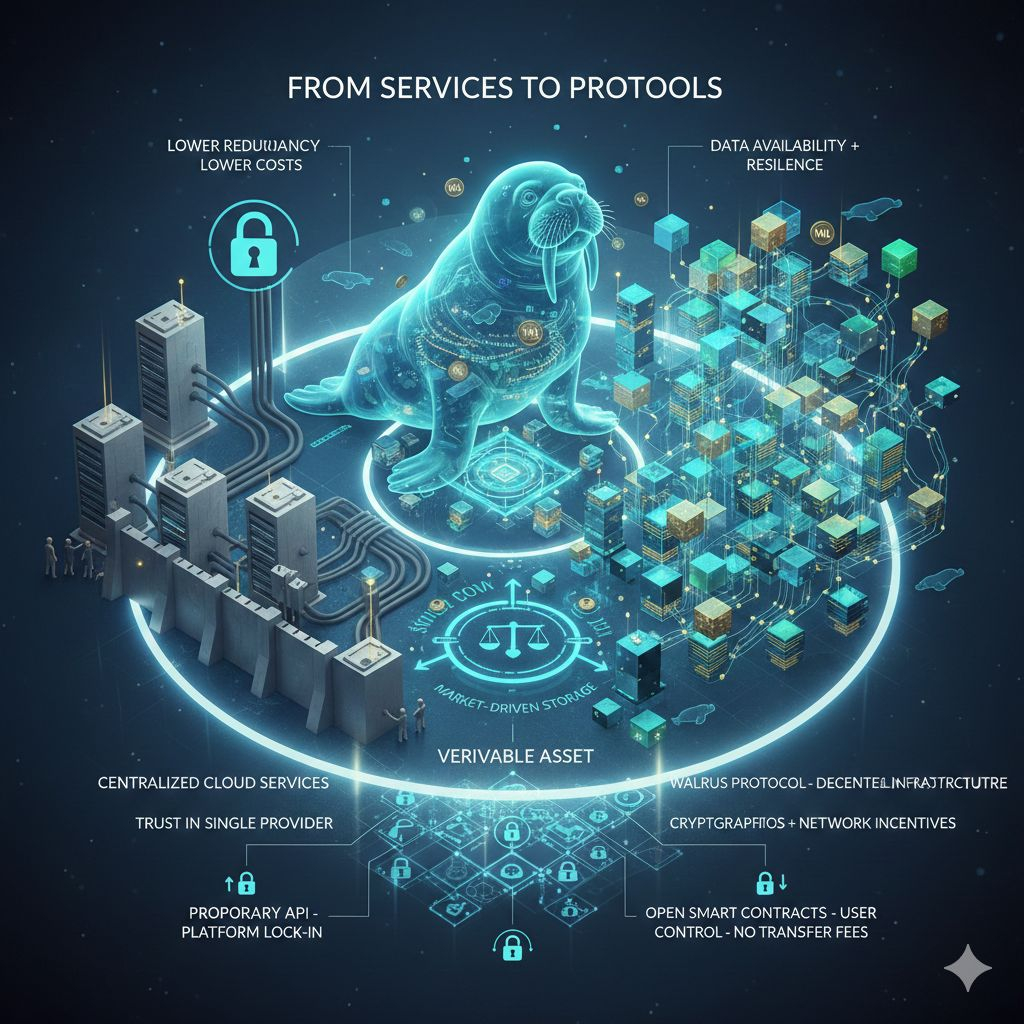
In doing so Walrus establishes more than just another decentralized storage network. It introduces a new economic model for data itself. Storage becomes a tradable verifiable and programmable asset governed by protocol rules rather than corporate policies. This shift marks one of the most significant changes in digital infrastructure since the rise of cloud computing redefining how data is stored valued and trusted across the internet.
By replacing subscriptions with markets and trust with proof Walrus signals a structural transformation in how storage infrastructure is designed deployed and governed. It is a move away from service dependency toward protocol sovereignty and it may well define the next era of global data infrastructure.