
The crypto market right now doesn’t feel “red or green” anymore, it feels like constant interference: good news flashes on and off, and price twitches like it’s feeling its way through fog. People keep saying capital is coming back, but the mood underneath is still a low, steady tension, like everyone’s afraid that if they blink, the whole phase flips again.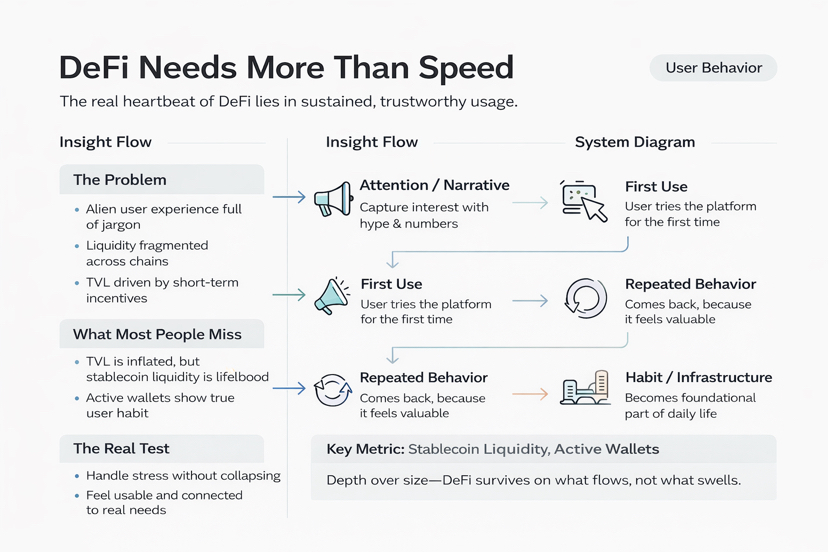
I’ve been hearing “blockchain will change the world” for so long that sometimes I find myself asking the question: “How many projects have actually changed the world?”
DeFi was supposed to bring financial freedom, but the more you dig, the more it feels like a tech system speaking to itself. TVL, APR, multi-chain... sounds very impressive, but every time you open a wallet, it still feels very alien and clinical, like entering a factory with no windows.
I think DeFi’s problem today isn’t a lack of speed, it’s a lack of reason. It’s like a machine running itself into a frenzy, getting faster and faster while forgetting why it exists.
Liquidity is fragmented like water trapped behind hundreds of small dams. Each chain is its own “island,” pumping and draining itself, while users get thrown across a maze of wallets, bridges, farms, and swaps. It’s truly ironic: something called “open finance” ends up making people feel locked inside an operational labyrinth.
Some days I stare at a DeFi interface and it feels… inhuman, like it doesn’t want me to understand, it just wants me to comply. And then I started reading about Plasma, not the way you read something hunting for a “quick flip,” but the way you read when you’ve seen hype arrive first and reality show up later.
Plasma talks about numbers like TVL, stablecoin liquidity, active wallets, but what made me pause wasn’t the dashboard, it was the way they talk about liquidity as something programmable, something that can move, adapt, and regenerate. I still remember that feeling: not “wow,” but “yeah… that makes sense.” A calm logic, mature, and not trying to shout.
In plain words, this is how I understand Plasma: they don’t just want to speed up capital, they want liquidity to behave like a living organism, something that moves to where it’s needed most.
“Programmable Liquidity” sounds technical, but in my head it resembles a circulatory system. Capital doesn’t sit still as a TVL trophy, it circulates with intent. In that design you run into concepts like Vanilla Assets, maAssets, and EOL (Ecosystem-Owned Liquidity). I’m not trying to dress it up, but the easiest way to picture it is this: Vanilla Assets are the simple “base” assets, while maAssets are a kind of “shape-shifting” asset layer that lets the same underlying resources work in different roles without breaking the flow.
And EOL feels like discipline: liquidity isn’t just rented through short-term incentives and gone tomorrow, it gradually belongs to the ecosystem itself, like a body learning to make its own blood.
Maybe because I’m exhausted by the old DeFi pattern of “pour incentives to inflate TVL,” I’m more sensitive to systems built for long-term operations.
I’ve watched TVL swell purely on rewards, then deflate like soap bubbles the moment APY drops. Stablecoin liquidity is different, it’s closer to oxygen than makeup, because stablecoins are what people actually use to live inside DeFi: to trade, to pay, to defend themselves when volatility hits.
Active wallets are a different question entirely: they’re traces of behavior, habits, people coming back not because they were baited, but because something felt usable and trustworthy.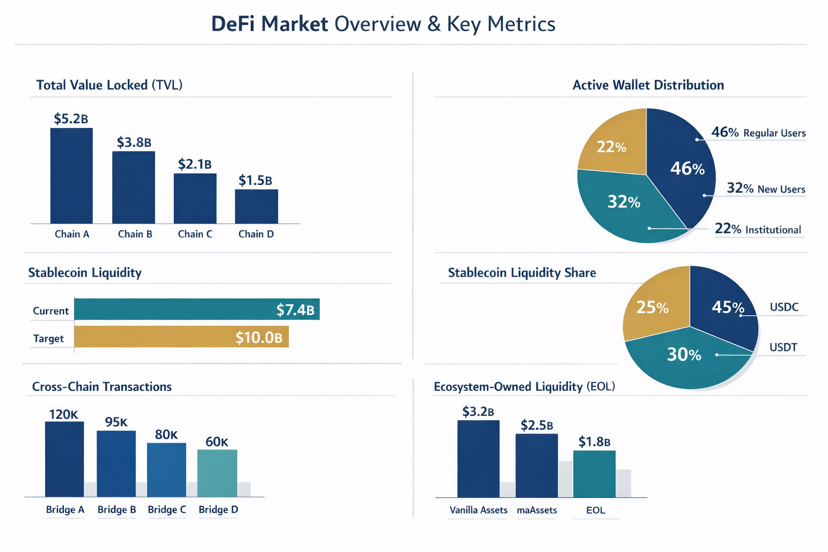
So which numbers matter most for Plasma? I think… if I had to pick a “soul,” I’d look at stablecoin liquidity and active wallets before TVL. TVL is often just a snapshot, while stablecoin liquidity is like blood flow, and active wallets are like a heartbeat. TVL says “how much money is sitting here,” but stablecoin liquidity and active wallets say “how much life is happening here.” It’s truly ironic: the market worships what looks big, while systems survive on what flows steadily.
But I’m not going to lull myself with poetry. Plasma might be pointing in the right direction conceptually, but reality is always ruthless: liquidity only “breathes” if it can handle stress, if it doesn’t collapse under a few shocks, if incentives don’t turn the whole thing into a short-term game. And more than anything, it has to touch human experience.
If users still have to wrestle with bridges, still feel their hand shake over fees and confirmation times, then every cyclical philosophy is just a nice lecture.
What keeps a small piece of belief alive for me is that Plasma doesn’t seem to chase hype, doesn’t try to scream “DeFi 2.0,” it feels like a team quietly laying foundations. While many projects try to prove they’re “more decentralized,” Plasma seems to choose “more connected” — between people, capital, and the operating system underneath. Something about that feels unusual: a preference for continuity, for flow, for what it feels like to use the thing over time.
And then I realized: maybe blockchain doesn’t need more speed, it needs more heartbeat. DeFi doesn’t need more yield formulas, it needs more breath.
If @Plasma can actually build a circulatory system where liquidity can move like a living organism learning to breathe, like a cell dividing to regenerate a network, then numbers like TVL will be a consequence, not the goal. The project may not be perfect, but if blockchain can truly “live,” then maybe this is where it starts to breathe.

