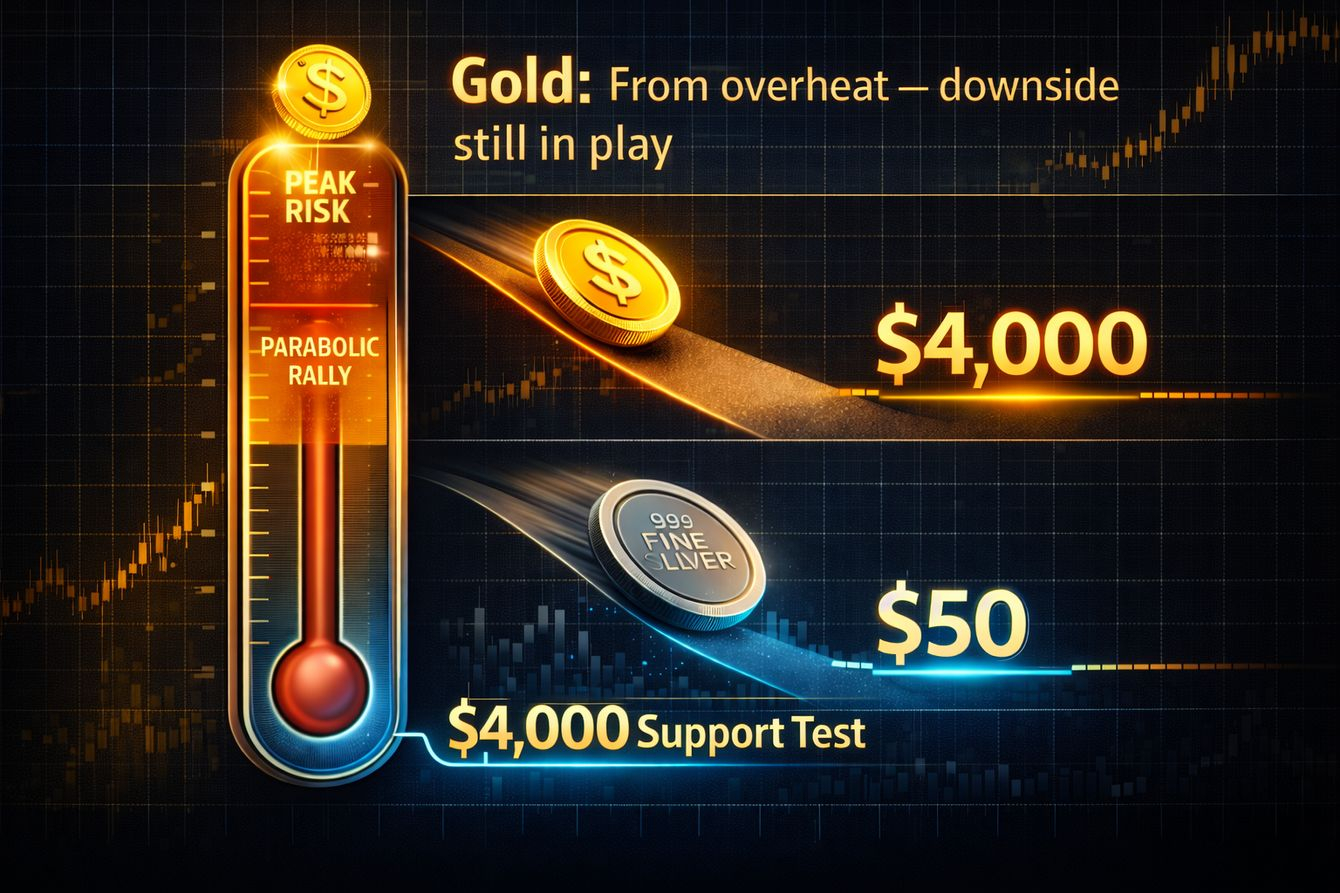
The meteoric rise of gold and silver at the start of 2026 has caught the eyes of investors globally, but a sobering warning is emerging from the desk of Mike McGlone, Senior Market Strategist at Bloomberg Intelligence. While the yellow metal has displayed incredible strength, McGlone suggests that the "parabolic" nature of January’s rally may actually be a harbinger of a significant market peak. Though the sheer momentum of the trade could theoretically push gold as high as $6,000 an ounce, the more probable outcome is a return to fundamental reality, with a potential slide back to test support at $4,000.
The High-Price Cure and Market Stretches
The current market environment is characterized by gold being significantly overextended when compared to broader commodity indices. McGlone points to the Bloomberg Commodity Index (BCOM)/gold ratio as a primary indicator of this imbalance. Historically, this ratio sat at a base of 100 in 1960 and marked significant lows (around 50) during major market shifts in 1980, 1987, and 2020. With the ratio currently trading near 32, gold appears exceptionally "stretched" against tangible assets.
This extreme divergence suggests that either broad commodities are undervalued or gold has entered a territory where the risk/reward profile is no longer favorable for new buyers. When prices move with such velocity, the underlying fundamental supports often struggle to keep pace, leaving the asset vulnerable to a sharp "mean reversion."
Gold as a Relative Performer
Despite the cautionary outlook on price, the metal's role within a diversified portfolio remains a point of interest. McGlone notes that gold is currently overvalued relative to inflation—a condition not seen with such intensity since the end of the gold standard in 1971. However, the gold/S&P 500 (SPX) ratio offers a different perspective.
Historic Highs: About 15 years ago, the ratio peaked near 1.7x.
Current Standing: On February 3, the ratio was recorded at 0.71x.
This suggests that while gold may be expensive in isolation, it is still less than half of its 2011 high when measured against equities. Consequently, if the stock market faces a significant correction, gold could still act as a superior hedge and outperform equities on a relative basis, even if its nominal price enters a downward trend.
The Outlook for Silver
The "devil’s metal" has not been immune to this volatility. Silver’s sharp decline in early February has already begun to push the gold/silver ratio back toward historical norms, moving it to 56.6 points. McGlone believes that while silver could see a return to its recent highs of $121.65, the more natural path for the volatile metal is a reversion toward $50. Much like gold, the rapid gains in silver appear to have created an "up-too-much" risk that typical market cycles eventually correct.#ADPDataDisappoints #WhaleDeRiskETH #EthereumLayer2Rethink? #TrumpEndsShutdown