
The @Walrus 🦭/acc is becoming an important part of the Sui ecosystem. It is helping to make sure that the next generation of decentralized applications are private, secure and work well. The Walrus is working closely with Nautilus Seal and the SP1 zkVM to make this happen. They want to show what a good Web3 infrastructure should look like when keeping data safe and being trustworthy are the priorities, not just extra features. The Walrus is doing this by making sure that privacy and security are built in from the start so people can trust these applications.
Walrus is really good at providing a way for people to store and share data without needing an authority. This is especially useful for applications. For people building things on Sui Walrus helps them keep information safe like the state of their application things that users have created and secret codes. Walrus is, like a base that things can be built on. It gets even better when you use it with tools that help keep things private and verify information without giving away secrets. Walrus and these other tools work well together to make things more secure.
Nautilus is a system that helps keep contracts private when they are being executed on Sui. This means that the logic of the contract can run without anyone seeing the details. When people build things with Nautilus they might need to store information or big private files. That is where Walrus comes in. It is like a storage space. Walrus can hold data and keep it safe. At the time Nautilus makes sure that only the right people can see this data and that it stays private. This way of doing things lets developers build apps that keep peoples information private without losing the benefits of decentralization or making the system slow. Nautilus and Walrus work together to make this happen for apps, on Sui.
Seal helps with this by making sure that people can share data safely and only show it to those who are supposed to see it. Applications can use Seal to decide who gets to unlock or use information and Walrus makes sure that this information is always available and cannot be changed by someone who should not be changing it. Seal and Walrus work together to make kinds of applications possible like private gaming, secret DeFi strategies and sharing regulated data in a way that lets the users stay in charge of Seal and Walrus and the data they are helping to protect with Seal.
The integration with SP1 zkVM is really useful because it adds a way to verify things. Developers can make proofs called zero knowledge proofs, about things that are calculated outside of the main system or private information that is stored on Walrus. Then they can check those proofs on Sui to make sure they are correct. This means that people can show that something is correct or that it was done properly without having to share the information that was used. Walrus is like a reference point, for the information that is used to make the proofs and the results of those proofs. SP1 zkVM makes sure that everything is honest and works correctly.
When you look at all of these collaborations they make sense as a system. Walrus is in charge of storing data in a way that is not controlled by one person and making sure that data is available. Nautilus makes sure that things are done privately. Seal is responsible, for who can access and share things. The SP1 zkVM provides a way to prove that something is true. Can be checked. All of these things are built on top of Sui, which means that developers can make applications that're able to handle a lot of users are private and do not require a lot of trust right from the start.
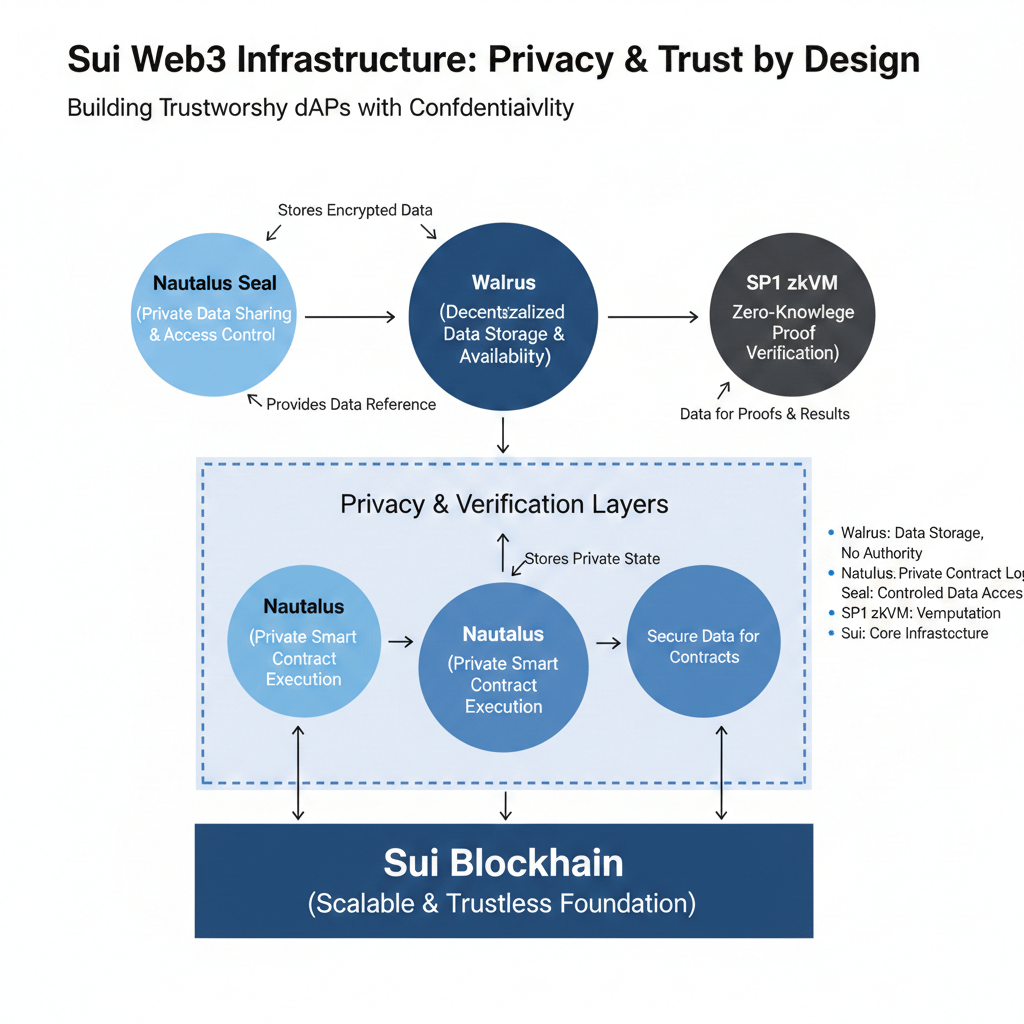
As the Sui ecosystem evolves Walrus role as connective tissue across privacy and verification layers positions it as a foundational primitive. The result is a new generation of dApps that can safely operate in open networks while meeting real world requirements for confidentiality and trust.

