

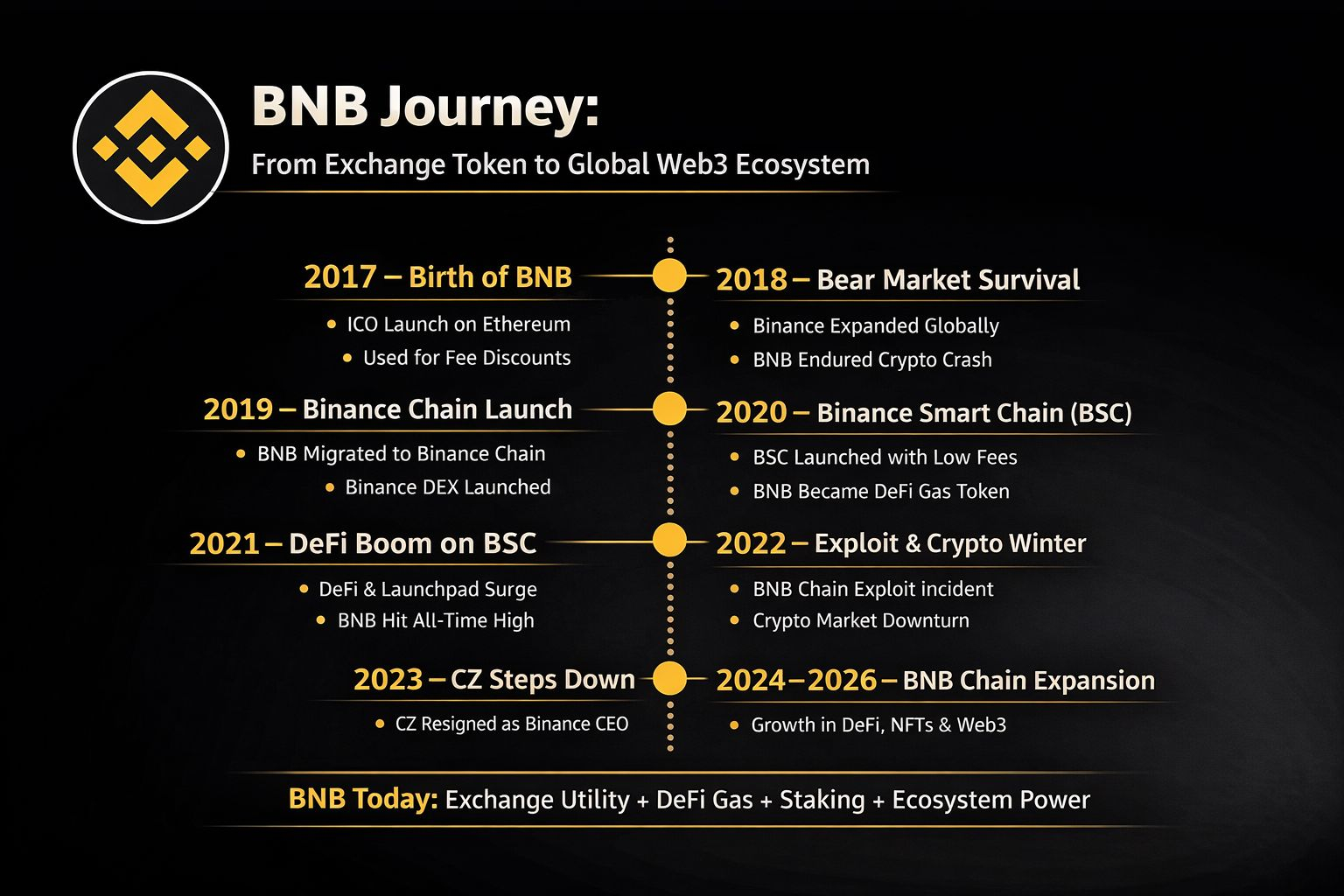
 BNB is one of the rare crypto assets that didn’t just survive multiple market cycles it evolved in every cycle. What started as a simple exchange utility token later became the gas token of one of the world’s most active blockchain ecosystems.
But if you really want to understand BNB, you can’t start from 2017. You have to start from before Binance even existed because BNB was born out of a very specific problem in crypto.
This is the full story of BNB: from pre-launch background, to the ICO, to Binance Chain, BSC, BNB Chain, burns, controversies, and its role today.
1. Before BNB: The Crypto Market Needed a New Type of Exchange
In 2016–2017, crypto exchanges were growing rapidly, but the user experience was still painful. Trading platforms were slow, customer support was weak, and listing new coins was a long process. Fees were high, liquidity was fragmented, and most exchanges felt outdated.
At the same time, the ICO boom was heating up. Thousands of new tokens were launching, and traders wanted access to them as early as possible. The demand was clear:
• Faster listings
• Better liquidity
• More trading pairs
• A global exchange that moves aggressively
That environment created the perfect opportunity for a new exchange model. That exchange became Binance.
And the token that powered its internal economy became BNB.
2. The Founder Behind BNB: Who Created Binance Coin?
BNB was created under the leadership of Changpeng Zhao (CZ), the founder of Binance.
CZ is known in the crypto world not just as a businessman, but as someone with a strong technical background. Before launching Binance, he worked in financial technology systems and later moved into crypto infrastructure. He was involved in the early development side of crypto exchanges and wallet ecosystems.
This mattered because Binance was not built like a slow corporate exchange. It was built like a startup that wanted to dominate the global market quickly.
CZ understood something early:
If you build the fastest exchange, you don’t just get users you get the entire market’s attention.
BNB was designed as the token that would grow along with that exchange.
3. Why Binance Needed a Token in the First Place
Many people think BNB was launched only to give fee discounts. That was the visible reason. But the deeper reason was strategic.
Binance wanted:
• a way to reward early adopters
• a loyalty system to retain traders
• an internal economic model that benefits Binance users
• a token that becomes stronger as Binance becomes bigger
BNB created a system where Binance growth and token demand were connected.
In simple words:
If Binance wins, BNB wins.
That single idea is the foundation of BNB’s long-term strength.
4. The Birth of BNB: The 2017 ICO Launch
BNB officially launched in July 2017, during the peak of the ICO era.
At that time, Binance was still new, but it was moving aggressively and already building traction. Binance raised capital through an ICO and introduced Binance Coin (BNB) as the main token of its ecosystem.
BNB Was Originally an ERC-20 Token
At launch, BNB was an ERC-20 token on Ethereum.
This is an important detail because it shows BNB was not initially its own blockchain coin. It started as an Ethereum-based token.
Total Supply
The maximum supply was set at:
200,000,000 BNB (200 million)
Token Distribution
BNB distribution was structured as:
• 50% sold to public investors (ICO participants)
• 40% allocated to the founding team
• 10% allocated to angel investors
This was the earliest tokenomics foundation of BNB.
5. The First Utility of BNB: Trading Fee Discounts
When BNB launched, its main use case was:
✅ Pay trading fees on Binance at discounted rates.
This was a simple but powerful strategy. Traders were always looking for ways to reduce fees, especially high-frequency traders. Binance used BNB as a loyalty tool to keep users inside the Binance ecosystem.
The more a person traded, the more useful BNB became.
This created consistent demand.
BNB was no longer just “another token.” It was directly connected to Binance trading activity.
6. Binance’s Rapid Growth: The First Phase of BNB Adoption
Between late 2017 and early 2018, Binance grew at an unbelievable speed.
Binance became popular because:
• it listed coins faster than competitors
• it offered many trading pairs
• it expanded globally
• it had a strong referral model
• it had a simple and fast user interface
As Binance trading volume increased, BNB demand also increased. Traders wanted BNB to reduce fees, and that created continuous buying pressure.
BNB’s price began to rise not just because of speculation, but because of actual platform utility.
7. The Deflation Model: Quarterly Token Burns (BNB Burn System)
One of the most important innovations Binance introduced was the burn system.
Binance announced that it would use part of its profits to buy back and burn BNB.
Burn means the tokens are destroyed permanently, reducing supply.
Binance’s Burn Promise
Binance promised to burn BNB until supply reduced from:
200 million → 100 million
This created a powerful long-term narrative:
• Binance is growing
• BNB demand is increasing
• supply is decreasing
That combination made BNB attractive for long-term holders.
It was one of the earliest examples of a structured deflation model in crypto.
8. 2018 Bear Market: The Survival Test
The 2018 bear market destroyed thousands of ICO tokens. Most of them never recovered.
BNB survived for one key reason:
Binance remained relevant and kept expanding.
Even in a bear market, Binance continued building products, adding trading pairs, improving liquidity, and expanding into new markets.
BNB did not collapse like typical ICO coins because its value was tied to the world’s fastest-growing exchange.
This period proved that BNB had real economic support behind it.
9. Binance Launchpad: BNB Becomes a “Ticket” to Early Opportunities
Another major turning point was Binance Launchpad.
Launchpad allowed users to participate in new token launches. But there was a catch:
To participate, users often needed to hold BNB.
This changed BNB’s role dramatically.
BNB was no longer just a fee discount token.
It became:
✅ a gateway asset to early investments
During the IEO era, many people bought BNB specifically to join Launchpad sales. This created massive demand spikes whenever a popular token sale was announced.
BNB started behaving like a strategic asset.
10. Binance Chain (2019): The Migration Away From Ethereum
In April 2019, Binance launched its own blockchain called:
Binance Chain
This was a huge milestone.
BNB migrated from Ethereum and became the native asset of Binance Chain.
Binance Chain was designed for:
• fast transactions
• token issuance
• decentralized exchange operations
Binance DEX
Along with Binance Chain, Binance launched Binance DEX, a decentralized exchange.
BNB became the main token used for:
• transaction fees
• trading operations
• ecosystem activity
This was the first time BNB became a blockchain coin rather than an ERC-20 token.
11. BEP-2 Standard: The Token Standard of Binance Chain
Binance Chain introduced the BEP-2 token standard.
Many assets were issued using BEP-2, and BNB remained the central fuel asset of this system.
However, Binance Chain was optimized for speed, not smart contracts. It did not offer the full programmable environment that Ethereum had.
Binance knew the next step would be smart contracts.
That next step changed crypto history.
12. Binance Smart Chain (BSC) 2020: The Biggest BNB Revolution
In September 2020, Binance launched:
Binance Smart Chain (BSC)
This was arguably the biggest event in BNB’s entire history.
At that time, Ethereum gas fees were extremely high. DeFi was booming, but retail users couldn’t afford $50–$200 transaction fees.
Binance saw the opportunity and launched BSC with a clear mission:
Low fees + high speed + Ethereum compatibility.
Key Feature: EVM Compatibility
BSC was built to be compatible with Ethereum’s tooling and smart contracts.
That meant developers could easily port Ethereum dApps to BSC.
This was a major adoption accelerator.
BNB became the gas token for this new smart contract chain.
Now BNB had a completely new demand driver:
✅ Every DeFi transaction needed BNB.
13. PancakeSwap and the DeFi Boom: BNB’s Demand Explosion
Soon after BSC launched, projects like PancakeSwap exploded in popularity.
BSC became the home of:
• yield farming
• staking
• liquidity pools
• meme coins
• GameFi projects
• NFT marketplaces
Because transactions were cheap, millions of users moved to BSC.
BNB became the fuel of all this activity.
This was not “marketing demand.” It was real on-chain demand.
BNB became a true ecosystem asset.
14. Centralization Criticism: The BSC Debate
BSC’s rapid growth brought criticism.
Many crypto communities argued:
• validator set was limited
• Binance influence was strong
• chain was more centralized than Ethereum
This criticism became a long-term debate.
But Binance’s response was indirect: it focused on usability and adoption.
For most users, cheap and fast transactions mattered more than ideological decentralization.
BSC became one of the most used blockchains in the world.
15. 2021 Bull Market: BNB Enters the Global Elite
During the 2021 bull market, BNB reached a new level of global recognition.
BNB became a top market cap asset because:
• Binance was dominating exchange volume
• BSC DeFi activity was booming
• Launchpad and Launchpool demand was strong
• token burns continued
• BNB became widely integrated into wallets and platforms
BNB transformed into one of the most powerful “ecosystem coins” ever created.
16. Launchpool, BNB Vault, and Staking Utility Expansion
Binance continued strengthening BNB’s value through:
Binance Launchpool
Users could stake BNB and earn new tokens.
This created a passive earning model:
• Hold BNB
• Stake BNB
• Earn new project tokens
BNB Vault
BNB Vault combined multiple earning opportunities in one product.
This increased long-term holding behavior and reduced sell pressure.
BNB became more than a coin. It became a yield asset inside Binance’s ecosystem.
17. BNB Tokenomics Evolution: From Profit Burns to Auto-Burn
Initially, BNB burns were based on Binance’s profits.
Later Binance introduced:
BNB Auto-Burn Mechanism
This model calculates burns based on:
• BNB market price
• number of blocks produced on BSC
This made burns more transparent and less dependent on Binance revenuezilla’s reported revenue.
Auto-burn strengthened BNB’s credibility as a deflationary asset.
18. BEP-20 Standard: BSC’s ERC-20 Equivalent
On BSC, the token standard became:
BEP-20
This is BSC’s equivalent of Ethereum’s ERC-20.
Thousands of tokens launched using BEP-20, including major DeFi protocols and meme coins.
BNB was required for every swap, transfer, and interaction.
This created continuous on-chain demand.
19. The Dark Side: Scams, Rug Pulls, and Copy-Paste Projects
BSC’s low fees made it easy to launch tokens.
This attracted innovation, but also attracted scams.
During 2021, BSC became known for:
• rug pulls
• fake DeFi projects
• copy-paste yield farms
• meme scams
BNB itself was not a scam, but the ecosystem suffered reputation damage because many bad actors used BSC.
This became one of BNB Chain’s biggest long-term challenges: trust management.
20. BNB Chain Rebranding: “Build and Build”
Binance later rebranded the ecosystem.
Binance Smart Chain and Binance Chain were unified under:
BNB Chain
BNB was also redefined as:
“Build and Build”
This was a strategic move to reduce the perception that BNB Chain exists only for Binance.
BNB Chain started positioning itself as a broader Web3 platform.
21. Governance and Validators: How BNB Chain Operates
BNB Chain uses a validator-based model where a limited number of validators produce blocks.
BNB is used for:
• staking
• validator participation
• governance decisions
• network security economics
This makes BNB not only a gas token, but also a network security asset.
22. Major Security Incident (2022): The BNB Chain Exploit
A major event in BNB Chain history was the bridge exploit that resulted in unauthorized minting.
The chain was temporarily halted to manage the incident, which triggered a big debate around decentralization.
This incident showed two sides:
• the risk of bridge vulnerabilities
• the ability of BNB Chain governance to respond quickly
The ecosystem recovered, but the event remained a major historical mark.
23. Crypto Winter and Exchange Trust Crisis (2022)
The 2022 bear market was brutal.
Many platforms collapsed, including major names in the industry.
After the FTX collapse, centralized exchanges faced extreme scrutiny.
Binance became the center of attention because it was the largest exchange.
BNB’s market sentiment during this time became heavily linked to one question:
Can Binance remain stable through global regulatory pressure?
Despite fear in the market, Binance survived and continued operations.
BNB remained one of the strongest large-cap coins in the bear market compared to many other assets.
24. Regulatory Pressure: Binance Under Global Attention
Binance faced increasing regulatory pressure across multiple jurisdictions.
This included:
• compliance investigations
• stricter licensing requirements
• legal settlements
• and operational adjustments in different countries
This period increased uncertainty for BNB because BNB is closely connected to Binance’s global brand.
However, Binance continued expanding in many markets and kept building new products.
25. CZ Steps Down (2023): A Historic Turning Point
One of the biggest historical moments for Binance and BNB happened when CZ stepped down as CEO.
This event created major fear in the crypto market, because CZ was not just the CEO he was the face of Binance.
Many people expected BNB to collapse permanently.
But the opposite happened over time:
• Binance continued operating normally
• leadership transitioned
• products continued
• BNB remained relevant
This proved that BNB had grown beyond being only “CZ’s token.”
It had become an ecosystem asset.
26. What BNB Represents Today
Today BNB is not one thing. It is multiple things at once.
BNB as an Exchange Utility Token
BNB is still used for:
• trading fee discounts
• VIP benefits
• participation in Launchpad
• participation in Launchpool
• access to Binance ecosystem perks
BNB as a Blockchain Gas Token
BNB is the fuel for:
• DeFi swaps
• staking protocols
• NFT marketplaces
• GameFi ecosystems
• on-chain governance
BNB as a Network Asset
BNB is used for:
• staking
• validator participation
• security economics
BNB as an Ecosystem Liquidity Asset
BNB is widely integrated across:
• wallets
• bridges
• dApps
• centralized and decentralized exchanges
BNB is essentially the heart of the Binance ecosystem.
27. BNB Burns Today: Deflation Continues
BNB remains deflationary because supply is continuously reduced through burns.
Burn mechanisms include:
• Auto-burn based on chain metrics
• gas fee burning mechanism
• periodic ecosystem burn events
The long-term goal remains to reduce total supply toward 100 million BNB.
This makes BNB one of the few major crypto assets with structured supply reduction.
28. Why BNB Became One of Crypto’s Most Successful Tokens
BNB succeeded because it had a rare combination:
• a strong exchange supporting it
• real utility demand
• burn-driven deflation narrative
• blockchain adoption
• DeFi activity
• long-term ecosystem expansion
Most exchange tokens remain limited.
BNB expanded into an entire chain economy.
That’s why it stands in a different category.
29. The Biggest Strength of BNB
BNB’s biggest strength is its network effect.
BNB has demand from:
• traders
• DeFi users
• Launchpool farmers
• long-term investors
• builders
• ecosystem participants
This diversified demand makes BNB stronger than most utility tokens.
30. The Biggest Risks of BNB
BNB is strong, but not risk-free.
Key risks include:
Binance dependency
BNB’s reputation is connected to Binance operations.
Regulatory uncertainty
If Binance faces restrictions in major markets, BNB sentiment can weaken.
Ecosystem scams
Low fees attract bad actors, and that can hurt chain trust.
Competition
Ethereum Layer 2 networks, Solana, and other high-performance chains continue competing for developers and liquidity.
BNB’s future strength depends on how well the ecosystem maintains trust and long-term adoption.
31. The Future of BNB: What Comes Next?
BNB’s future is driven by three major factors:
1. BNB Chain real-world adoption
If BNB Chain becomes a mainstream payment and DeFi infrastructure chain, BNB can remain dominant.
2. Developer growth
A chain survives long-term only if developers keep building high-quality applications.
3. Binance’s global stability
Binance’s compliance evolution will decide how stable the BNB narrative remains in the long run.
If these three pillars remain strong, BNB can continue as one of crypto’s most important ecosystem coins.
Final Thoughts: The Real Story of BNB
BNB started as an exchange discount token.
Then it became:
• a launchpad ticket
• a deflationary asset
• a blockchain gas coin
• a DeFi ecosystem fuel
• a staking and validator asset
• a global Web3 infrastructure token
Very few crypto assets have successfully transformed so many times.
BNB is not just a token. BNB is the economic engine of Binance’s entire ecosystem.
And that is why it continues to stay relevant in every cycle.
Disclaimer
This post is for educational purposes only and does not constitute financial advice. Always do your own research and manage risk responsibly.