
Dusk did not arrive with noise. It did not come shouting about revolution or promising overnight change. It arrived quietly in 2018 shaped by a question that felt almost uncomfortable in the blockchain world at that time. What happens when this technology has to live inside real finance instead of sitting outside it. I am seeing now that this question became the soul of the project. While others were focused on speed speculation and escape from rules Dusk was focused on responsibility. They were not trying to break the system. They were trying to understand it deeply enough to rebuild it with care.
In the early days blockchain felt like a protest. It was about removing middlemen and avoiding oversight. That energy was powerful but it also created distance from reality. Finance does not exist in a vacuum. It is built on trust law and long standing human agreements. If it becomes detached from these foundations it may grow fast but it rarely lasts. Dusk started with the belief that for blockchain to matter long term it must be able to survive under scrutiny. We are not talking about rebellion. We are talking about maturity.
At the heart of Dusk lies a different understanding of privacy. In many systems privacy is treated as invisibility. The idea is to hide everything from everyone. Dusk does not see privacy that way. Here privacy is closer to dignity. It is the ability to protect sensitive information while still being able to prove what needs to be proven. Under the surface cryptographic techniques allow transactions and assets to be verified without exposing their full details. This matters deeply in finance. Institutions do not want darkness. They want controlled clarity. They want to demonstrate compliance without revealing confidential data to the entire world.
I am realizing how human this design choice is. People want safety but they also want accountability. They want to know that systems are fair without giving up their entire identity. If it becomes possible to balance these needs then blockchain stops being an experiment and starts becoming infrastructure. We are seeing privacy framed not as hiding but as selective sharing. That shift changes everything.
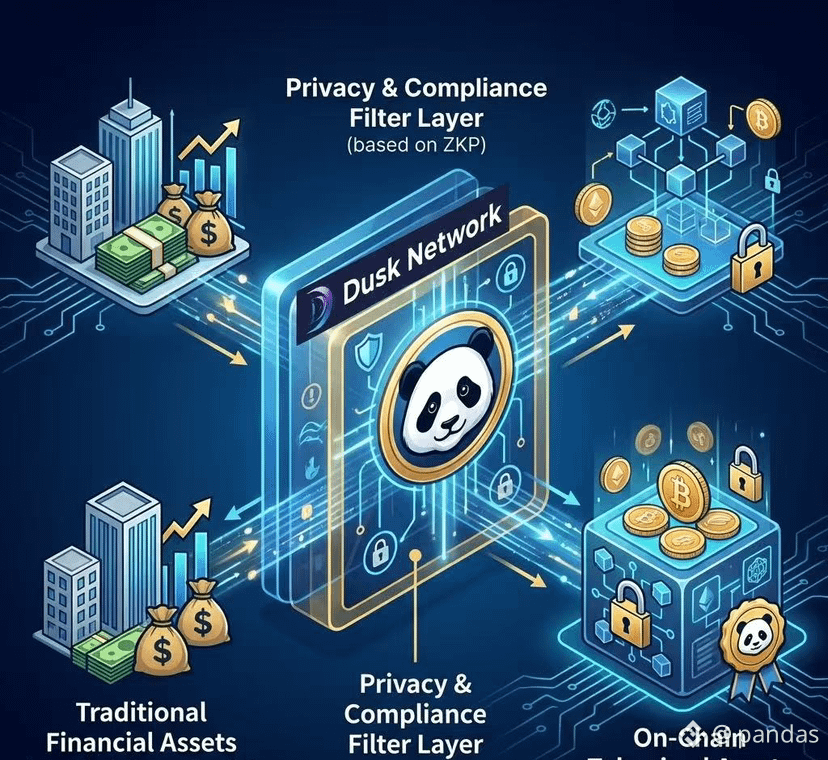
Dusk chose to build as its own Layer 1 network and that decision reveals a lot about its character. Building on top of an existing chain would have been faster and cheaper. Many projects take that route. But it also means inheriting assumptions and limitations that may not fit regulated finance. Dusk needed control over its foundation. Consensus privacy and compliance needed to speak the same language. Compromise at the base would echo forever.
This choice required patience. Layer 1 development is slow and demanding. Mistakes are costly. Progress feels quiet. But I am seeing how this patience creates coherence. Every part of the system is designed with the same values in mind. If it becomes strong it will be because nothing was rushed. We are watching roots grow before branches appear.
The architecture of Dusk reflects an acceptance of change. Finance is not static. Regulations evolve. Technology advances. Markets behave unpredictably. Dusk does not pretend otherwise. Its modular design allows parts of the system to be upgraded without tearing everything apart. This flexibility is not about chasing trends. It is about survival.
I am noticing that this mindset feels very different from the usual promise of perfection. Dusk does not claim to have the final answer. It assumes that future adjustments will be necessary. If new standards emerge the system can adapt. If rules change the network can respond without panic. We are seeing humility built into code.

One of the most serious areas Dusk touches is the tokenization of real world assets. This is often spoken about as the future of finance but it is also one of the most sensitive spaces. When you tokenize equity debt or financial instruments you are not just moving data. You are representing legal rights and obligations. Mistakes here can harm real people.
Dusk approaches this area with caution. Identity verification auditability and compliance are treated as essential elements not optional add ons. I am seeing a respect for capital and for the systems that protect it. Institutions are not looking for excitement. They are looking for safety reliability and clarity. If it becomes successful in this area it will be because trust was earned slowly.
Progress in Dusk is measured differently than in many blockchain projects. Instead of focusing only on daily transaction counts or social media noise the project looks at deeper signals. Are institutions continuing to engage. Are pilots turning into long term implementations. Are developers confident enough to build without fear of sudden changes.
These metrics matter because they reflect commitment. Attention can be bought but trust must be earned. I am seeing progress measured in stability and continuity. If people stay and build then the system is doing something right. We are seeing patience valued over spectacle.
Technology often fails when it ignores human behavior. Dusk seems deeply aware of this. People want privacy but they also want clarity. Institutions want innovation but fear chaos. Regulators want oversight but do not want to micromanage every action. These tensions are real.
Dusk is designed for imperfect humans living in complex systems. It does not assume ideal behavior. Instead it tries to make responsible behavior easier than reckless behavior. If systems reward caution and transparency stability emerges naturally. We are seeing ethics expressed not through slogans but through architecture.
There are risks and Dusk does not pretend otherwise. Privacy technology is complex and can be misunderstood. Users may misuse tools. Regulations can tighten suddenly. Market pressure can push teams to chase short term gains. These are real challenges.
What stands out is the lack of illusion. Dusk accepts slower growth in exchange for resilience. By aligning early with compliance and realistic use cases the project reduces existential risk. I am seeing preparation instead of reaction. If it becomes tested under pressure the foundation is already shaped to hold weight.
In a market obsessed with disruption Dusk is focused on continuity. It is not trying to replace everything overnight. It is trying to fit into the world as it exists while slowly improving it. This approach does not create headlines quickly but it creates durability.
I am seeing belief in steady construction and long term thinking. If Dusk becomes widely used it will not feel sudden. It will feel earned. Institutions will trust it because it respects their constraints. Developers will build on it because it is predictable. Regulators will understand it because it was designed with them in mind.
There is something deeply human about this journey. Dusk feels less like a product and more like a commitment. A commitment to build technology that can live in the real world without breaking it. A commitment to privacy that respects law. A commitment to progress that does not sacrifice stability.
Everything that lasts is built this way. Quietly carefully and with restraint. Dusk is not chasing applause. It is building something meant to remain standing when excitement fades. I am believing that resilience comes from alignment not rebellion.
If it becomes foundational one day it will be because the harder path was chosen early. We are seeing what happens when builders think beyond cycles and focus on decades. That belief carried forward patiently is how something real is built to last.