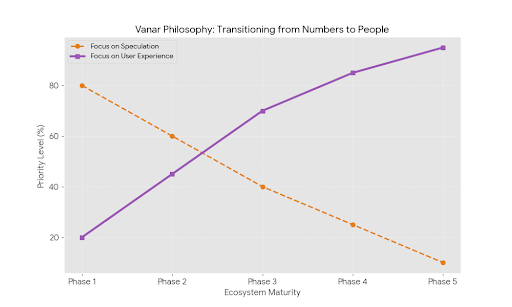
 When you look at most blockchains, you can feel what they were designed for. Trading comes first. Numbers come first. Speed, fees, and charts dominate the conversation. Users are often an afterthought. Vanar feels like it started from a different place.
Vanar begins with a simple observation. People do not wake up wanting to use a blockchain. They wake up wanting to play games, explore digital worlds, follow stories, collect things they care about, and spend time in communities that feel alive. If blockchain cannot fit naturally into those behaviors, it will always remain niche.
That idea sits quietly underneath everything Vanar is building.
What Vanar actually is, when you strip away labels
Yes, Vanar is a Layer 1 blockchain. But thinking of it only as a chain misses the point. Vanar behaves more like infrastructure for digital experiences. It is meant to sit underneath games, metaverse environments, entertainment platforms, and brand driven products without constantly reminding users that it is there.
The team behind Vanar comes from industries where users are unforgiving. In games and entertainment, if something feels slow, confusing, or broken, people leave immediately. There are no second chances. That mindset shows up in how Vanar is designed.
Instead of expecting users to learn wallets, gas, and transaction mechanics, Vanar tries to absorb that complexity into the system itself. The goal is not to educate everyone about crypto, but to make crypto quietly functional.
Why Vanar matters in a bigger sense
Crypto does not lack innovation. It lacks continuity. People move from one app to another, one chain to another, one trend to another, without building any lasting relationship with the technology.
Vanar tries to address this by creating an environment rather than isolated applications. The idea is that once a user enters through one product, a game for example, they should be able to move naturally into other experiences without resetting their identity or learning everything again.
This kind of continuity is normal on the internet. It is rare in Web3. Vanar is attempting to close that gap.
How Vanar works without making noise about it
Vanar runs its own independent blockchain so it can control the things that matter most for consumer products. Stability, predictable fees, and fast confirmations matter more here than extreme theoretical performance.
For developers, the system tries to remove unnecessary work. Shared tools, common standards, and reusable infrastructure mean teams can focus on making good experiences instead of rebuilding the same backend over and over.
For users, the ideal outcome is simple. Things just work. Transactions complete quickly. Assets behave as expected. The blockchain fades into the background, doing its job without demanding attention.
The role of the VANRY token, realistically
The VANRY token exists because the network needs an internal economic system. It is used for fees, staking, and securing the chain. But Vanar does not try to turn the token into the main story.
In this system, value is supposed to come from activity, not promises. When people use applications built on Vanar, value flows through the network. The token benefits because the network is alive, not because it is loudly promoted.
Validators stake VANRY to secure the chain, which ties long term holders to the health of the system. Developers interact with the token as part of building and maintaining their products. It is functional first, speculative second.
An ecosystem that already exists
Vanar is not an empty chain waiting for developers to arrive. It already supports live products that show what the network is meant to handle.
Virtua Metaverse is one example, focusing on immersive digital spaces and licensed content. It shows how blockchain can support entertainment without overwhelming users with technical steps.
The VGN games network adds another layer by connecting multiple game experiences. Games are important because they naturally create identity, progression, and community, all things that benefit from blockchain when designed carefully.
Together, these products give Vanar something many chains lack, real usage that feeds back into the system.
Where Vanar seems to be going
Vanar’s direction feels patient. Instead of chasing constant attention, the focus appears to be on improving onboarding, reducing friction, and strengthening the tools developers rely on.
Account abstraction, easier recovery, smoother payment flows, and deeper links between applications all point toward one goal. Make the system easier to live inside.
Long term, the real test will be whether independent teams choose Vanar because it makes their lives easier, not because incentives temporarily attract them.
The risks that should not be ignored
Consumer focused crypto is hard. Tastes change quickly. Games lose relevance. Metaverse narratives come and go. Vanar needs to stay flexible enough to support new kinds of experiences as behavior shifts.
There is also a delicate balance between convenience and decentralization. Making things smooth often introduces trust assumptions. How Vanar manages that balance will matter over time.
And of course, competition is everywhere. Many chains want to be the home for mass adoption. Only a few will survive.
Thinking about Vanar at a system level
Seen as a whole, Vanar is less about technology and more about alignment. It tries to align blockchain with how people already behave online instead of forcing new habits onto them.
If it succeeds, users may never think about Vanar at all. They will just remember the games they played, the worlds they explored, and the communities they stayed in.
That may be the most honest form of adoption crypto can aim for.