

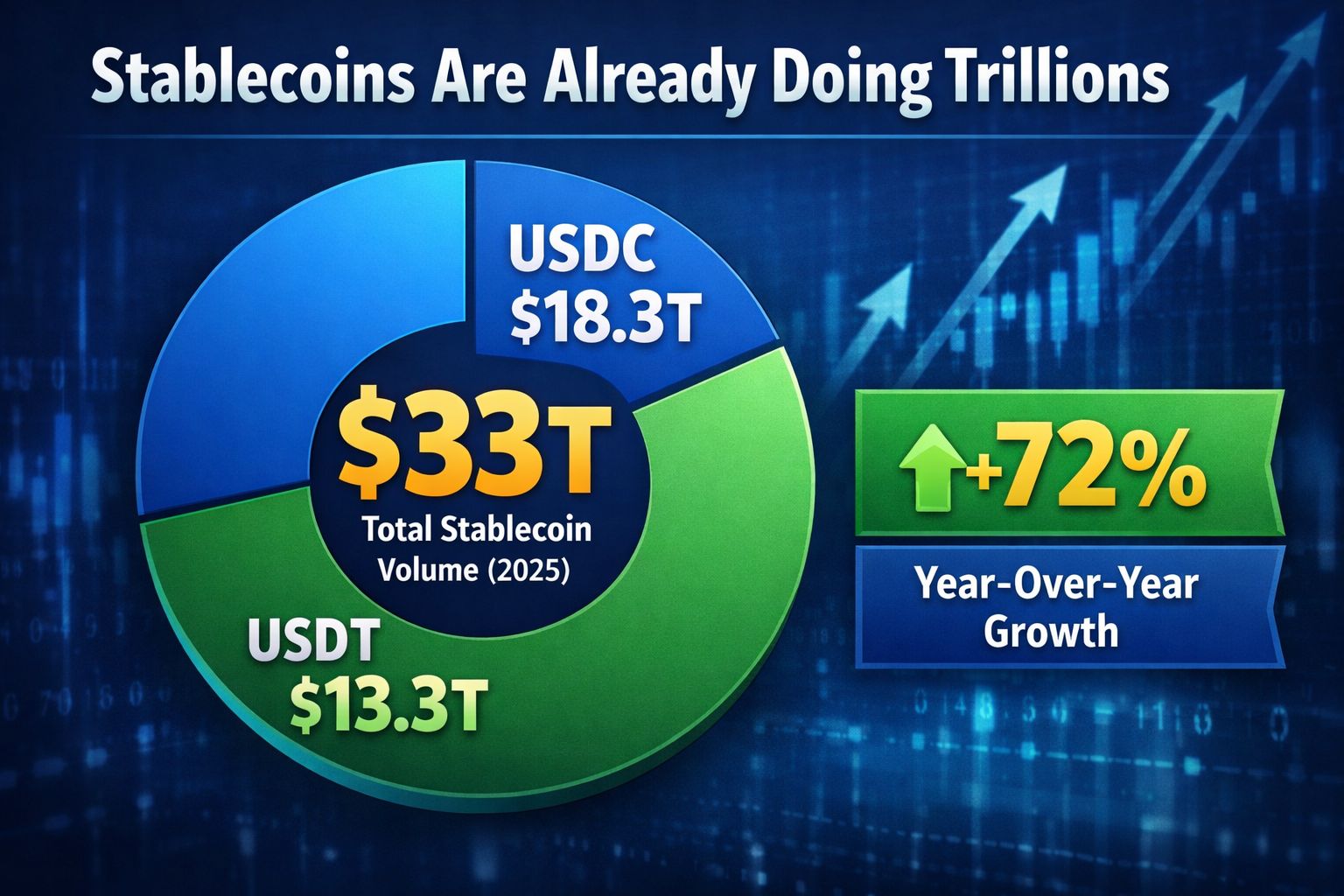
Plasma is having a moment because the market finally admits what traders have known for years: the “real” crypto volume isn’t always spot or perp trading, it’s dollars moving around the world as stablecoins. In 2025 alone, global stablecoin transaction value was reported at about $33 trillion, up roughly 72% year over year, with USDC handling $18.3T and USDT around $13.3T in transaction flow (data compiled by Artemis and cited by Bloomberg). When flows get that big, the conversation stops being “can blockchains scale?” and becomes “which rails can handle payments without breaking user experience?”
That’s the lane Plasma is trying to occupy: not a general purpose chain chasing every narrative, but a stablecoin settlement network built around the stuff that actually matters for payments latency, reliability, and predictable costs. In plain English, it’s a Layer 1 (a base blockchain) designed so sending USDT feels more like sending a message than making a trade. Plasma publicly positions itself as a high performance L1 for stablecoins, claiming near-instant transfers and “fee-free” USD₮ transfers as a core feature.
If you’ve been around long enough, the word “Plasma” might ring a different bell. In 2017, “Plasma” originally referred to an Ethereum scaling framework proposed by Joseph Poon and Vitalik Buterin essentially a way to move activity off the main chain while keeping a link back to it for security. That older Plasma family of ideas mattered historically, but rollups largely became the mainstream path for Ethereum scaling. The Plasma we’re talking about here is a newer, branded network that borrows the “scale for payments” ambition, but executes it as a dedicated chain with stablecoin first design choices.
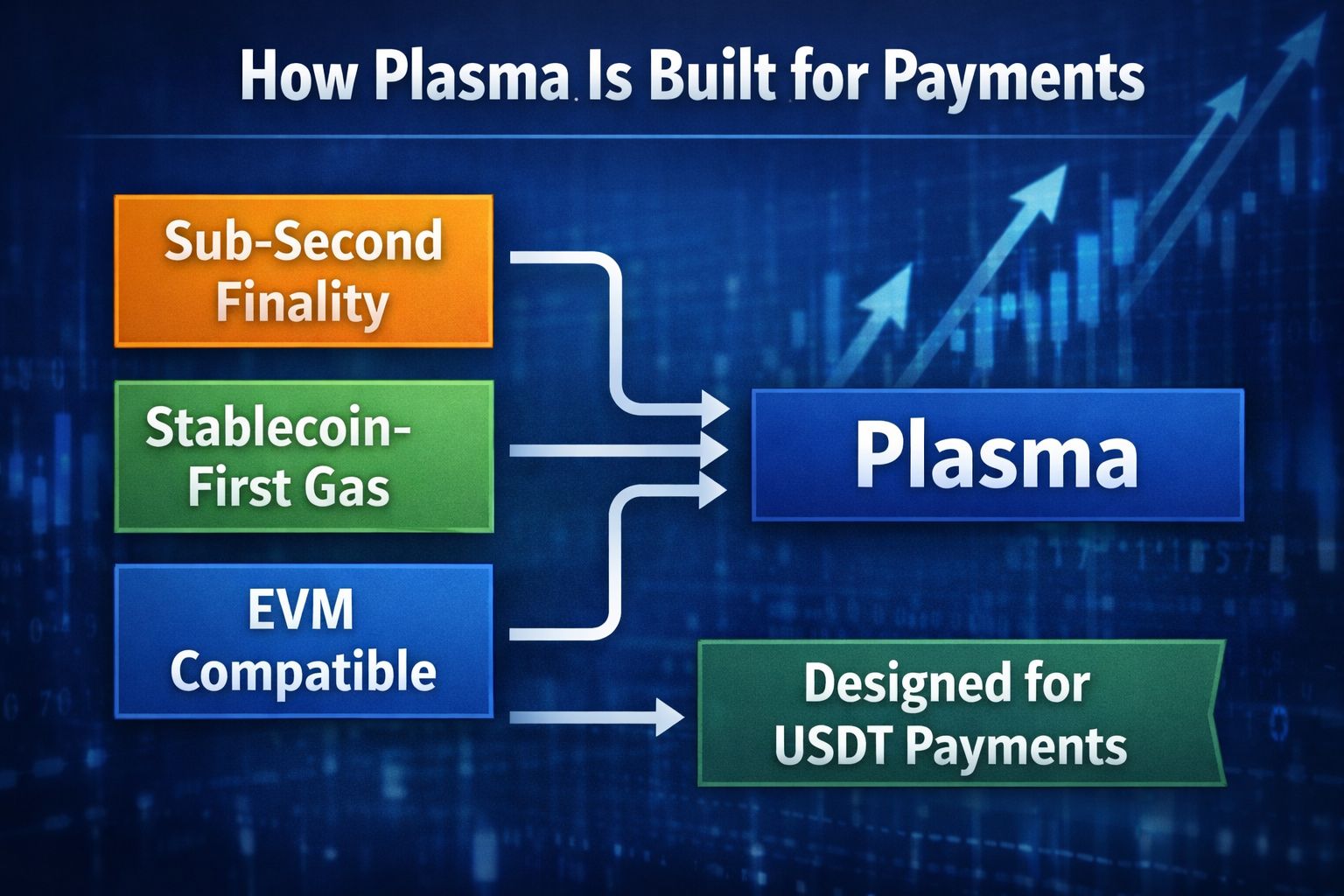
So what’s actually under the hood, and why do traders and builders care? Plasma says it pairs an EVM execution layer (meaning Ethereum-style smart contracts can run without rewriting everything) with a BFT style consensus called PlasmaBFT that targets sub-second finality. “Finality” is just the point where you can treat a payment as done no anxious refreshing, no “wait three confirmations,” no merchant wondering if they got paid. Plasma also leans into “stablecoin-first gas,” which is trader-speak for removing one of the most annoying frictions in crypto UX: needing the chain’s native token just to pay fees. According to Binance Research’s write-up, the design aims to let users pay fees in USD₮ or BTC via an auto-swap mechanism while keeping XPL as the native gas token at launch.
The progress piece is what makes this more than a whitepaper story. Plasma announced its mainnet beta would go live on September 25, 2025 at 8:00 AM ET alongside the launch of its native token, XPL, and claimed about $2B in stablecoins would be active on day one with “100+” DeFi partners (Aave and others were named). Earlier in the cycle, it also disclosed a $24M raise led by Framework with participation tied to Bitfinex/USD₮0, framing it as infrastructure for the next phase of stablecoin adoption. Even if you discount marketing language (always wise), the combination of dated milestones and concrete liquidity targets is why people started watching it like a “payments trade” rather than a pure tech curiosity.
From a trader’s perspective, here’s the cleaner way to think about Plasma’s role in the future of digital payments: it’s a bet that stablecoins win distribution first, and specialized settlement wins optimization second. Stablecoins already behave like a global dollar API especially in corridors where banking is slow or expensive. But when you try to use them like everyday money, you immediately hit the pain points: fees that feel random, failed transactions, and clunky onboarding. Plasma’s whole pitch is to sand down those edges specifically for USDT-style flows. The question I keep asking is the same one I ask about any new venue: does it bring real flow, or does it just reshuffle liquidity for a while?
Regulation is part of why the timing looks different now than the last “payments” hype cycle. In the U.S., 2025 saw a stronger push toward stablecoin frameworks often discussed as a catalyst for institutions to treat stablecoins less like a gray-zone instrument and more like a payments primitive. That doesn’t automatically make every stablecoin rail “safe,” and it definitely doesn’t erase issuer risk (USDT headlines still move markets). But it does explain why infrastructure projects that focus on settlement quality rather than yet another DeFi clone are getting attention.
Will Plasma be the future? Too early to crown anything. Payments are brutally competitive, and the winners tend to be the rails that integrate best, not the ones with the slickest TPS chart. Still, if stablecoins really are becoming the default way value moves across borders, then a chain optimized for stablecoin UX fast finality, predictable costs, and Ethereum-compatible tooling has a clear job to do. The next 12–24 months will tell us whether Plasma becomes a serious piece of that plumbing, or just another cycle’s attempt to productize a good narrative.