

Let’s talk real for a minute about something that’s been quietly and steadily evolving in our space a project that refuses to be just another flashy crypto narrative and instead is building real infrastructure for the future of regulated finance on blockchain. I’m talking about DUSK Network and today I want to walk you through what’s been happening, what’s new, and why it matters in human terms, no fluff, no AI robot voice.
I know many of you have been asking about DUSK updates, mainnet developments, new features, ecosystem traction, and how it fits into the broader picture of privacy and institutional adoption especially going into 2026. Let’s unpack all that together.
A Bit of Context Before the Latest Stuff
For those who are newer or need a refresher, DUSK is not your typical public blockchain that thrives on broadcasting everything to everyone. It’s designed from the ground up for privacy, but with a twist privacy that plays nicely with regulations and institutions. Instead of just being anonymous for anonymity’s sake, DUSK wants to give financial players the tools they need to move assets and confidential information on-chain without violating compliance expectations. That’s a big deal if you’re trying to bring real-world finance into the crypto world.
It uses a combination of cryptographic tech like zero-knowledge proofs, dual transaction models (private and transparent), and a privacy-first execution environment that lets institutions share only what they need to with the right parties.
Where DUSK Is Right Now
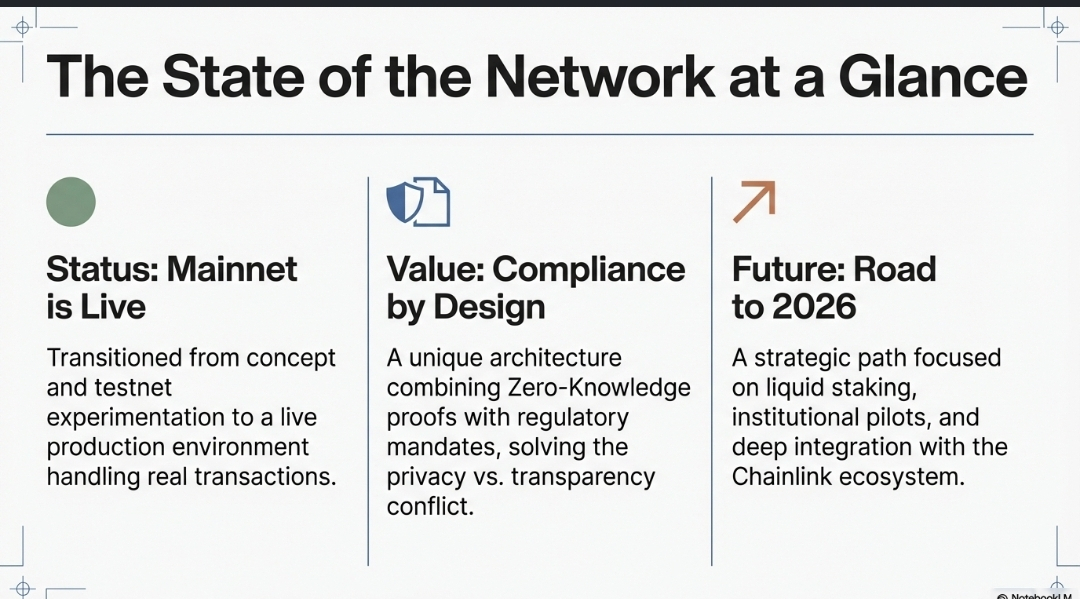
In the past couple of years, DUSK has been on a clear path from concept and testnet experimentation toward mainnet reality and commercial integration. That journey is finally hitting its stride.
Here’s what’s going on that you should know:
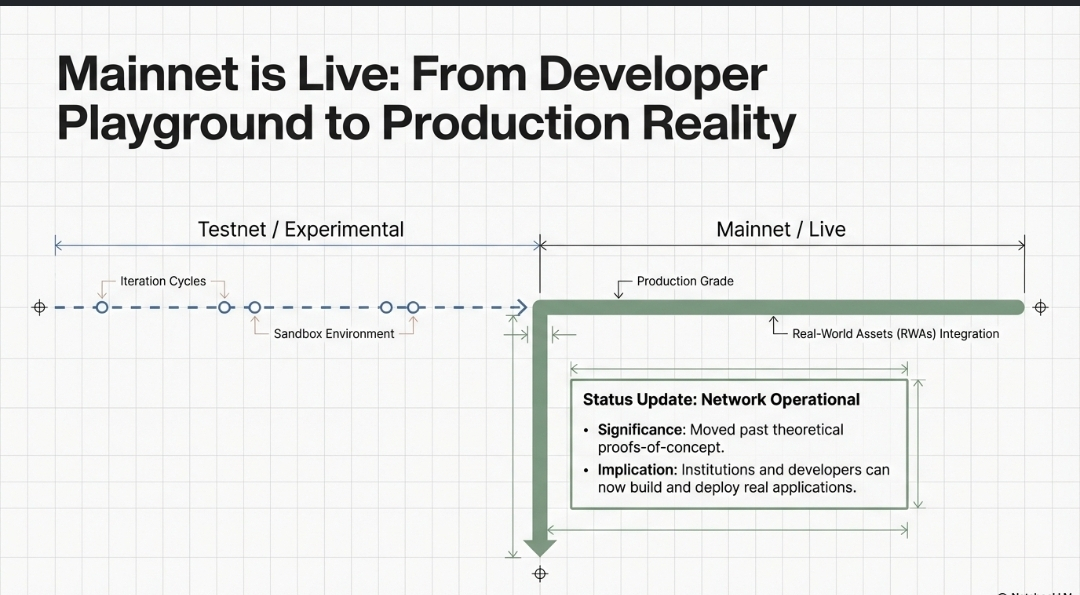
Mainnet Is Live — Real Production, Not Test Projects
DUSK’s mainnet officially rolled out with meaningful operations, not just a developer playground. This is when the chain starts living actual transactions, real network participants, and the infrastructure that financial use cases need.
This is important because it means DUSK is no longer a theoretical project or proof-of-concept. The network is live in a way that institutions and developers can begin building real applications on top of it.
New Features and Tools Developers Are Actually Using
Part of what makes a blockchain genuinely useful is the developer tooling and infrastructure improvements around it. Over the last year or so, DUSK has been rolling out some heavy technical upgrades that deserve attention:
1. W3sper SDK — A New Developer Experience
One of the standout developments has been the release of the W3sper SDK. This is not just another library it’s a toolkit that lets developers manage accounts, send transactions, listen to events, and even handle cryptographic proofs with a smooth workflow. It changes how easy (or hard) it is to build meaningful applications on DUSK.
What’s great here is that this SDK isn’t just about low-level blocks. It comes with contract drivers which act as a bridge between wallets and smart contracts, making full-stack apps easier to build and maintain.
2. Multisignature Accounts
Security matters. The introduction of multisig support lets funds be managed by multiple parties with shared control whether that’s a team managing treasury or a governance board approving spend moves. It’s flexible and built with modern security needs in mind.
3. Performance Upgrades
Under the hood, performance has been a major focus. Modules like Piecrust saw significant updates for faster commit operations and better data handling, which helps when you’ve got many contracts or high activity happening at once.
Even the network layer, thanks to improvements in Kadcast, is now more efficient and resilient in how messages and blocks propagate across nodes.
Wallet Experience and User Tools
A blockchain is only as good as how easy it is for people to actually use it. The Rusk Wallet and Web Wallet have been getting meaningful upgrades that make everything from sending transactions to staking and managing assets much smoother for users.
A few standouts:
Pre-calculated gas costs so you see exactly what you’re paying before you send
Better staking information and reward visibility
Controls that prevent low-gas spam transactions from bogging down the chain
These are the kinds of improvements that make everyday users feel comfortable, not just hardcore techies.
Strategic Integrations and Institutional Appeal
Now let’s talk about the bigger picture and why DUSK is starting to get attention beyond just crypto nerd circles.
One of the biggest shifts has been the integration with Chainlink technology, which opens the door to more real-world data and interoperability. For any institutional player looking at tokenized assets or financial contracts, having access to reliable external data and cross-chain communication is huge and now DUSK supports that reality.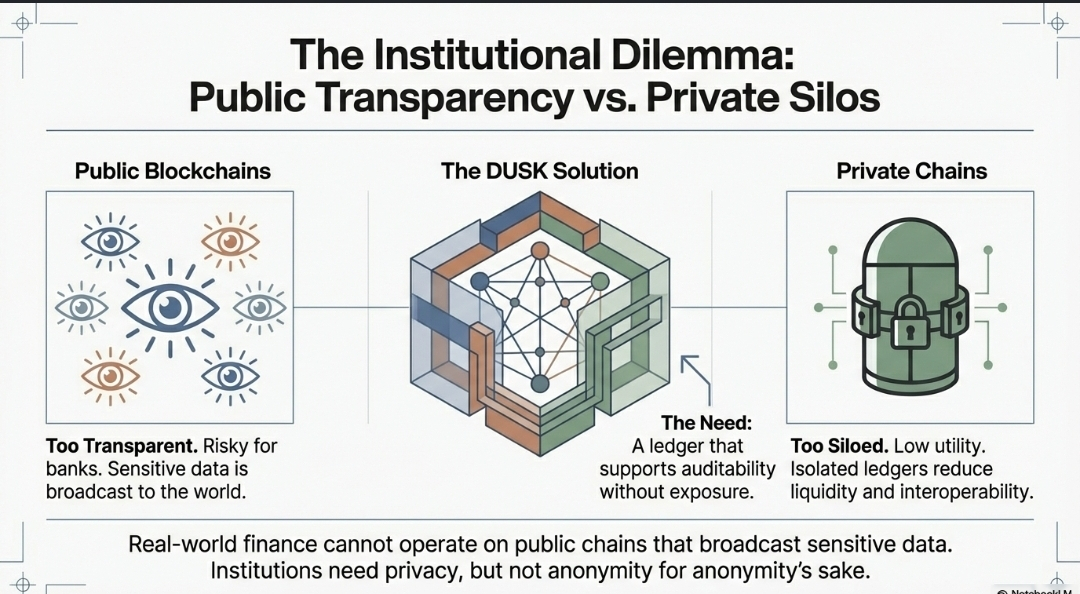
Alongside that, DUSK’s roadmap for 2026 includes things like liquid staking and hyperstaking rewards, which introduce more sophisticated participation models for validators and token holders.
All of this is part of a broader push to meet institutional expectations, not just hobbyist interest. Privacy with auditability, regulatory alignment, and real-world financial tooling are not buzzwords here they’re architecture principles baked into the chain.
Ecosystem Trends and Adoption
We often focus on tech upgrades, but it’s equally important to see the ecosystem activity.
Over the last year, several key movements tell us that momentum is real:
There’s growing discussion in Europe and Asia about blockchain platforms that can satisfy regulatory requirements while maintaining data privacy. DUSK is positioning itself squarely in that conversation.
The nature of talks around tokenized real-world assets like securities, equity, and financial instruments means DUSK’s tools (privacy plus compliance) are not just nice but actually required for many players.
More developers are sharing projects and experimenting with applications that leverage DUSK’s privacy models and contract execution engine.
These are early signs, but they’re the kinds of signs we used to look for in networks that later became foundational.
How DUSK Balances Privacy and Regulation
A question I hear often is: How can a blockchain be private and still friendly to regulators? That’s exactly the tension DUSK was built to solve.
Instead of doing blanket anonymity, DUSK uses zero-knowledge proofs cryptographic tools that let you prove a fact about data without revealing the data itself. That means you can prove a transaction is compliant without exposing the spending details.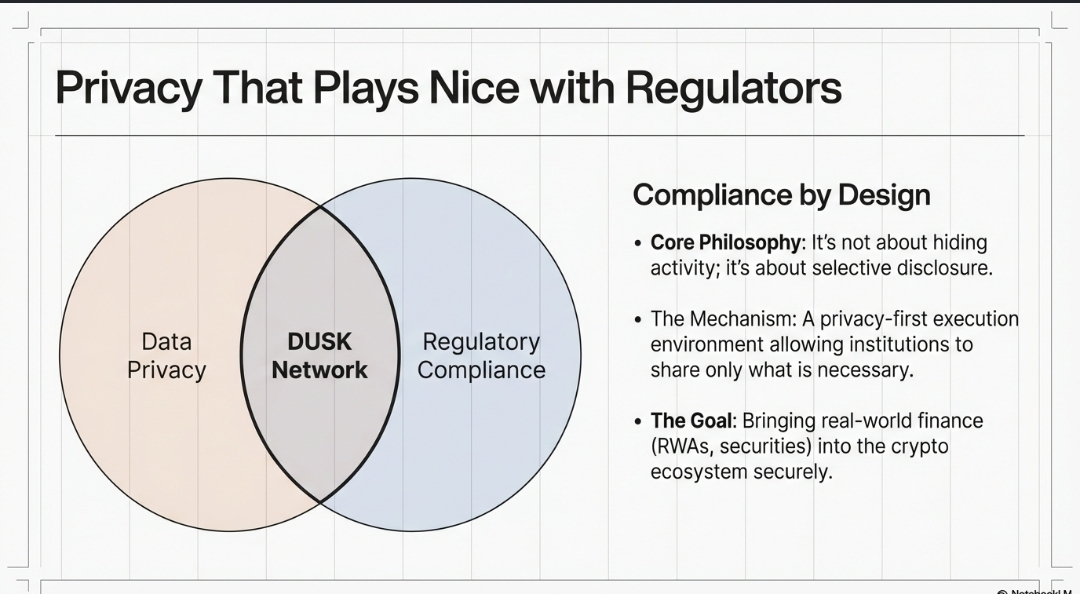
There are also dual transaction models:
Phoenix, which prioritizes confidentiality
Moonlight, which can be transparent when transparency is needed
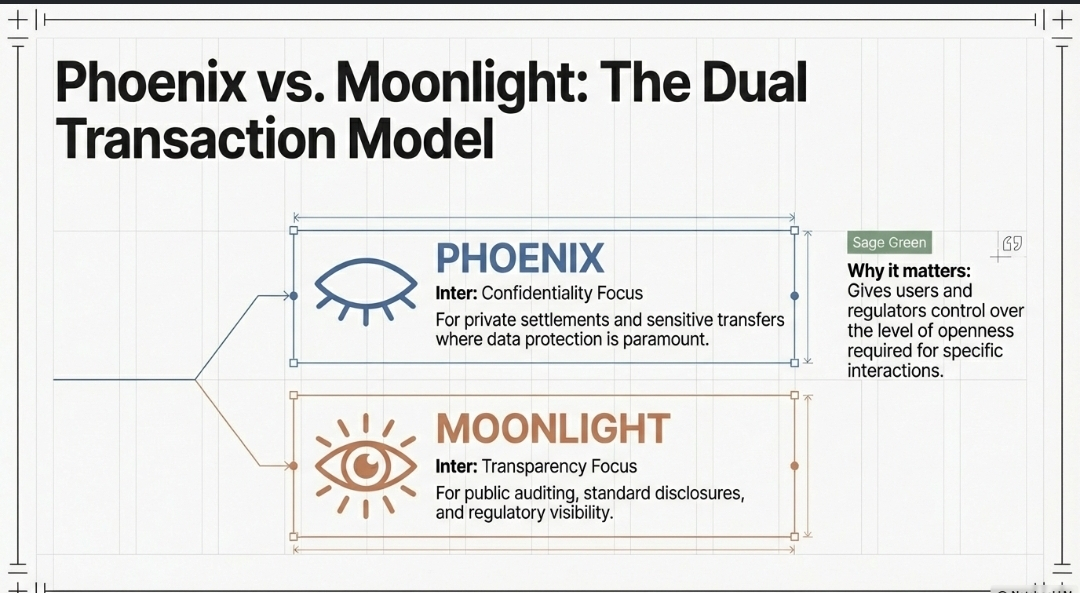
That gives users control over how private or open their interactions are and that nuance is critical for regulated applications.
This design isn’t just clever cryptography for its own sake it’s what allows institutions to trust a public blockchain with sensitive financial operations.
What’s Next on the Horizon
So where do things go from here?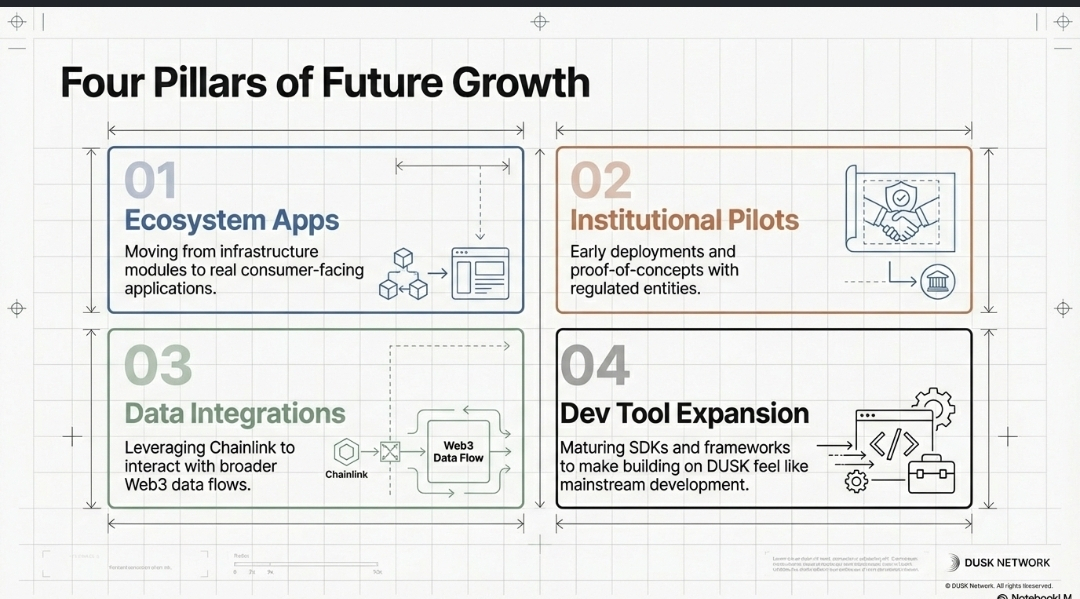
Here are the big threads I’m watching:
1. Ecosystem Growth
Now that mainnet is live and tooling is landing, we’ll start seeing more real applications not just infrastructure modules. This is where real adoption metrics begin to show whether the chain can sustain demand.
2. Institutional Pilots and Deployments
Expect more proof-of-concepts with regulated entities. These early deployments are critical because once someone actually uses the network for production workflows, it creates a feedback loop for improvements and trust.
3. Cross-Chain and Data Integrations
With Chainlink and similar integrations, DUSK can start interacting with broader Web3 data flows. That’s what turns a niche network into a center of gravity in the ecosystem.
4. Developer Tools Expansion
As SDKs mature and more languages, client tools, and frameworks plug into DUSK, building on it will feel less like bleeding-edge experimentation and more like mainstream development.
Final Thoughts
If you’ve been watching DUSK from the sidelines, these developments should give you confidence that something meaningful is happening behind the scenes. This is not just another privacy coin or a gated research project it’s a privacy-first institutionally-minded blockchain building real infrastructure for the future of regulated finance.
We’re moving into a phase where privacy is no longer an afterthought, and solutions like DUSK are proving that it can be integrated without sacrificing compliance or utility. That’s precisely the shift many of us have been waiting for.
I’ll be keeping a close eye on ecosystem growth and real-world adoption, and I suspect the next wave of updates will be even more exciting especially as we get deeper into 2026.