
Most blockchain infrastructure fails for a simple reason.
it’s built away from where builders actually work.
Why the Future of Blockchain Infrastructure Is Becoming Unavoidable
Most infrastructure doesn’t fail because the technology is weak.
It fails because it’s built in the wrong place.
That’s the quiet truth behind Vanar’s latest message—and it explains why this moment matters.
For years, blockchain ecosystems have followed a familiar pattern: build something powerful, then hope developers migrate to it. New chains launch, tooling improves, incentives grow louder—but adoption still struggles. The friction isn’t technical. It’s contextual.
Vanar is choosing a different path.
Instead of asking builders to come to the chain, Vanar is going where builders already are.
That single design decision reframes everything.
Infrastructure Must Live Where Work Happens
Developers don’t operate in isolation. They work across environments, stacks, frameworks, and platforms that already exist. When infrastructure demands relocation—new assumptions, new workflows, new mental models—it adds cost. Not just financial cost, but cognitive cost.
Unavoidability doesn’t come from marketing volume. It comes from relevance. From embedding yourself so deeply into the builder’s existing workflow that opting out feels inefficient.
That’s what Vanar is architecting.
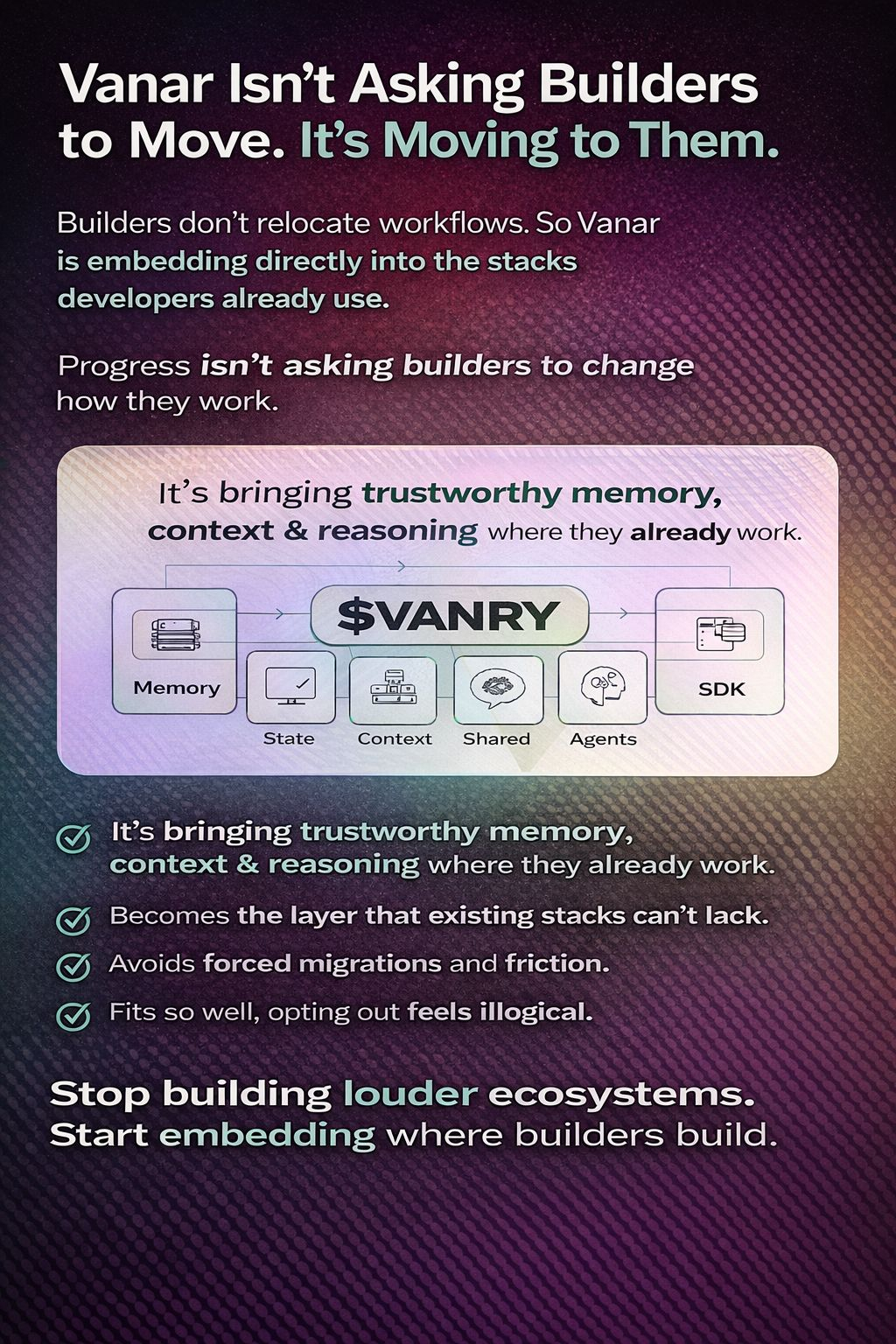
Understanding the Visual: A Builder-First Architecture
The image accompanying the post tells a deeper story.
At the center is $VANRY, not as a speculative asset, but as a coordination layer. On either side sit Base 1 and Base 2, representing environments developers already use. Vanar doesn’t replace them—it connects them.
Above sits the developer.
Below sits the intelligence stack:
Memory
State
Context
Reasoning
Agents
SDK
This isn’t just infrastructure. It’s cognitive infrastructure.
Vanar is positioning itself as the layer that remembers, reasons, and maintains context across systems. In an era where AI agents, autonomous software, and composable applications are becoming normal, raw execution is no longer enough.
What matters is continuity.
Why “Being Louder” No Longer Works
Crypto has tried loud.
Incentive programs. Hackathons. Grants. Social hype.
They work temporarily—but they don’t compound.
Vanar’s strategy recognizes a more uncomfortable reality.
Developers don’t adopt platforms; platforms dissolve into developer workflows.
By integrating directly into where builders already operate, Vanar reduces friction to near zero. No forced migration. No abandoned toolchains. No ideological buy-in required.
Just usefulness.
That’s how infrastructure becomes invisible—and therefore indispensable.
Vanar as the Trust Layer for Intelligent Systems
Another subtle but powerful idea in the post is trust.
Vanar doesn’t present itself as what users interact with. That role belongs to execution layers and applications. Instead, Vanar is what makes those systems trustworthy.
In practical terms, that means:
Persistent memory that survives across sessions and chains
Verifiable state that agents and applications can rely on
Context that prevents fragmentation of logic
Reasoning layers that make autonomous systems accountable
As AI agents increasingly operate on-chain, trust shifts from interfaces to infrastructure. Vanar is building exactly where that trust must live.
Why This Matters Now
Timing matters.
AI agents are moving from experiments to production.
Builders are overwhelmed with fragmented stacks.
Users demand systems that work quietly and reliably.
Vanar’s approach fits this moment precisely.
It’s not trying to be the loudest chain.
It’s trying to be the most structurally necessary one.
And history shows that the most important infrastructure often looks boring at first—until everything depends on it.
From Destination Chains to Embedded Layers
Vanar’s message signals a broader shift in blockchain design philosophy.
The future isn’t about destination blockchains competing for attention.
It’s about embedded layers that quietly power everything else.
When infrastructure stops asking for attention and starts delivering continuity, adoption follows naturally.
That’s how progress becomes unavoidable.
Final Thought
Vanar isn’t promising hype.
It’s promising presence.
And in infrastructure, presence beats noise every time.
More soon isn’t a tease—it’s a warning.
Because when builders realize the most useful layer is already where they work, there’s no reason to leave.
