
Vanar is trying to do something most Layer-1 projects talk about, but very few actually design for from day one, which is making Web3 feel normal for real people who will never care about block times, consensus names, or technical buzzwords, and that direction makes sense because mass adoption is never won by being the fastest chain on paper, it is won by building products and experiences that people naturally use without even realizing there is a blockchain underneath.
When I look at Vanar, I don’t see a project that wants to live only inside crypto culture, I see a project that wants to sit at the intersection of games, entertainment, brands, and everyday digital experiences, and that focus matters because those industries already understand how to onboard millions of users with simple UX, clear incentives, and strong distribution, which is exactly what Web3 has been missing for years.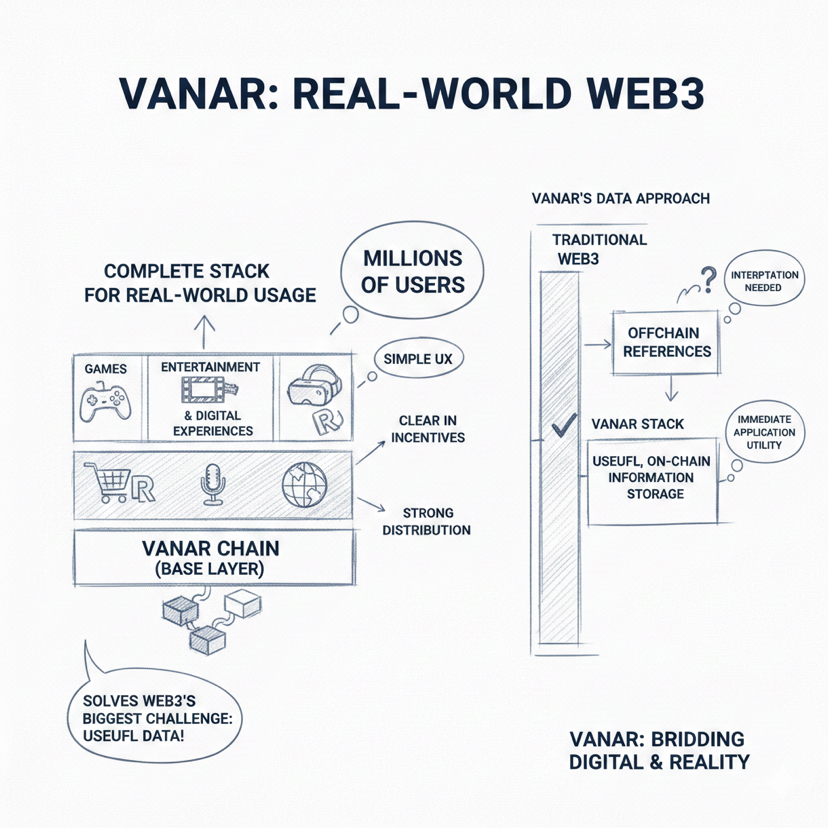
The most important part is that Vanar is not positioning itself as “just another chain”, it is presenting itself as a complete stack built to support real-world usage, where the chain is the base layer and the layers above it are meant to handle something Web3 struggles with constantly, which is storing information in a way that is actually useful for applications instead of storing references that still require offchain systems to interpret what is real and what is not.
Their architecture is built around a simple but powerful idea, that data should not be dead weight onchain, and that smart contracts should not be limited to executing basic transfers and rigid logic, because if Web3 wants to support real business workflows, payments, ownership proofs, and regulated assets, then the chain must be able to work with meaningful information, not just with numbers and addresses.
That is where Vanar’s “semantic memory” direction becomes interesting, because instead of treating documents, records, and real-world proofs like something that must stay outside the chain, Vanar describes a flow where files can be transformed into structured onchain objects that applications can search, reference, and use as part of execution, which is a very different mindset compared to the usual “store a hash and keep the real file somewhere else” model that breaks as soon as you need compliance, audits, or reliable automation.
What makes this more than a storage story is that Vanar also emphasizes a reasoning layer that can query that onchain information and trigger actions, and if that direction is implemented well, it changes what people can build, because you move from a world where contracts only react to transactions, to a world where contracts can react to verified information and rules, and that is exactly the type of foundation you need for serious workflows that require checks, restrictions, approvals, and automated enforcement without constant human involvement.
This is also why Vanar keeps its identity tied to mainstream verticals like gaming and entertainment, because those are not just marketing words, they are real distribution channels, and distribution is the rarest advantage in this space, since most chains can attract developers and liquidity for a while, but far fewer can attract millions of users through products that feel like something people already understand.
The project’s ecosystem narrative has been built around creating bridges into those mainstream sectors, including known initiatives tied to metaverse and gaming networks, because in the long run the strongest onchain economies are not created by traders swapping tokens with each other, they are created by users spending value inside systems that provide entertainment, identity, social status, ownership, and utility in ways that feel natural.
The token story fits that bigger transition, because VANRY is not a random token that appeared out of nowhere, it represents a continuation and expansion of an existing ecosystem identity into a wider “chain plus stack” direction, and the way the token is meant to matter is straightforward, because if the network becomes busy, VANRY becomes the fuel for transactions, network activity, and participation, and if staking grows into a meaningful network role, it adds a second demand loop where holders are not only speculating on price but also taking part in security and long-term alignment.
The real benefits of VANRY become clear when you stop treating it like a chart and start treating it like a network asset, because the best token models are always the ones where demand is created by usage, not by hype, and Vanar’s entire strategy seems designed to push toward that kind of usage by building infrastructure that supports real applications and by focusing on markets that can bring large user bases into the ecosystem through products rather than through technical persuasion.
Behind the scenes, what Vanar appears to be building is a path toward programmable real-world workflows, where data, compliance, automation, and execution can live closer together instead of being split across a dozen offchain systems, and if that works, it creates a kind of “business-friendly” foundation that makes it easier for companies and brands to ship onchain experiences without exposing users to complexity, while still keeping the verifiable nature of blockchain as the base layer of trust.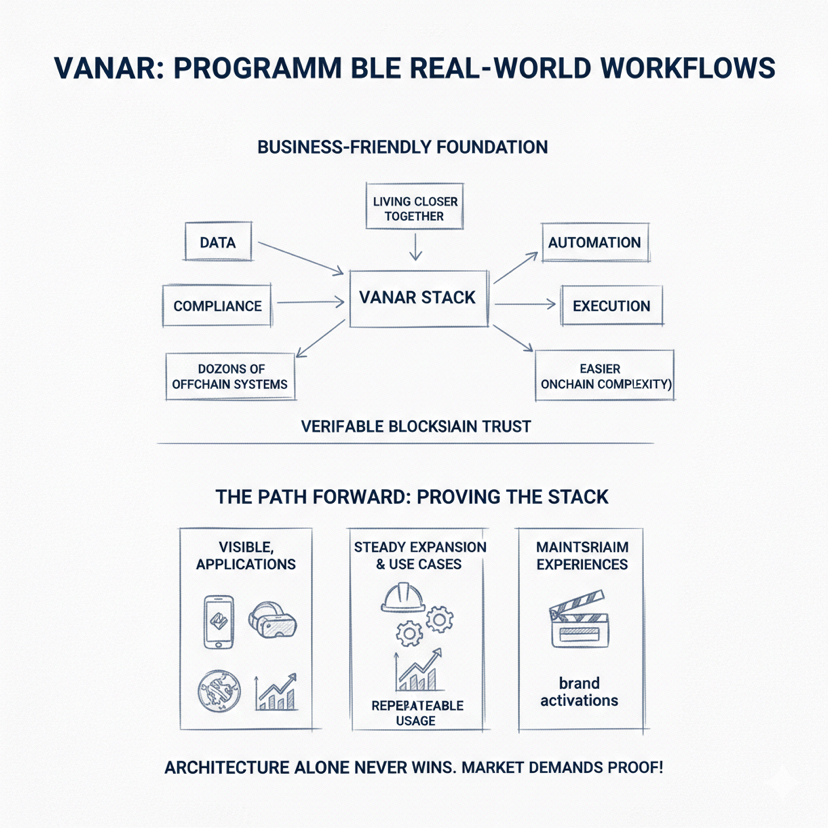
What’s next for Vanar, in the most realistic sense, is proving this stack through visible, working applications that people can actually touch, because architecture alone never wins, and the market eventually demands proof in the form of real tools, real integrations, and repeatable usage that continues even when the broader market mood changes, which is why the most meaningful progress from here would be a steady expansion of builders, more production-grade use cases that show why their data and reasoning layers are needed, and a clearer pipeline of mainstream experiences that naturally pull users in through games, entertainment, and brand activations.
My takeaway is that Vanar is aiming for a lane that has real demand if executed properly, because the world does not need another chain that is only competing on speed, the world needs platforms that make digital ownership, payments, proof, and automation feel normal, and Vanar’s focus on mainstream verticals combined with a stack that tries to make onchain data usable gives it a more grounded adoption thesis than many projects that only sell “tech”, and the next chapter is all about execution, because if they deliver products that people use without friction, this becomes a story of adoption and utility rather than a story of narrative cycles.