
The metaverse conversation has become exhausting. Every project claims they’re building the future of virtual worlds, yet most deliver little beyond speculative tokens and vague promises. Vanar Chain approached this space differently from the beginning, focusing on the infrastructure needed to make immersive digital experiences actually function at scale. Understanding Vanar requires looking past the buzzwords into the technical decisions and strategic partnerships that define what this project genuinely attempts to accomplish.
The Origin Story and Founding Philosophy
Vanar didn’t start as another blockchain looking for a use case. The project emerged from teams who had already spent years working in gaming, entertainment, and digital content creation. They understood the practical limitations that prevented mainstream adoption of blockchain technology in consumer applications. Traditional blockchains were too slow, too expensive, and too complicated for the average person who just wanted to play a game or explore a virtual world without becoming a cryptocurrency expert.
The founding vision centered on carbon neutrality and accessibility as core principles rather than afterthoughts. While many blockchain projects treat environmental concerns as marketing problems to manage, Vanar’s architecture was designed from the ground up to minimize energy consumption. This wasn’t purely altruistic. The team recognized that major brands and entertainment companies increasingly demanded sustainable technology partners, and building carbon neutrality into the foundation created strategic advantages for attracting institutional partnerships.
Accessibility meant more than just low transaction costs. It meant creating systems where users didn’t need to understand gas fees, wallet management, or blockchain mechanics to participate in digital experiences. The technical team spent considerable effort developing abstraction layers that hide blockchain complexity from end users while maintaining security and decentralization where it matters. This philosophy reflects a pragmatic understanding that mass adoption requires removing friction rather than educating billions of people about cryptographic principles.
The initial team brought diverse expertise spanning blockchain engineering, game development, virtual world design, and business development. This multidisciplinary approach shaped Vanar’s trajectory because decisions weren’t made solely by blockchain purists optimizing for theoretical decentralization. Instead, they balanced technical ideals against practical requirements for building applications that real users would actually enjoy. That tension between idealism and pragmatism runs through every aspect of Vanar’s development.
The Technical Architecture and Design Choices
Vanar operates as a Layer 1 blockchain, which means it’s not building on top of Ethereum or another existing chain. This decision carries significant implications. Layer 1 chains have complete control over their consensus mechanisms, block times, and architectural choices, but they also bear full responsibility for security and validator coordination. The team believed that achieving their performance targets required this level of control rather than working within constraints imposed by another blockchain’s design decisions.
The consensus mechanism uses a proof-of-stake variant optimized for fast finality and high throughput. Block times measure in seconds rather than minutes, enabling responsive applications where users don’t wait awkwardly after every action. Transaction throughput reaches levels necessary for gaming applications where hundreds or thousands of users might interact simultaneously within shared virtual spaces. These aren’t theoretical maximums but sustained performance characteristics under actual network load.
Smart contract functionality supports both building new applications and integrating existing standards. The chain maintains compatibility with Ethereum Virtual Machine tooling, which means developers familiar with Solidity can work on Vanar without learning entirely new programming paradigms. This compatibility decision significantly lowered barriers to developer adoption, allowing the ecosystem to leverage existing talent and tools rather than building everything from scratch.
The carbon-neutral architecture deserves detailed examination because it represents genuine engineering rather than purchased carbon offsets. Vanar’s proof-of-stake mechanism inherently requires far less energy than proof-of-work systems, but the team went further by optimizing validator requirements and implementing efficient state management. They’re partnering with renewable energy providers and implementing monitoring systems that track and verify the environmental impact of network operations. This isn’t perfect, but it demonstrates more serious commitment than most blockchain projects show toward environmental responsibility.
Interoperability features enable assets and data to move between Vanar and other blockchains when necessary. These bridges carry inherent security risks, as the entire industry learned through numerous exploits, but they’re also essential for connecting Vanar’s ecosystem with the broader cryptocurrency landscape. Users need ways to bring assets from other chains into Vanar applications, and projects need liquidity connections beyond just what exists natively on Vanar.
The Brand Partnerships and Strategic Direction
Vanar’s most distinctive characteristic is its focus on partnering with established brands rather than just attracting crypto-native projects. The team secured collaborations with major entertainment properties, gaming companies, and consumer brands looking to explore blockchain technology. These partnerships provide more than just credibility. They bring existing user bases, professional development teams, and real business requirements that push the technology in practical directions.
One notable partnership involved major intellectual property holders exploring how to bring their characters and worlds into blockchain-based experiences. These companies weren’t interested in speculative tokens or decentralized finance. They wanted infrastructure that could support engaging games and virtual experiences while protecting their brand values and meeting regulatory standards. Vanar’s approach to this partnership required building specific tools for content moderation, user authentication, and intellectual property protection that most blockchain projects never consider necessary.
Gaming studios discovered that Vanar’s performance characteristics enabled game genres that struggled on slower blockchains. Real-time multiplayer experiences became feasible when transaction confirmation didn’t create noticeable delays. Complex game economies could function without players constantly worrying about transaction costs eating into their in-game earnings. These partnerships resulted in actual playable games rather than just whitepapers describing theoretical possibilities.
The brand partnerships also influenced Vanar’s governance and moderation approaches. Major companies won’t associate with platforms that host illegal content or enable harassment. This reality forced Vanar to develop content policies and enforcement mechanisms, creating tension with crypto idealists who view any form of moderation as antithetical to decentralization. The team’s response has been pragmatic, implementing necessary safeguards for brand partnerships while maintaining core blockchain properties like censorship-resistant transactions and transparent on-chain data.
Retail and consumer brands explored using Vanar for loyalty programs and digital collectibles. These use cases lack the revolutionary rhetoric of DeFi but represent actual business applications with clear value propositions. A major retailer could issue blockchain-based loyalty points that users could trade or use across partner ecosystems, creating more engaging customer relationships than traditional points programs. The technical requirements for these applications differ significantly from those of gaming or virtual worlds, pushing Vanar to develop versatile infrastructure rather than optimizing narrowly for one use case.
The Token Economics and Ecosystem Incentives
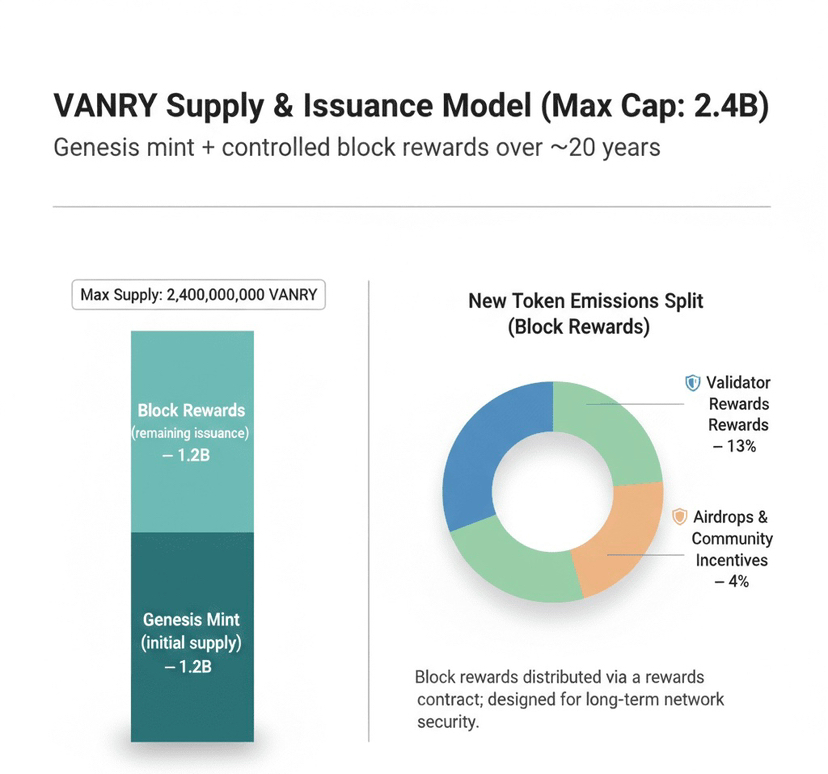
VANRY functions as Vanar’s native token, serving multiple roles within the ecosystem. Users pay transaction fees in VANRY, creating baseline demand correlated with network activity. Validators stake VANRY to participate in consensus, aligning their economic incentives with network security and reliability. The token also enables governance participation, allowing holders to vote on protocol upgrades and ecosystem development priorities.
The token distribution balanced various stakeholder interests through allocations to the founding team, strategic partners, validators, and community incentives. Vesting schedules extend over multiple years for team and partner allocations, reducing risks of sudden supply increases from early participants exiting positions. Community incentives encourage application development, content creation, and ecosystem participation through various reward programs.
Staking mechanisms offer multiple options depending on participants’ risk tolerance and liquidity preferences. Validators running full nodes earn higher rewards but face technical requirements and slashing risks if they behave maliciously or incompetently. Delegators can stake through validators without running infrastructure themselves, earning reduced rewards in exchange for convenience. These tiered participation options allow both sophisticated operators and casual holders to contribute to network security while earning rewards.
Transaction fee structures were designed to remain predictable and affordable even as network usage grows. Unlike blockchains where fees spike dramatically during congestion, Vanar implements mechanisms to keep costs stable. This predictability matters enormously for gaming and entertainment applications where unpredictable costs would destroy user experiences. Someone playing a game shouldn’t suddenly face prohibitively expensive transaction fees because unrelated network activity caused congestion.
The economic model faces challenges common to all blockchain tokens. If network usage doesn’t grow sufficiently, token demand remains limited regardless of technical capabilities. If competing blockchains offer similar functionality with better network effects or larger ecosystems, users and developers might choose alternatives despite Vanar’s advantages. The team addresses these risks by focusing on unique value propositions through brand partnerships and specialized gaming infrastructure rather than competing directly with general-purpose blockchains.
The Developer Ecosystem and Application Landscape
Vanar’s value ultimately depends on what people build using its infrastructure. The developer ecosystem started with projects closely connected to strategic partners, providing high-quality launch applications that demonstrated the platform’s capabilities. These initial applications set quality standards and showed developers what kinds of experiences Vanar’s performance enabled.
Gaming applications dominate the early ecosystem, which aligns with Vanar’s positioning and technical optimization. These range from casual mobile games integrating blockchain elements to more ambitious multiplayer experiences built specifically for blockchain infrastructure. The games vary in quality and ambition, but collectively they demonstrate that Vanar can support actual gaming rather than just financial applications disguised as games.
Virtual world platforms emerged as another major application category. These projects create persistent digital spaces where users can socialize, create content, and participate in shared experiences. Some emphasize user-generated content, giving creators tools to build within these worlds. Others focus on curated experiences designed by professional development teams. The diversity of approaches reflects different visions for what virtual worlds should become, with Vanar providing infrastructure flexible enough to support multiple paradigms.
NFT marketplaces and creator platforms enable digital artists and content creators to monetize their work. These platforms aren’t revolutionary in concept, but Vanar’s low transaction costs make them practical for smaller creators and collectors who couldn’t justify fees on more expensive blockchains. The ability to mint and trade NFTs without significant financial barriers opens these markets to broader participation than when every transaction carries substantial costs.
Developer tools and documentation evolved based on feedback from teams actually building applications. The initial toolkit focused on basic functionality, but real-world usage revealed gaps and friction points that required additional tools. The core team invested in improved documentation, code examples, testing frameworks, and integration guides. They also created developer support channels where teams could get technical assistance, share knowledge, and provide feedback on platform development priorities.
Grant programs funded promising projects that expanded Vanar’s capabilities or demonstrated innovative use cases. These grants balanced several objectives including filling ecosystem gaps, showcasing technical possibilities, and attracting developer talent. Selection criteria emphasized teams with relevant experience and clear execution plans rather than just interesting ideas. The most successful grant recipients often became long-term ecosystem contributors, building multiple projects and helping newer developers navigate Vanar’s infrastructure.
The Challenges and Market Realities
Building blockchain infrastructure for gaming and entertainment involves challenges that pure financial applications don’t face. User expectations differ dramatically. Someone using a DeFi protocol might tolerate occasional complexity and technical friction, but gamers expect seamless experiences comparable to traditional games. Meeting these expectations while maintaining blockchain benefits requires extensive optimization and careful user experience design.
Competition intensified as other projects recognized gaming and virtual worlds as potentially valuable blockchain applications. Established gaming blockchains had head starts in ecosystem development and developer mindshare. Meanwhile, general-purpose blockchains improved their performance to levels where gaming applications became feasible. Vanar had to differentiate through specific advantages like brand partnerships and carbon neutrality rather than claiming generic superiority.
The broader cryptocurrency market volatility affected Vanar like all blockchain projects. When markets declined, speculative interest evaporated and attention shifted away from new platforms. Teams building on Vanar faced funding challenges as investor enthusiasm waned. The core team’s response emphasized continuing development regardless of market conditions, maintaining focus on long-term infrastructure building rather than short-term token price movements.
Regulatory uncertainty posed particular challenges for projects working with major brands. Entertainment companies and consumer brands operate in heavily regulated industries with substantial legal compliance requirements. Ensuring that Vanar’s infrastructure could support applications meeting these requirements without compromising core blockchain properties required ongoing legal and technical work. The team couldn’t simply dismiss regulatory concerns as irrelevant to decentralized systems when their primary use cases involved regulated entities.
Technical limitations emerged as applications pushed the network’s capabilities. While Vanar’s throughput exceeded most blockchains, it still fell short of what traditional centralized game servers could handle. This gap meant certain game genres remained impractical for blockchain implementation regardless of Vanar’s optimizations. The team’s roadmap includes ongoing performance improvements, but closing the gap with centralized alternatives completely might not be possible given blockchain’s inherent overhead.
The Cultural and Community Dimensions
Vanar’s community differs from typical crypto projects because it includes traditional gamers and entertainment fans alongside blockchain enthusiasts. This diversity creates interesting dynamics. Crypto natives understand blockchain technology and value decentralization but might lack context for gaming and entertainment industry norms. Meanwhile, gamers and entertainment fans bring different priorities, often caring more about user experience and content quality than technical blockchain properties.
Community building efforts had to bridge these different audiences. Content strategies addressed both technical blockchain topics and gaming or entertainment subjects. Community events brought together diverse stakeholders including developers, gamers, content creators, and blockchain investors. This multifaceted approach required more nuanced communication than projects targeting only crypto audiences.
The governance system enables community participation in protocol decisions, though early governance focuses primarily on technical parameters rather than broader strategic choices. As the ecosystem matures, governance may evolve to address more complex decisions involving trade-offs between competing interests. How effectively Vanar’s governance handles these challenges will significantly impact long-term sustainability and community satisfaction.
Social media presence emphasizes authentic engagement rather than hype-driven marketing. The team shares development progress, partnership announcements, and ecosystem updates without resorting to the exaggerated claims common in cryptocurrency marketing. This approach might generate less short-term excitement but builds credibility with audiences skeptical of blockchain technology’s typical promotion style.
Looking Toward Future Possibilities
Vanar’s trajectory over coming years depends on several evolving factors. Continued growth in brand partnerships would validate the strategy of focusing on established companies rather than just crypto-native projects. If more major entertainment properties and gaming studios adopt Vanar for blockchain integration, it could establish the platform as preferred infrastructure for this use case. Conversely, if partnerships fail to materialize or don’t translate into actual user adoption, the strategy would require reevaluation.
Technical development roadmaps include further performance optimizations, expanded developer tools, and new features responding to ecosystem needs. The team continues refining the balance between blockchain properties and practical usability requirements. Zero-knowledge technology might eventually enhance privacy capabilities, while cross-chain interoperability improvements could better connect Vanar with the broader blockchain ecosystem.
The metaverse narrative will likely evolve beyond current hype cycles. If genuine virtual world adoption occurs, infrastructure like Vanar becomes increasingly valuable. If the metaverse concept fades as another overhyped trend, projects positioned around it would need to pivot toward other applications. Vanar’s broad gaming and entertainment focus provides some insulation against narrow metaverse hype collapsing, but the project’s fortunes remain connected to virtual world adoption trajectories.
Institutional adoption could significantly accelerate growth if major gaming studios and entertainment companies conclude that blockchain technology offers genuine advantages for their applications. This adoption wouldn’t happen suddenly but would likely involve cautious experimentation gradually expanding into more substantial deployments. Vanar’s carbon-neutral positioning and brand partnership experience could provide advantages in attracting institutional interest compared to alternatives.
Building Infrastructure That Might Actually Matter
Vanar represents a pragmatic approach to blockchain technology focused on solving real problems for specific applications rather than pursuing abstract ideological visions. The emphasis on carbon neutrality, brand partnerships, and user experience optimization reflects understanding that mass adoption requires meeting mainstream expectations rather than demanding users adapt to blockchain’s inherent complexity and limitations.
Whether this approach succeeds remains uncertain. The blockchain industry has witnessed countless projects with sound strategies fail for reasons ranging from execution challenges to market timing to pure luck. Vanar’s differentiation through brand partnerships and gaming infrastructure provides advantages but doesn’t guarantee success in a competitive and unpredictable market.
What seems clear is that if blockchain technology genuinely becomes infrastructure underlying gaming and entertainment experiences, projects like Vanar will have played crucial roles in that transition. Not through revolutionary breakthroughs but through patient infrastructure building, strategic partnership development, and continuous refinement based on real-world usage requirements. The unglamorous work of making technology actually function reliably at scale matters more than visionary whitepapers describing theoretical possibilities.
Years from now, if you’re playing a game or exploring a virtual world built on Vanar, you probably won’t think about the blockchain infrastructure enabling that experience. You’ll simply enjoy the content, perhaps appreciating that transactions happen quickly and affordably without requiring cryptocurrency expertise. That invisibility would represent success, proof that infrastructure has matured beyond requiring constant attention to its own operation. Whether Vanar achieves that invisibility depends on continued execution and fortunate timing, but the foundation appears more solid than most projects attempting similar goals.