
The speed looked wrong.
Not slow. Just... suspicious. Like watching someone run a marathon without sweating.
I'd seen chains promise throughput before, parallel execution, sharding, whatever and they all smelled the same: compromise dressed as innovation. So I started poking. Sent a Phoenix transaction with a credential that was technically valid but contextually thin.
Waited.
Nothing. Not rejection. Not failure. Just... hesitation. The kind that lives in the gap between "submitted" and "settled."
I thought: lag. Network congestion. Then I checked the Moonlight rail, the compliance side and saw the hold. Execution-time validation, they call it. Which sounds like a feature list.
Felt more like a hand on your shoulder.
"Modular," I muttered. Hated the word immediately. Too clean. Suggests Lego blocks snapping together.
What Dusk actually does is isolation. The Rusk VM runs here. The DuskEVM runs there. The Hedger prices in its own corner. If one chokes, the others don't even flinch.
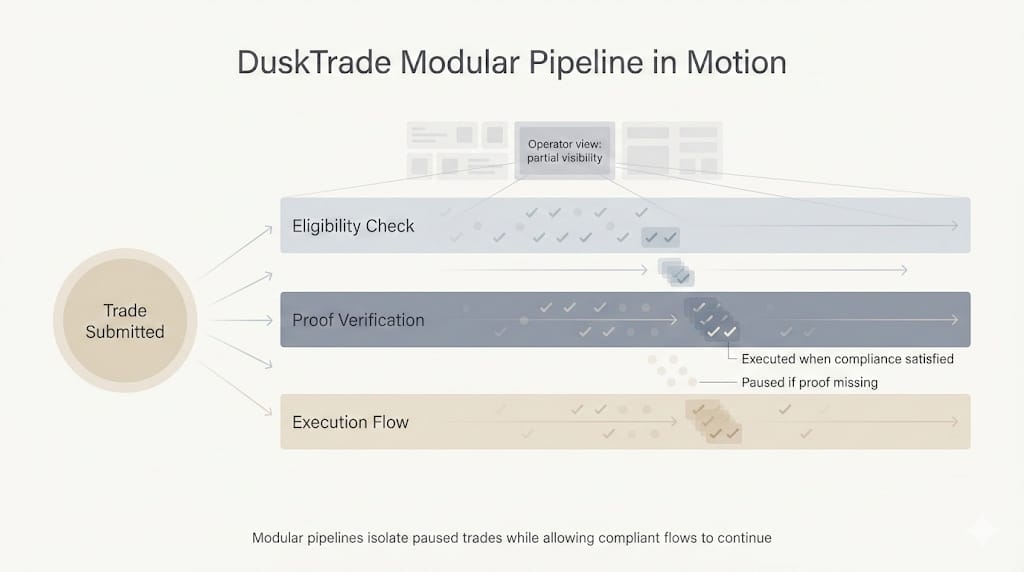
I tried to force a cascade, overloaded the EVM with junk contracts while pushing a DuskTrade RWA through.
The tokenized asset settled anyway. The junk stalled in its own lane.
No dominoes.
I kept waiting for the shortcut. The governance loophole. Some committee override that lets institutional players skip the queue.
Found instead a staking requirement that bleeds operators slowly if they drift.
Skin in the game isn't metaphor here. It's math. Your Dusk locked, your behavior weighted, your rewards clipped if you even look like you're compromising.
The RWA trade that finally cleared, a warehouse, some logistics debt, tokenized and ugly, took eleven seconds.
Eleven seconds for credential checks against off-chain registries. For the committee's encoded logic to confirm the asset wasn't double-pledged in some jurisdiction I can't pronounce. For the Phoenix privacy layer to hide the buyer's exposure while Moonlight exposed just enough for compliance to sleep at night.
"Fast," I wrote. Then crossed it out.
Fast implies loose.
This was... dense. Compressed. Like matter packed tight enough to hold shape under pressure.
Upgrades happened while I watched. No halt. No migration drama.
The chain rewrote its own rules mid-stride, validators agreeing on new logic before the old logic stopped executing.
I'd seen hard forks kill communities. This felt more like... consensus as conversation. Ongoing. Never finished.
I wanted to hate it. Wanted to find the seam where privacy becomes darkness, where compliance becomes surveillance.
Probably exists. Human systems always rot somewhere.
But what I found instead was refusal. The chain that says: you can have speed, you can have secrecy, you can have regulators at the table but you cannot have them by pretending they don't conflict.
Everything moves because it passes.
Nothing moves because it should.
Dusk doesn't compromise. It just... holds. Which might be the same thing.