
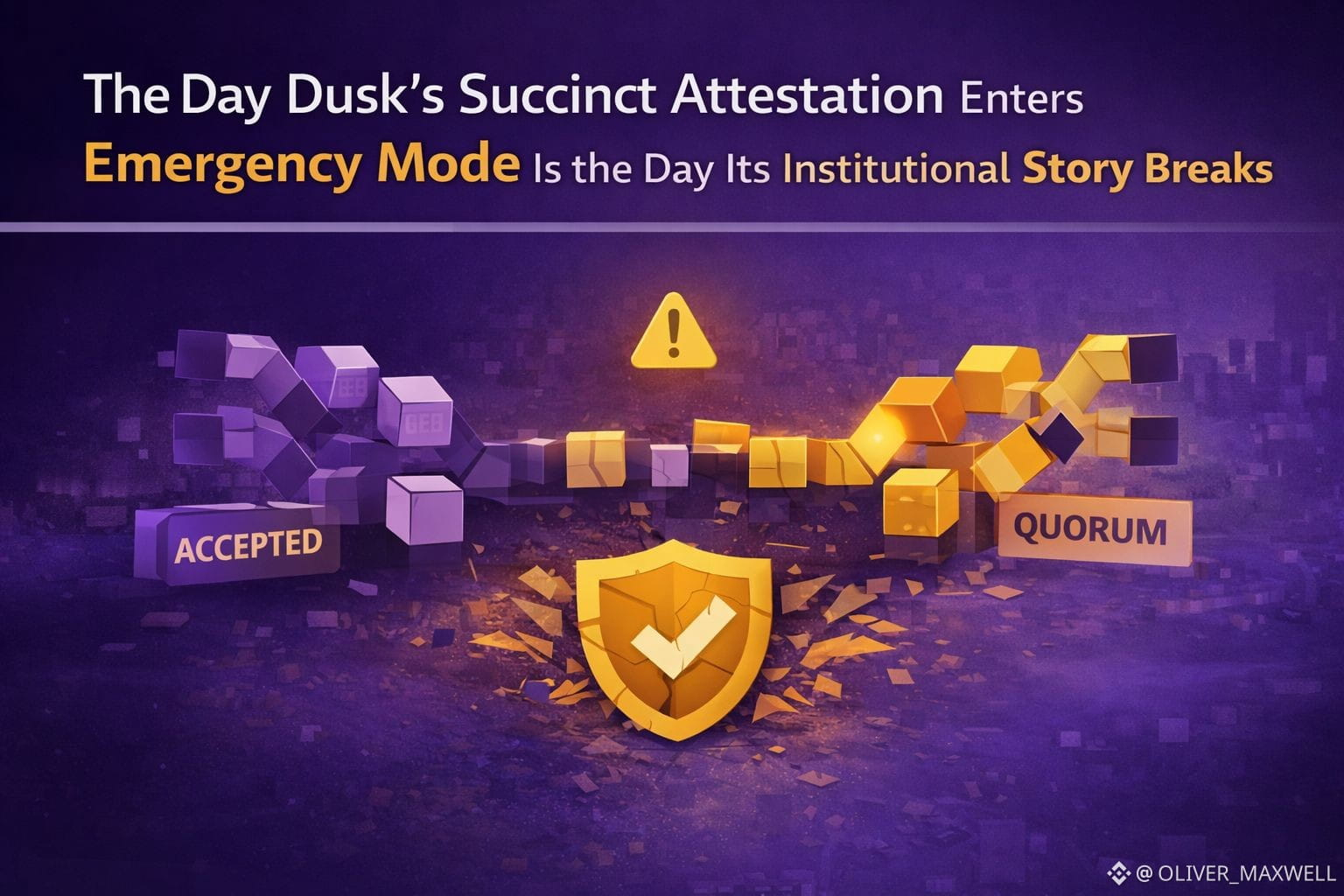
Most people are pricing Dusk’s Succinct Attestation as if “ratified” always means “cannot be replaced.” That assumption only holds while SA stays in its normal regime. The moment it has to enter emergency mode, the protocol explicitly relaxes the rules it uses to keep a single clean history, and fork risk returns through a mechanism the chain treats as legitimate, not as an accident.
In normal operation, SA looks like a settlement engine built for market timing: a provisioner proposes, a committee validates, another committee ratifies, and ratification is supposed to mean you can treat the block as done. The point is not that committees exist. The point is that Dusk is trying to turn agreement into something closer to “instant finality” than “wait for probability to decay,” because regulated flows price certainty more than they price raw throughput.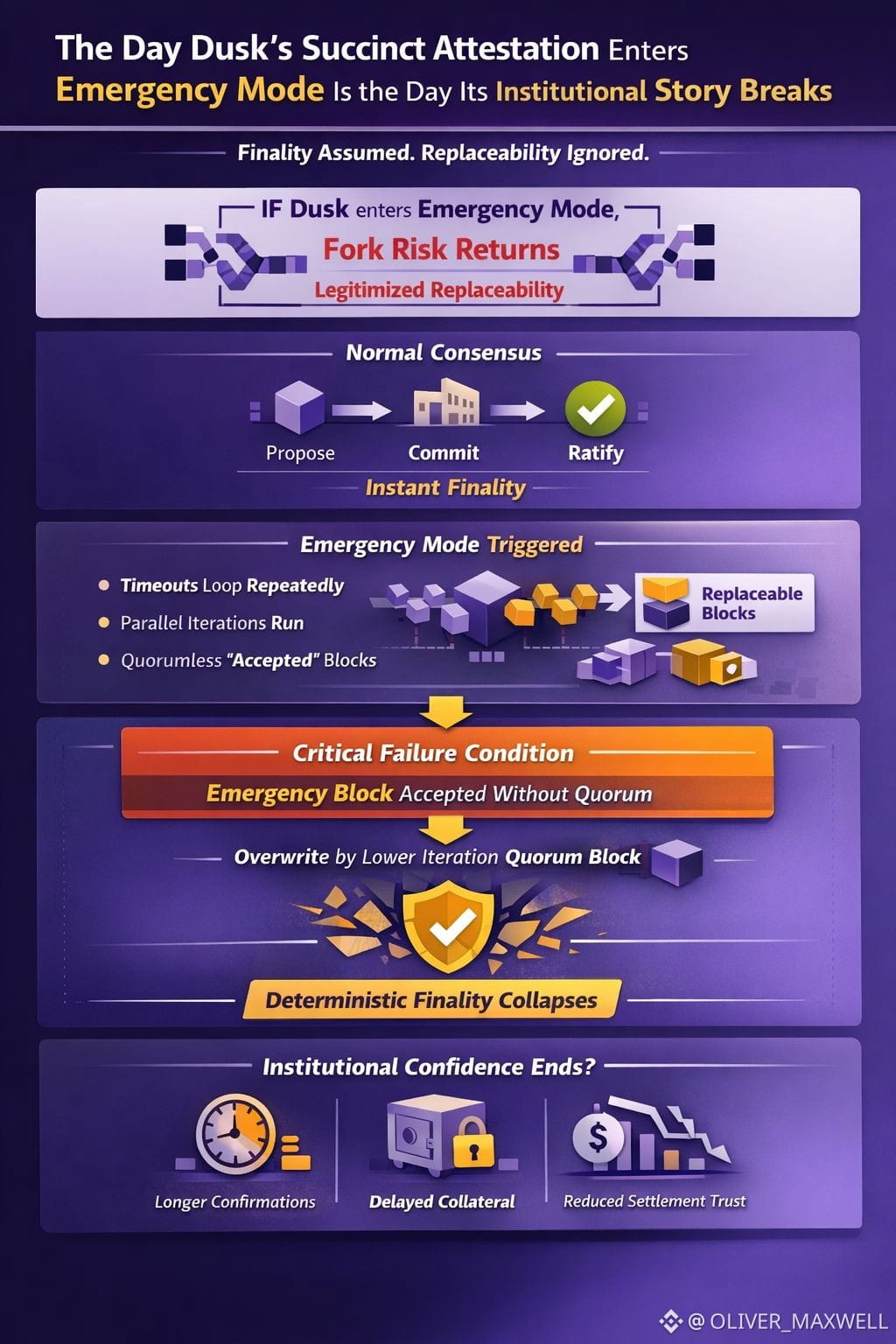
That certainty is bought with a very specific internal behavior: step timeouts and iterations at the same height. If the chosen provisioner is offline, if a committee is partially isolated, if propagation is degraded, the protocol does not just stall. It times out a step, advances, and tries again with new draws from the provisioner set. That iteration ladder is not cosmetic. It is how Dusk turns bad randomness and partial synchrony into forward motion without conceding to longest chain drift.
The constraint is that once you build around repeated iterations, you are admitting a regime where the network can fail to reach quorum for long enough that “keep retrying” becomes indistinguishable from “halt.” Emergency mode is the protocol’s answer to that. It is also the point where the settlement promise becomes conditional, because emergency mode changes what timeouts mean inside consensus.
In emergency mode, step timeouts stop producing Timeout outcomes and become triggers that start the next step or the next iteration while keeping earlier steps active indefinitely. An iteration does not terminate because a timeout certificate accumulated. It only terminates when consensus is reached on a candidate block. That is what enables time-unbound parallel iterations, and it is also what makes the uncomfortable state possible: multiple live iterations can be chasing agreement on different candidates at the same height.
If parallel iterations still cannot produce a quorum block, the design goes one layer further into “keep the chain moving at all costs.” The last-resort path is a Dusk-signed emergency block accepted without any quorum and appended locally as ACCEPTED, meaning it is replaceable by a lower-iteration quorum block if one exists and later reaches agreement. I do not read that as a vibe issue. I read it as a hard trust boundary appearing exactly when the network is stressed or split, and the protocol itself telling you that replaceability is now an allowed property of the tip.
This only works if you are willing to pay the real trade-off: liveness is prioritized over safety at the edge. That is defensible engineering for many networks. It is the wrong bargain for a chain whose institutional pitch depends on settlement being non-revisable under stress, not only when everything behaves. Dusk can have privacy and auditability nailed and still lose the institutional buyer if the consensus layer sometimes treats “accepted” as a placeholder rather than as a final outcome.
The market is underestimating how much “deterministic finality” depends on never invoking the relax-and-parallelize escape hatch. People talk about privacy, compliance, execution layers, and tokenization primitives as if the deciding variable is feature completeness. I think the deciding variable is whether SA can avoid its emergency regime during the exact moments markets care about most, when latency spikes, participation wobbles, or an adversary can cheaply push the network into repeated failed iterations.
Dusk’s modularity makes this sharper, not softer. DuskDS is the settlement layer every execution environment inherits, including DuskEVM. If the settlement layer admits a regime where parallel iterations run and an ACCEPTED block can be replaced by a lower-iteration quorum block, downstream execution does not get to pretend it is insulated. Any application relying on “ratified equals settled” inherits the same conditionality if the network ever crosses into the emergency path.
The falsification signal I care about is simple and brutal: a Dusk-signed emergency block accepted without quorum appears on mainnet and later that same height is overwritten by a lower-iteration quorum block. That is not a philosophical debate about definitions. It is an observable reorg event with protocol sanction behind it, and it collapses the institutional claim from “finality by design” to “finality until the escape hatch is used.”
So I am not watching Dusk through integrations r surface metrics. I am watching whether SA can take real stress without ever needing to relax timeouts into parallel iterations, and without ever needing a quorumless emergency block to keep the chain moving. If that never happens, the market’s confidence in Dusk’s settlement story is earned. If it happens once, risk teams will respond the only way they can: longer confirmation windows, delayed collateral release, tighter exposure limits, and the silent removal of same-block settlement as a product.
